March Records Highest Number of Job Vacancies Ever at 8.1 Million
Citizens Avoid Job Hunting Due to Monthly Unemployment Benefits Up to 5 Million Won
Industry: "Wages Must Rise Further... Concern Over Passing Labor Costs to Consumers"
Ray Dalio: "Excessive Government Fiscal Spending Negatively Impacts Economy"
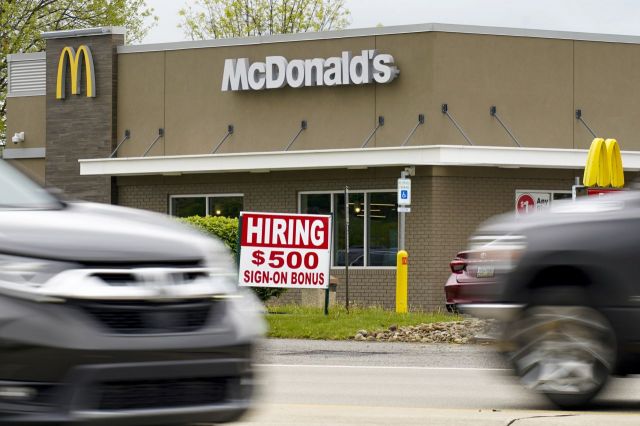 A hiring notice offering a $500 bonus is placed in front of a McDonald's branch in the United States. [Image source=AP Yonhap News]
[Asia Economy Reporter Kim Suhwan] Although there is an abundance of jobs in the United States, the number of new hires remains low, indicating a worsening imbalance between supply and demand in the labor market. Some point out that unemployment benefits, which can reach up to 5 million won per month, discourage citizens from seeking employment and lead them to rely solely on these benefits. Consequently, industries are raising wages to attract employees, raising concerns that the increased labor costs may be passed on to consumers, potentially fueling inflation.
According to a report released by the U.S. Department of Labor on the 11th (local time), as of March, the proportion of unfilled job openings reached 5.3%, marking the highest level since statistics began in 2000. This figure surpasses the pre-COVID-19 pandemic peak of 4.8% recorded at the end of 2018. Additionally, the number of unfilled jobs in March reached 8.1 million, setting a record high.
Data from the job information site Indeed.com shows that the number of job postings on its platform last month was 24% higher than in February of last year, just before the COVID-19 pandemic. Furthermore, according to The Wall Street Journal (WSJ), while the number of new job openings increased by 600,000 in March, the number of new hires remained in the 200,000 range.
These figures have raised concerns about the imbalance in the job market. Nick Bunker, an economist at Indeed.com, stated, "Companies want to hire more people, but people are simply not engaging in job-seeking activities."
Unemployment Benefits Comparable to Average Wages in the Hospitality and Food Service Industry
This phenomenon is attributed to the U.S. government's significant increase in unemployment benefits as part of COVID-19 economic recovery efforts. The Biden administration provides additional federal unemployment benefits on top of state-level programs. As a result, citizens can receive state unemployment benefits plus a federal unemployment benefit of $300 per week (approximately 340,000 won), with monthly payments reaching up to $4,492 (about 5.02 million won) depending on the state.
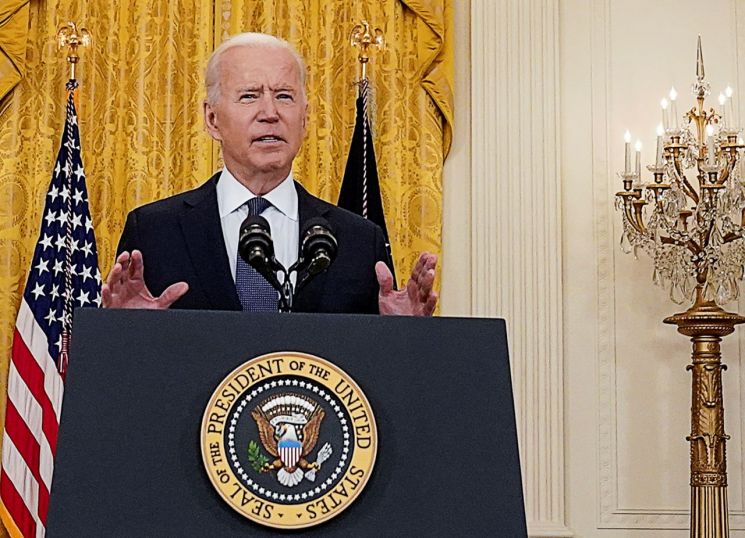
Ultimately, unemployment benefits of up to 5 million won per month are seen as a factor hindering employment indicators. According to WSJ, receiving current unemployment benefits results in earning more than a worker making $15 per hour. For example, the average wage in the U.S. hospitality and food service industry is $16.63 per hour, so individuals can earn a similar amount by not working and only receiving unemployment benefits. In March, the number of new jobs in the hospitality and food service sector increased by 185,000, showing significant growth, yet the industry still reports labor shortages, suggesting that people are not seeking jobs in order to continue receiving unemployment benefits.
A local business owner told WSJ in an interview, "You only earn about $1 more per hour by working than by receiving unemployment benefits," adding, "Under these circumstances, no one wants to work."
Industries Raising Wages to Hire Employees... Concerns Over Inflation
From the perspective of companies, they must offer wages higher than unemployment benefits to attract employees. There are concerns that the increased labor costs will be passed on to consumers, causing inflation. The National Owners Association, a group representing U.S. McDonald's franchisees, criticized, "Ultimately, the increased labor costs will lead to menu price hikes," and added, "The government is causing inflation on its own."
Earlier, the U.S. fast-food chain Chipotle announced plans to raise its hourly wage to $15 starting in June. With expectations of a minimum wage increase under the Biden administration, and given that current wages in the food service industry are similar to unemployment benefits, the industry is reluctantly raising wages as people are not actively seeking jobs.
Moreover, there are predictions that such large-scale federal government spending will have a cascading negative effect on the economy, including inflationary pressures and a decline in the value of the U.S. dollar. Ray Dalio, founder and chairman of Bridgewater Associates, the world's largest hedge fund, commented on the Biden administration's economic policies, stating, "Excessive fiscal spending will cause overheating of the economy and inflation," and emphasized, "The government should focus on managing these risks in a balanced manner."
Statistical Survey Methods and COVID-19 Infection Concerns Also Cited as Causes of Weak Employment Indicators
Some believe that the problems caused by unemployment benefits are temporary. Economist Bunker predicted, "Federal unemployment benefit payments are expected to end in September this year, and the job market may revive thereafter."
There are also views that government statistical methods contribute to the weak employment indicators. Since the COVID-19 pandemic, over 20 million jobs have been lost in the U.S., causing rapid changes in the labor market. Amid ongoing COVID-19 concerns, the government shifted from traditional face-to-face surveys to indirect methods such as online surveys, which may have resulted in less accurate statistics.
WSJ added, "Other reasons for low job-seeking activity include concerns about COVID-19 infection during job searches and the challenges faced by many people in childcare due to ongoing remote schooling."
© The Asia Business Daily(www.asiae.co.kr). All rights reserved.



















