At the End of Last Year, Women Executives at 4 Major Banks Accounted for 6.8%
Regional Banks Only 3.3% During the Same Period
Women's Share Increasing in ESG Evaluation Models
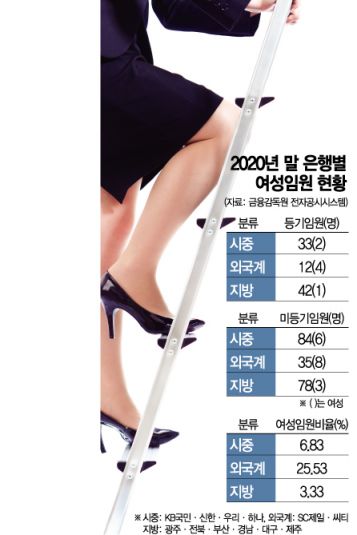
The proportion of female executives varies greatly across different sectors within financial companies. Although the share of female executives has emerged as an important indicator amid the spread of ESG (Environmental, Social, and Governance) management principles, the glass ceiling in financial firms remains intact.
According to the Financial Supervisory Service's electronic disclosure system as of the end of last year, among 117 executives at the four major banks?KB Kookmin, Shinhan, Hana, and Woori?only 8 (6.83%) were women. Of the total 33 registered executives, 2 were women, and among the 84 non-registered executives, only 6 were female.
The glass ceiling was even more severe at regional banks. During the same period, among 120 executives at six major regional banks?Gwangju, Jeonbuk, Busan, Gyeongnam, Daegu, and Jeju?only 4 (3.33%) were women. Female non-registered executives numbered just 3 (3.84%). At the end of last year, the only woman listed as a registered executive was Jeong Sun-yeo, an outside director at Jeju Bank. This slow pace of change compared to other financial sectors is often criticized.
The importance of female executives is increasingly recognized. As ESG management becomes a trend in the financial sector, having more female personnel can lead to higher scores in the S (Social) and G (Governance) categories. Although evaluation agencies assign different weights, they all score efforts toward gender equality. The Korea Corporate Governance Service (KCGS) has also seen growing calls to include the proportion of female executives as an ‘S’ evaluation factor in ESG assessment models.
While Foreign Banks Actively Hire Female Executives, Domestic Banks Say "Immediate Change Is Difficult"
Legislation ensuring a minimum appointment of female executives is also progressing in the political arena. In January last year, the National Assembly passed an amendment to the Capital Market Act requiring listed companies to have at least one female director on their boards. According to the amendment, from August next year, publicly listed companies with assets exceeding 2 trillion won cannot compose their boards entirely of one gender.
Nonetheless, financial companies argue that change is inevitable but difficult to implement immediately. A banking industry official explained, "Current financial firms do not discriminate against women in executive promotions," adding, "However, it is true that due to past social atmospheres and organizational culture, there are few women currently considered for executive positions."
However, this contrasts with the proactive appointment of female executives by foreign banks operating domestically. During the same period, SC First Bank and Citibank had a total of 47 executives, with women accounting for 25.53% (12 individuals). Among the 12 registered executives, 33.33% (4) were women.
Citibank is currently led by Yu Myeong-soon, the first female president of a domestic bank. SC First Bank recently appointed Yang Jeong-won as Executive Director of Sales last month, increasing the number of female executives from 6 to 7. The proportion of female branch managers and department heads is also reported to be about one-quarter of the total.
An official from a foreign bank stated, "Foreign banks do not give special bonus points to women during appointments," but added, "However, their internal development systems have been well established for some time."
© The Asia Business Daily(www.asiae.co.kr). All rights reserved.
![Clutching a Stolen Dior Bag, Saying "I Hate Being Poor but Real"... The Grotesque Con of a "Human Knockoff" [Slate]](https://cwcontent.asiae.co.kr/asiaresize/183/2026021902243444107_1771435474.jpg)
















