2021 Growth Rate 5.9%, Up 0.9%P from 6 Months Ago
Similar to IMF 6.0% and OECD 5.6%
"US Tax Increase Push and Fiscal Policy Exceed Expectations"
"Strong Rebound in Second Half... Inflation Concerns Are Overstated"
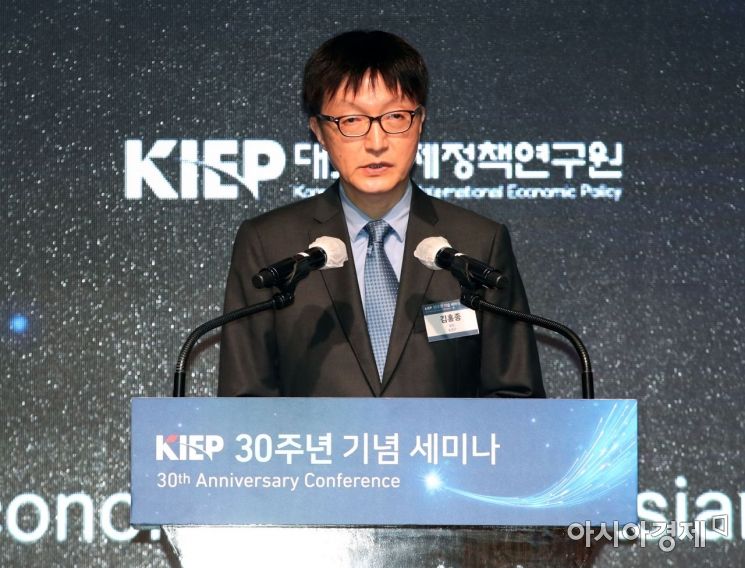
[Sejong=Asia Economy Reporter Moon Chaeseok] The Korea Institute for International Economic Policy (KIEP) has raised its forecast for global economic growth this year by 0.9 percentage points from six months ago to 5.9%.
At a press briefing on the '2021 World Economic Outlook (Update)' held on the 11th, KIEP presented this forecast. It is similar to the International Monetary Fund (IMF)'s 6.0% and the Organisation for Economic Co-operation and Development (OECD)'s 5.6% projections. This is a 0.9 percentage point increase from the 5% forecast issued six months ago. In particular, the U.S. forecast was revised upward from 2.8% to 6.6%, a 3.8 percentage point increase. An Seong-bae, head of KIEP's International Macroeconomic and Financial Research Division, explained, "Last November, when the Biden administration had just taken office, it was difficult to anticipate the large fiscal package policy that was introduced, and they intend to raise tax rates to secure future funding," adding, "The U.S. issuing government bonds to implement a large short-term fiscal package was a major factor influencing the upward revision of the growth rate."
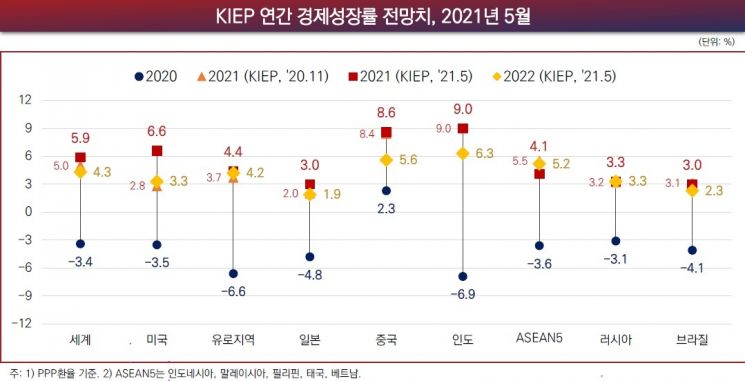
Europe is expected to grow by 4.4% due to consumption recovery from vaccinations and fiscal spending, which is 0.7 percentage points higher than the previous forecast. Japan's forecast was raised by 1 percentage point to 3%, but concerns remain due to the resurgence of COVID-19, with states of emergency declared in four areas including Tokyo, and slow vaccine distribution.
China is projected to grow by 8.6% (an upward revision of 0.2 percentage points from the previous forecast) as vaccinations increase, leading to growth in both the service sector and employment. However, emerging countries such as India (forecast maintained at 9%), Russia (3.3%, up 0.1 percentage points), and Brazil (3.0%, down 0.1 percentage points) are expected to recover slowly or experience negative growth. Although conditions vary by country, a common weakness among emerging countries is slower vaccine supply compared to developed countries.
South Korea is no exception to the forecast that its economy will recover later than advanced countries like the U.S. due to the level of vaccine distribution. Going forward, each country is expected to implement exclusive, country-centered stimulus measures tailored to their COVID-19 vaccine distribution levels and economic conditions, making it likely that only the U.S. will surge ahead. Kim Heung-jong, president of KIEP, predicted that as countries implement economic and quarantine policies suited to their own situations and levels, the U.S. will dominate while other developing countries barely keep up, highlighting an imbalance in growth.
He said, "The keyword for the global economy this year is 'uneven recovery and differentiated policy paths' among countries. Although a much stronger global economic rebound than expected is anticipated in the second half of the year, this recovery will be differentiated and uneven, resembling a 'K-shaped' pattern." He added, "The global economic recovery process may fluctuate due to various risk factors, but governments worldwide will inevitably implement economic and health policies tailored to their own circumstances," and "Therefore, as uneven development is expected to continue, continuous attention is necessary."
Concerns about inflation, which some have pointed out, are not considered significant. The possibility of inflation will vary depending on factors such as expanded fiscal spending in major countries like the U.S., increases in labor costs including wages and production costs, the reshuffling of global value chains (GVC), reshoring (return of manufacturing to home countries), and the speed and pattern of COVID-19 crisis recovery. However, the inflation occurring from last month to the present is largely attributed to the base effect caused by the COVID-19 pandemic last year.
The COVID-19 economic crisis differs from the two World Wars and the global financial crisis in that it did not directly damage supply infrastructure but rather caused shocks to both supply and demand sides due to lockdown measures in various countries. Kim said, "Governments maintained supply capacity through fiscal and monetary policies in response to the COVID-19 crisis, so the impact of supply-driven inflation is expected to be limited," adding, "Because supply capacity was maintained, a rapid rebound was possible, and expanded fiscal policies also have room to absorb demand-side inflation risks from the supply capacity perspective, so the risk of demand-driven inflation is also considered low."
Meanwhile, Kim emphasized that after the COVID-19 recovery, South Korea should proactively pursue membership in the Comprehensive and Progressive Agreement for Trans-Pacific Partnership (CPTPP) faster than the U.S. He also suggested cooperating with countries like the UK that are seeking to join. He advised that while the conflict between the U.S. and China is not as urgent as the COVID-19 crisis, it should be recognized as a potential risk factor that could trigger future GVC restructuring and other risks.
© The Asia Business Daily(www.asiae.co.kr). All rights reserved.


















