IBS Kim Eun-jun Research Team Uncovers Mechanism of TANC2 Protein Deficiency
 Independent Living Education Program for People with Developmental Disabilities. Photo is not related to the article.
[Asia Economy Reporter Kim Bong-su] Domestic researchers have discovered that the loss of a specific protein causes autism and brain developmental disorders. This finding is expected to provide clues for the development of treatments.
The Institute for Basic Science (IBS) announced on the 11th that the research team led by Director Kim Eun-jun of the Synapse Brain Disease Research Center identified the mechanism by which the loss of the TANC2 protein induces autism and brain developmental disorders.
Autism spectrum disorders are a type of brain developmental disorder affecting about 2% of the global population. Brain development is regulated by various intracellular signaling systems. Among them, the ‘mTOR signaling’ controls the development and function of most cells, including neurons. It is known to be associated with various diseases such as metabolic disorders and brain developmental disorders. However, the regulatory mechanism of mTOR in the nervous system has been largely unknown until now.
The Synapse Brain Disease Research Center previously demonstrated that the ‘TANC2 protein’ is essential for normal brain development. Subsequent clinical studies suggested a possible link between TANC2 and autism as well as brain developmental disorders. However, the exact pathogenic mechanism had not been clarified. In this study, the research team revealed that the TANC2 protein acts as a direct negative regulator of the mTOR protein, thereby controlling brain development and function.
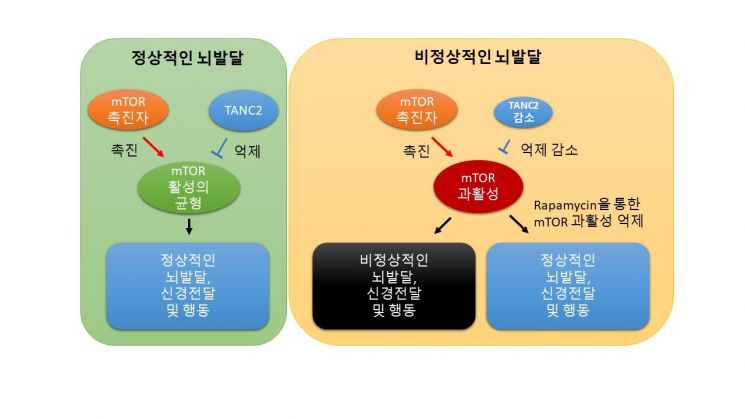
To understand the relationship between the TANC2 protein and mTOR signaling, the researchers created an autism mouse model with TANC2 expression reduced by half. Experimental results showed that the loss of TANC2 protein led to abnormal overactivation of mTOR signaling proteins, resulting in impaired synaptic function and cognitive abilities such as memory and learning. When the mTOR inhibitor drug Rapamycin was administered, synaptic and cognitive brain functions were restored to normal. This indicates that the TANC2 protein regulates brain function by inhibiting mTOR signaling proteins.
They also found that in human neurons, a reduction in TANC2 causes abnormal activation of the mTOR signaling pathway. Thus, in the human nervous system, TANC2 acts as an mTOR inhibitor regulating brain development and function.
Director Kim Eun-jun stated, “This study revealed the pathogenic mechanism of TANC2 gene mutations, which have recently emerged as a cause of autism and brain developmental disorders,” adding, “Through follow-up research, mTOR signaling inhibitors could be utilized to treat autism and brain developmental disorders caused by TANC2 gene mutations.”
The research findings were published online on the same day in the international journal Nature Communications (IF 12.121).
© The Asia Business Daily(www.asiae.co.kr). All rights reserved.


















