Income Tax, Corporate Tax, and Value-Added Tax All Increase
'Q1 Managed Fiscal Balance Deficit' Records 48.6 Trillion Won
[Asia Economy Reporter Jang Sehee] It has been reported that national tax revenue in the first quarter of this year increased by 19 trillion won compared to last year. This was due to an increase in capital gains tax from housing transactions and the government's tax support deferral for small individual business owners being collected in March. However, the managed fiscal balance, which reflects the actual fiscal situation, recorded a deficit of 48.6 trillion won.
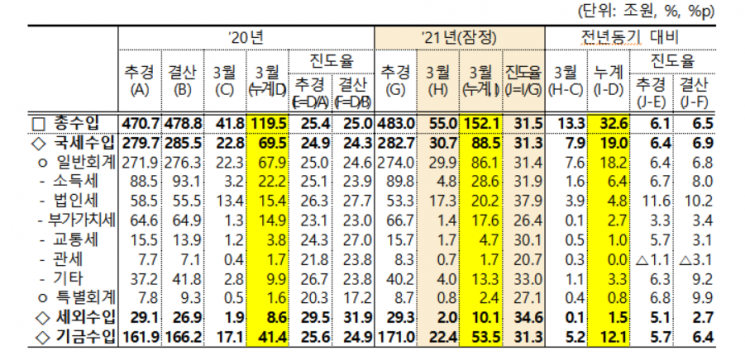
According to the 'Monthly Fiscal Trends May Issue' released by the Ministry of Economy and Finance on the 11th, national tax revenue in the first quarter of this year was 88.5 trillion won, an increase of 19 trillion won compared to last year. The progress rate of national tax revenue was 31.3%, up 7.0 percentage points compared to last year's 4th supplementary budget.
The three major tax items forming the basis of taxation (income tax, corporate tax, and value-added tax) all increased. In particular, income tax revenue (28.6 trillion won) increased by as much as 6.4 trillion won due to increased real estate transaction volume and the payment of deferred comprehensive income tax from small individual business owners. In fact, the volume of housing transactions from November last year to February this year increased by 1.7% compared to the same period last year.
Corporate tax revenue (20.2 trillion won) increased by 4.8 trillion won due to an increase in corporate operating profits last year. The operating profit of KOSPI-listed companies with December fiscal year-end last year was 67.5 trillion won, showing a 19.8% increase compared to 56.3 trillion won in 2019.
Other national tax revenues such as comprehensive real estate tax, securities transaction tax, and stamp tax (13.3 trillion won) also increased by 3.3 trillion won. Value-added tax revenue was 17.6 trillion won, an increase of 2.7 trillion won compared to last year.
Besides national tax revenue, non-tax revenue such as fines and business income from special corporate accounts (10.1 trillion won) and fund revenue (53.5 trillion won) also increased by 1.5 trillion won and 12.1 trillion won respectively.
The integrated fiscal balance (total revenue - total expenditure) in the first quarter of this year recorded a deficit of 30.1 trillion won, and the managed fiscal balance, which represents the actual fiscal balance, recorded a deficit of 48.6 trillion won. Although national tax revenue increased, expenditures for responding to COVID-19 also grew accordingly. Total expenditure in the first quarter was 182.2 trillion won, an increase of 17.4 trillion won compared to last year.
Regarding this, Ando Geol, the 2nd Vice Minister of the Ministry of Economy and Finance, evaluated, "A virtuous cycle of economic recovery and tax revenue improvement, supported by proactive fiscal management carried out during the COVID-19 crisis, has begun to appear."
© The Asia Business Daily(www.asiae.co.kr). All rights reserved.
![Clutching a Stolen Dior Bag, Saying "I Hate Being Poor but Real"... The Grotesque Con of a "Human Knockoff" [Slate]](https://cwcontent.asiae.co.kr/asiaresize/183/2026021902243444107_1771435474.jpg)











