Government to Establish '1 Trillion Won Special Fund for Semiconductor Facility Investment'
Tax and Permit Procedures to be Shortened
Administrative Procedure Simplification Over Financial Support
Industry Demands Water Supply for Factory Expansion
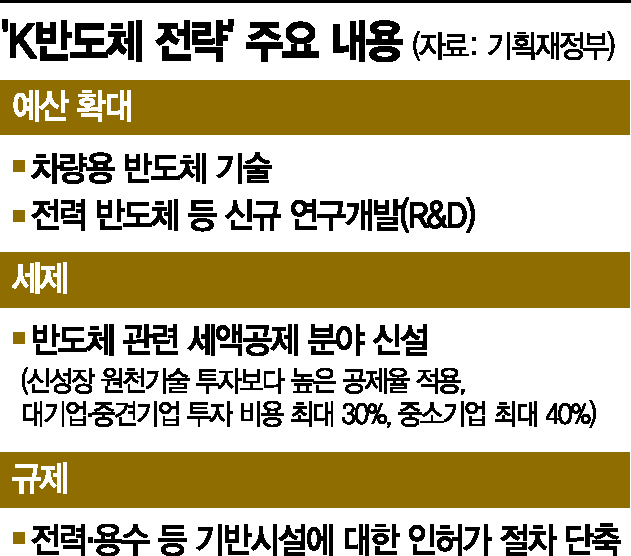
[Asia Economy Reporter Jang Sehee] As the semiconductor hegemony competition among countries intensifies, the government plans to introduce groundbreaking industrial promotion measures in terms of finance, taxation, finance, regulation, and workforce development. However, since the budget is limited and there are controversies over 'preferential treatment for large corporations,' the focus will be on supporting medium-sized and small businesses.
A senior government official said on the 10th, "If the amount of financial support increases, a preliminary feasibility study must be conducted, which could take a long time," adding, "We are focusing on resolving the taxation and licensing procedure shortening issues that the industry strongly demands."
The government plans to actively support investments by small and medium-sized enterprises (SMEs) and medium-sized companies by preparing a 1 trillion won scale 'special fund for semiconductor facility investment.' The 1 trillion won will be supported by the Korea Development Bank's own resources and used by lowering the loan interest rate for companies by up to 1 percentage point compared to existing loan rates.
In addition, discussions are underway to establish a separate track in the semiconductor sector to expand tax credits. Considering that benefits higher than the current system are being reviewed, large corporations are likely to receive tax credit rates exceeding 30%, and SMEs over 40%. For research and development (R&D) investments, the tax credit rate for large corporations is only 2%, but for new growth source technology investments, large and medium-sized companies can receive tax credits up to 30% of investment costs (including an additional 10% credit), and SMEs up to 40%. The government explains that excessively increasing tax credits is burdensome given the relatively large investment costs of large corporations.
In the semiconductor infrastructure sectors such as power, water supply, and wastewater, the focus appears to be on shortening administrative procedures rather than direct financial support. A government official stated, "Contents related to factory construction and wastewater treatment plant expansion are unlikely to be included in this measure."
The possibility of the government being embroiled in controversies over preferential treatment for large corporations when supporting specific companies with project funds also played a role. In the past, the political sphere criticized national funding because more than 90% of wastewater discharge was attributed to specific large corporations.
However, the industry insists that factory expansion and securing water supply are urgent. Therefore, there is speculation that additional construction of power transmission lines may be included in the final coordination process. In fact, during the tenure of Minister Ju Hyung-hwan of the Ministry of Trade, Industry and Energy in 2016, the government solved power supply issues by constructing additional 154kV transmission lines in two phases. Also, the current annual enrollment of 1,856 students in semiconductor-related departments is planned to be expanded.
Regarding this measure, Professor Sung Tae-yoon of Yonsei University's Department of Economics said, "In Korea, the semiconductor market is centered on major large corporations and holds an international monopoly advantage," adding, "Rather than dividing large and small companies, measures should be prepared to strengthen the overall industrial capacity." He also stated, "The focus should be on rationally reforming regulations in the industry rather than financial support." Furthermore, regarding the expansion of semiconductor university enrollment, he added, "Instead of increasing manpower for a specific industry, universities should be allowed to autonomously adjust the number of students according to demand."
© The Asia Business Daily(www.asiae.co.kr). All rights reserved.
![From Hostess to Organ Seller to High Society... The Grotesque Scam of a "Human Counterfeit" Shaking the Korean Psyche [Slate]](https://cwcontent.asiae.co.kr/asiaresize/183/2026021902243444107_1771435474.jpg)
















