Emergency Measures for Securing Gasoline and Aviation Fuel
Government Ministries and White House Struggle to Devise Countermeasures
Gasoline Hits Highest Level Since 2014...Concerns Over Further Increase
Cannot Rule Out Possible Attacks on Capital's Electricity and Other Infrastructure
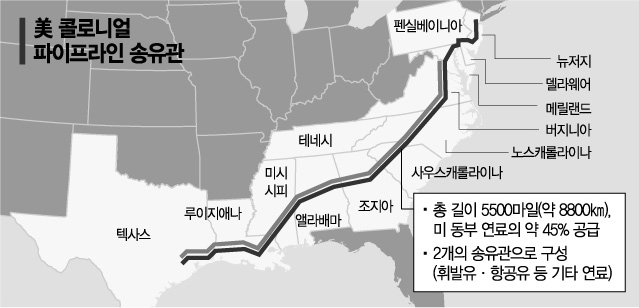
[Asia Economy New York=Correspondent Baek Jong-min] As the largest oil pipeline in the United States remains shut down for the third day due to a hacking incident, the U.S. government has declared a state of emergency and taken action. With demand rising and supply likely to decrease, it is becoming certain that U.S. gasoline prices will rise to their highest level in seven years. There is also growing concern that additional attacks could target infrastructure networks such as water, gas, and electricity beyond the pipeline.
◇ Biden Briefed During Holiday = According to U.S. media including the Associated Press on the 9th (local time), the Department of Transportation declared a state of emergency in 17 states and Washington D.C., from Texas to New York, through which the Colonial Pipeline?the largest pipeline operator in the U.S.?runs, in relation to the pipeline shutdown. This means the government will spare no effort to support the supply of gasoline, diesel, and jet fuel, which are currently in critical condition.
Commerce Secretary Gina Raimondo appeared on CBS News that day and said, "We are putting all efforts into ensuring the pipeline operates normally and that there is no disruption in petroleum supply."
The White House also reported that President Joe Biden, who was resting at Camp David, was briefed on the issue. Bloomberg News reported that President Biden would take emergency measures to prevent damage caused by the pipeline shutdown.
The Colonial Pipeline has been halted since the 7th due to a ransomware hacking attack. The pipeline stretches 8,850 km and is responsible for transporting 45% of the petroleum products consumed in the U.S. East Coast.
Coincidentally, the 'Memorial Day' holiday weekend begins at the end of this month. The fuel supply disruption emerging just before the expected increase in fuel demand with the start of the U.S. summer vacation season could cause serious repercussions. This is why the U.S. government is under intense pressure. Compared to the semiconductor chip shortage, the destructive impact of the fuel supply disruption is considered even more severe.
It is known that gasoline, diesel, and jet fuel transported through this pipeline amount to 2.5 million barrels per day. Major airports such as Hartsfield-Jackson Atlanta International Airport in Georgia also rely on this pipeline. If the pipeline shutdown prolongs, flight operations will inevitably be disrupted.
The Colonial Pipeline has not disclosed when normal operations might resume as of this day. Only limited small-scale areas have been restored. The company stated, "We will resume full system operations only when it is deemed completely safe," indicating that a prolonged shutdown is inevitable.
◇ Gasoline Surges 4% in Futures Market = This incident is expected to push up domestic fuel prices in the U.S., further fueling inflation. Bloomberg warned that U.S. gasoline prices could surge to their highest level since 2014. The national average gasoline price compiled by the American Automobile Association (AAA) is $2.96 per gallon. Gas stations charging over $3 per gallon are already common in New York State.
The last time the U.S. average gasoline price exceeded $3 per gallon was in 2014. Giovanni Stranubo, a commodities analyst at UBS, forecasted, "If the pipeline shutdown period extends, oil prices could rise significantly." Gasoline prices rose 4% in the futures market that day, but the prevailing analysis suggests further increases are possible.
Rising oil prices could also accelerate inflation. If oil prices unexpectedly rise above $3 due to this incident, it could further fuel inflation and raise concerns about its impact on monetary policy.
◇ "Electricity and Water Also at Risk" = On the same day, Commerce Secretary Raimondo warned, "Companies need to prepare for ransomware attacks." In the U.S., major social infrastructure networks such as electricity, water, and gas are operated by private companies. National integrated management is difficult, making them vulnerable to hacker attacks.
The ‘DarkSide’ group, suspected of causing this hacking incident, is estimated to have caused hundreds of billions of dollars in damages to companies so far. Considering their past activities, authorities believe additional crimes cannot be ruled out.
© The Asia Business Daily(www.asiae.co.kr). All rights reserved.

















