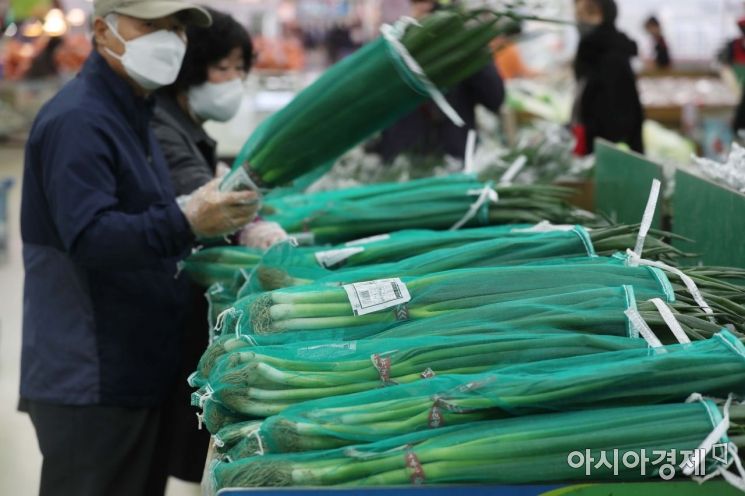
 On the 4th, citizens were shopping at the Nonghyup Hanaro Mart Yangjae branch in Seocho-gu, Seoul. According to the 'Consumer Price Trends' announced by Statistics Korea on the same day, the consumer price index in April rose by 2.3% compared to the same month in 2019. This is the largest increase since August 2017 (2.5%). Due to poor crop yields and the impact of highly pathogenic avian influenza (AI), prices of shopping basket items such as green onions, eggs, and red pepper powder have surged. Photo by Moon Honam munonam@
[Asia Economy Reporter Seungjin Lee] Prices of agricultural, livestock, and fishery products, which have been rising in double digits for four consecutive months, have not stabilized in May either. Prices of major food ingredients, including rice, have turned upward again, increasing the burden on grocery prices.
According to the Korea Agro-Fisheries & Food Trade Corporation (aT) on the 10th, the retail price of 20kg of rice was 60,957 won as of the 7th. Rice prices hit a record high of 61,059 won in February, then fell to the 50,000 won range, but have recently risen again. Rice prices increased due to a significant drop in production caused by last year's longest rainy season, and recently, steady demand from school meal providers has pushed prices back up.
Prices of garlic and red pepper powder, essential ingredients in major side dishes and cooking, have also failed to stabilize for several months. Last week, dried red pepper (hwageon) traded at prices 65% higher than the previous year, and peeled garlic prices were 75% higher during the same period. Additionally, prices of soybeans, sweet potatoes, spinach, and ginger rose by 5-15% within a month.
Green onion prices, which surged so much that the term "Patech" (a pun meaning growing green onions as a form of investment) became popular, slightly decreased compared to last month but were still traded at prices 130% higher than the previous year. Meanwhile, as green onion prices slightly fell, the price of chive onions rose sharply, increasing by 21% within a month.
After seven months, African Swine Fever (ASF) was detected at a pig farm in Yeongwol-gun, Gangwon Province, prompting a nationwide ASF alert and causing pork prices to rise. As of the 7th, the retail price of 100g of pork belly was 2,425 won, up 13.5% from last month. Pork prices are expected to continue rising due to supply instability caused by movement restrictions, which will likely affect dining-out prices as well.
Meanwhile, consumer prices rose at the fastest rate in 3 years and 8 months last month. Poor crop yields and the impact of Avian Influenza (AI) caused agricultural, livestock, and fishery product prices to rise in double digits for four consecutive months, and with oil prices also fluctuating, prices of manufactured goods increased one after another. The government expects the consumer price increase rate in May to exceed 2%, as the base effect from COVID-19 continues.
© The Asia Business Daily(www.asiae.co.kr). All rights reserved.
!["The Woman Who Threw Herself into the Water Clutching a Stolen Dior Bag"...A Grotesque Success Story That Shakes the Korean Psyche [Slate]](https://cwcontent.asiae.co.kr/asiaresize/183/2026021902243444107_1771435474.jpg)
















