Withdrawal of Expatriates Not Yet
Minimum Staff Working, Maximizing Remote Work While Closely Monitoring the Situation
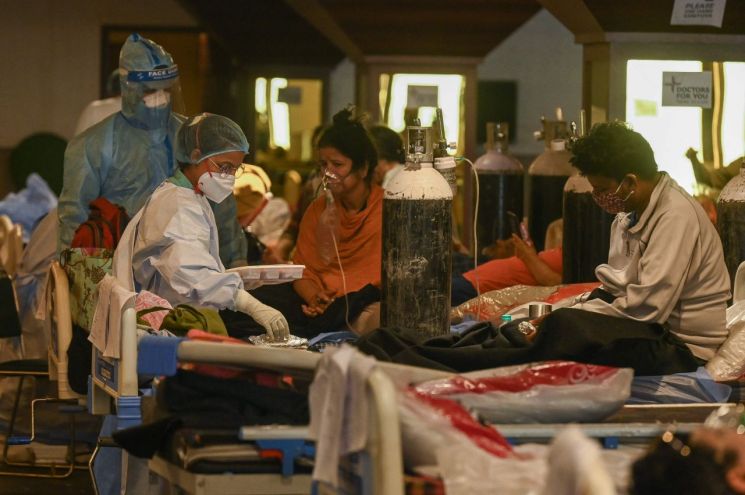
[Asia Economy Reporter Park Sun-mi] Following the experience of withdrawing expatriates due to the Myanmar military coup, the domestic banking sector is now facing an emergency in managing local staff in India, where deaths are rapidly increasing amid the massive spread of COVID-19. Although no decision has yet been made to withdraw expatriates, India ranks third in Asia for the number of overseas branches of domestic banks after Vietnam (18 branches) and China (17 branches), so banks are closely monitoring the situation while maximizing the use of remote work.
According to the Financial Supervisory Service on the 10th, as of the end of last year, eight domestic banks have overseas branches, local corporations, or offices in India. Shinhan Bank operates local branches in six regions: New Delhi, Mumbai, Kanchipuram, Pune, Rangareddy, and Ahmedabad. Woori Bank (3 branches), Hana Bank (2 branches), KB Kookmin Bank (1 branch), NH Nonghyup Bank (1 office), and Busan Bank (1 office) follow. Among policy banks, Industrial Bank of Korea and Export-Import Bank of Korea each operate one branch and one office, respectively.
Shinhan Bank, with 320 employees working across six branches in India, is currently operating essential services with only 15% of staff in the Maharashtra region (Mumbai, Pune) according to state government measures, while other branches are running with half of their workforce working remotely. A Shinhan Bank official stated, "We are not yet considering the return of expatriates, but we are prioritizing employee safety and operating with minimal staff." They added, "Expatriate families are already in the process of returning home." The official also explained, "To ensure the safety of expatriates and local employees, we have delivered support supplies such as masks, diagnostic kits, and food. Since there is concern about oxygen shortages if employees test positive, we are preparing to ship oxygen generators locally."
Woori Bank, with 33 employees including 9 expatriates in India, is not considering expatriate withdrawal but is minimizing employee impact by operating shortened business hours from 10 a.m. to 2 p.m. at its three branches. Some staff are working remotely, and all employees undergo temperature checks and biweekly disinfection, strictly following quarantine guidelines while closely monitoring the COVID-19 spread.
KB Kookmin Bank has shifted half of its workforce to remote work, and Hana Bank has mandated remote work for all except essential personnel. NH Nonghyup Bank has required all employees at its New Delhi office to work remotely since mid-last month. Banks have their own diagnostic kits at branches and conduct daily branch closures and disinfection by external contractors when confirmed cases occur. They also support vaccination costs for local employees and are promoting temporary repatriation support for expatriate families upon request.
The COVID-19 spread in India following the Myanmar coup poses a risk to domestic banks that are turning their eyes overseas to secure continuous revenue sources beyond the limited domestic market.
Domestic banks have been focusing on expanding new overseas businesses since the beginning of the year to counteract deteriorating profitability in the domestic market due to low growth and low interest rates. Recently, KB Kookmin Bank obtained preliminary approval from the Monetary Authority of Singapore to establish a branch and set up an Asia Credit Review Center, expanding its scope from credit reviews in Hong Kong and China to Southeast Asia, India, and Oceania. NH Nonghyup Bank also obtained final approval to establish a branch in Hong Kong. Woori Bank, which has a network of 15 branches in Vietnam, plans to open an additional five branches there by the end of the year.
© The Asia Business Daily(www.asiae.co.kr). All rights reserved.

















