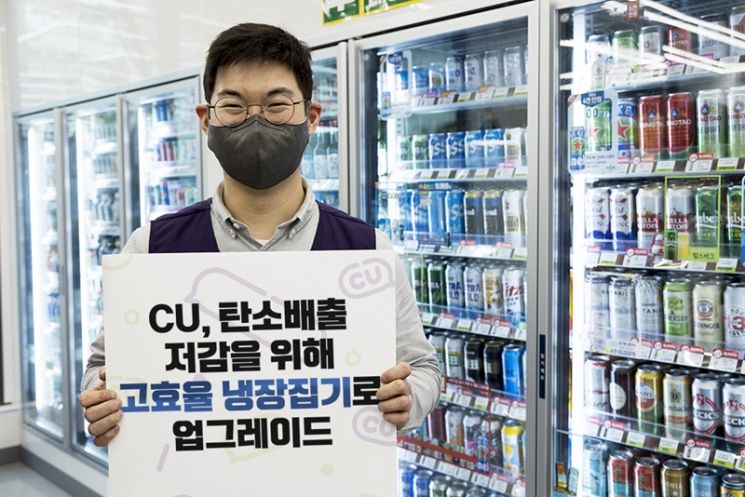
 CU will sequentially replace the key components of beverage, lunchbox, and dairy product refrigerators with high-efficiency products starting this month.
[Asia Economy Reporter Lim Chunhan] CU announced on the 10th that starting this month, it will sequentially replace key components of beverage, lunchbox, and dairy refrigerators?which account for a large portion of convenience store electricity consumption?with high-efficiency products, leading efforts to save energy and reduce carbon emissions.
Beverage refrigerators will be equipped with door heater controllers. Door heaters are devices installed to prevent fogging on the doors of beverage refrigerators caused by temperature differences between the inside and outside. In existing beverage refrigerators, door heaters operate 24 hours a day unless manually controlled. With the door heater controller attached, the door heater is automatically controlled according to the store’s temperature and humidity conditions, reducing power consumption by 28.5% compared to before.
For lunchbox and dairy refrigerators, the fan motors that assist cold air circulation will be replaced with high-efficiency products. Although high-efficiency fan motors cost about twice as much as regular fan motors, they achieve the same refrigeration effect using about half the power consumption of regular fan motors. Electricity bills are also reduced by 42.5%.
In fact, CU conducted tests at its eco-friendly stores, Green Stores, such as Seocho Green Branch and Wirye 35 Complex Branch. The expected annual reduction in power consumption from introducing high-efficiency refrigeration equipment reaches about 6,000 kW per store. Considering the carbon emission reduction effect of 0.466 kg per kW, approximately 2.8 tons of carbon emissions are reduced.
If high-efficiency refrigeration equipment is expanded to more than 15,000 CU stores nationwide, it is expected to reduce carbon emissions by over 42,000 tons annually. This is equivalent to planting about 5,400 ten-year-old pine trees. BGF Retail plans to invest a budget of approximately 8 billion KRW to upgrade refrigeration equipment in all stores nationwide, with the entire cost borne by the franchise headquarters.
A BGF Retail official said, “CU incorporates eco-friendly management throughout the stores, not only in products and services that customers directly encounter but also in logistics, store facilities, and systems that are out of sight. We will continue to seek ways to contribute to local communities and environmental protection and expand sincere ESG (Environmental, Social, and Governance) management comprehensively.”
© The Asia Business Daily(www.asiae.co.kr). All rights reserved.

















