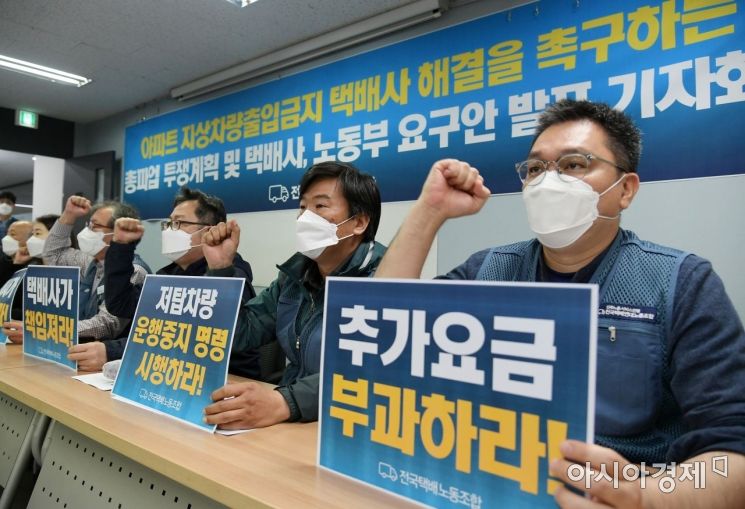
 On the 7th, participants of the National Courier Workers' Union held up hand placards at a press conference announcing the results of the strike vote by the Courier Union regarding the 'delivery conflict' at the Service Federation in Seodaemun-gu, Seoul. The Courier Union stated on the 7th, "The strike vote among union members was approved with 77.0%," and announced that the timing of the strike will be delegated to the chairman and that the strike will proceed as a partial strike. Photo by Hyunmin Kim kimhyun81@
[Asia Economy Reporter Jeong Dong-hoon] Last month, the National Courier Workers' Union (Courier Union), which has been in conflict with an apartment complex and courier companies after banning delivery vehicles from entering the ground level of an apartment in Gangdong-gu, Seoul, decided to launch a general strike. They are urging courier companies to take measures such as imposing additional fees on apartments that restrict vehicle access.
The Courier Union recently held a press conference, stating, "Out of 5,835 eligible voters, 5,298 (90.8%) participated in the vote, with 4,078 in favor, 1,151 against, and 69 invalid votes, resulting in the approval of the strike vote by all union members." They added, "All procedures necessary to commence the general strike have been completed, and about 2,000 union members who have completed the labor dispute procedures with the Labor Relations Commission will participate in this strike."
Jin Kyung-ho, chairman of the Courier Union, said, "We will focus our struggle on urging courier companies to quickly present delivery measures and resolve the issue." He added, "Courier companies must promptly designate apartments that restrict ground-level access as delivery-restricted areas and impose additional fees as part of their countermeasures."
The Courier Union's strike originated from a 'delivery conflict' at a large apartment complex in Godeok-dong, Gangdong-gu, Seoul. Since April 1, the apartment complex has banned vehicle traffic on ground roads within the complex. The union once halted individual household deliveries and piled up delivery items in front of the complex, escalating the conflict. Subsequently, the union condemned courier companies for forcing the use of low-height vehicles (low-floor vehicles). They argue that using low-floor vehicles negatively impacts the safety and health of courier workers. The union has also filed a complaint against the CEO of CJ Logistics for violating the Industrial Safety and Health Act.
Additionally, the union presented results from a survey conducted on April 29-30 involving 319 courier workers who operate only low-floor vehicles. The survey revealed that workers are exposed to musculoskeletal burden tasks and suffer significant pain. According to the results, 69-94% of respondents perform all nine musculoskeletal burden tasks defined by the Ministry of Employment and Labor's notification.
Among them, 46.7% experienced pain or discomfort related to their job in areas such as shoulders, waist, and knees over the past year, indicating suspected cases requiring immediate medical attention. Even those not meeting the disease criteria but reporting musculoskeletal symptoms related to work, termed 'presumed patients,' accounted for 86.6%. The union claimed, "Nearly half of those delivering packages inside low-floor vehicles, which are only 127 cm high, currently show symptoms of musculoskeletal disorders and should be classified as patients."
Although the strike was initially reported to begin on the 11th, the Courier Union stated that they will not specify the date of the general strike. The union explained, "To minimize inconvenience to the public, the chairman will decide the timing if an unavoidable situation arises that necessitates the strike." They also said, "The strike's intensity and number of participants will be minimized, and delivery refusals will mainly target fresh food, which accounts for about 10% of total courier volume."
This is the third time the Courier Union has declared a strike since the COVID-19 pandemic began last year. In September last year, courier workers declared a 'refusal to sort packages' but withdrew the strike after reaching an agreement in a social dialogue body involving the government and courier companies, which clarified that sorting responsibility lies with courier companies and agreed to deploy sorting personnel. In January, when sorting personnel were not adequately deployed on-site, courier workers declared a general strike, claiming they were forced back into sorting tasks. The strike was suspended after the labor and management sides prepared a more detailed agreement on deploying sorting personnel than the previous one. Some critics argue that the union excessively uses the general strike, which could cause public inconvenience, as a 'negotiation card.'
© The Asia Business Daily(www.asiae.co.kr). All rights reserved.
![Clutching a Stolen Dior Bag, Saying "I Hate Being Poor but Real"... The Grotesque Con of a "Human Knockoff" [Slate]](https://cwcontent.asiae.co.kr/asiaresize/183/2026021902243444107_1771435474.jpg)
















