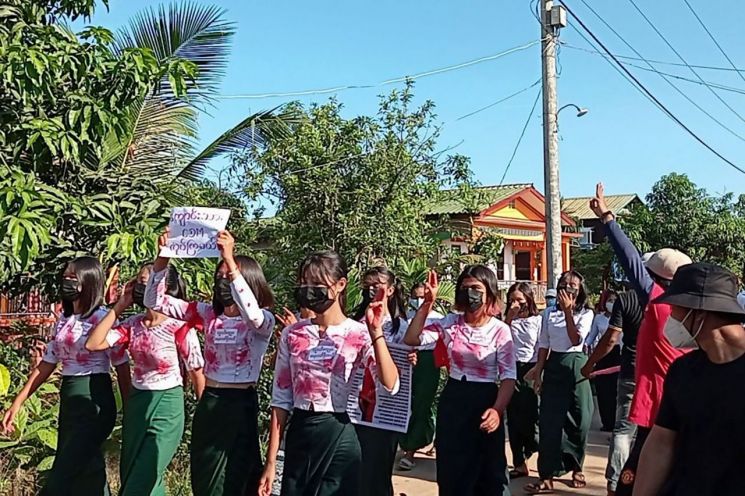
 Protesters condemning the Myanmar military coup are wearing clothes painted red and making the "three-finger salute," a symbol of resistance against dictatorship.
 [Image source=Yonhap News]
[Asia Economy Reporter Hwang Sumi] In Myanmar, where a military coup has occurred, recent clashes between the military and protesters have escalated into armed confrontations. What began as nonviolent resistance is increasingly turning into armed struggle, and amid this atmosphere, China?an influential power in Myanmar?appears to be siding with the military, intensifying anti-China sentiment within Myanmar.
Recently, security personnel guarding facilities related to China’s oil and gas pipelines passing through Myanmar were attacked, resulting in fatalities.
According to local media on the 7th (local time), three security personnel guarding oil and gas pipeline facilities in the Mandalay region, which connect to China, died on the 5th, two days earlier. They were reportedly stabbed to death by unidentified assailants.
The media described the attack as part of the increasing armed resistance against the military and noted that as anti-military and anti-China sentiments rise within Myanmar, the Chinese government’s concerns over the safety of the oil and gas pipelines are likely to grow.
Myanmar is strategically located at the gateway of oil transport routes from the Middle East and Africa, significantly impacting China’s energy security. Accordingly, in 2014, China constructed approximately an 800 km oil and gas pipeline connecting Kyaukphyu on Myanmar’s western coast to Kunming City (昆明), Yunnan Province, China.
For this reason, China has paid close attention to the safety of the oil and gas pipelines amid rising anti-China sentiment among the Myanmar people. When anti-China protests intensified in Myanmar, China reportedly met with the military at the end of February to demand guarantees for the safety of the pipelines, according to the media. Additionally, China urged strengthening security measures, stating that "if the oil and gas pipelines are destroyed, it would cause enormous damage to both countries."
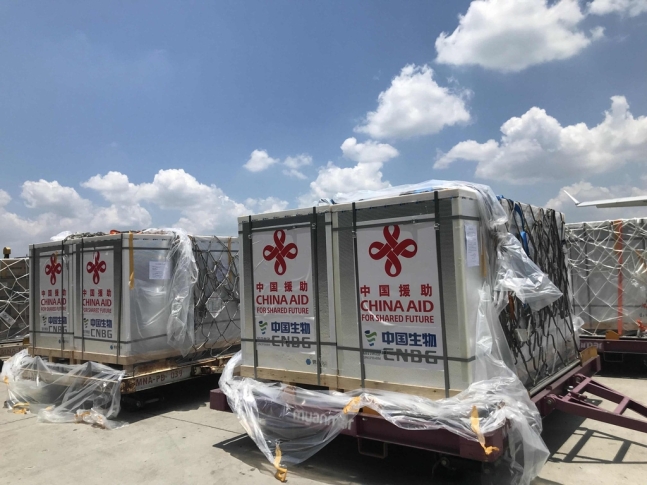 On the 2nd (local time), Chinese-made COVID-19 vaccines arrived in Yangon, Myanmar.
 [Photo by Chinese Embassy in Myanmar Facebook]
Meanwhile, in Myanmar, voices criticizing China have grown louder since the military coup. Unlike the international community’s condemnation of the coup, China has repeatedly emphasized the principle of "dialogue and negotiation" regarding Myanmar, a strategic stronghold for China. When it became known that China, along with Russia, opposed the UN Security Council’s statement condemning the Myanmar coup, protesters pointed to China as the military’s "backer."
As a result, anti-China protests have been held daily in front of the Chinese embassy since the coup, and a boycott of Chinese products is underway. In March, dozens of Chinese-owned factories were set on fire. Unknown individuals broke into the gates of Chinese-owned factories in Yangon, Myanmar’s capital, poured gasoline inside, and set them ablaze. Two Chinese employees were injured in the process, but fortunately, no fatalities were reported, according to local media. The affected factories are owned by Chinese companies or Chinese-Myanmar joint ventures, mostly related to the garment industry, the Chinese embassy explained.
Recently, as China provided COVID-19 vaccines to the Myanmar military, an increasing number of citizens have refused, saying, "I will not take the Chinese vaccine."
According to local media on the 4th (local time), 500,000 doses of COVID-19 vaccines provided by the Chinese People’s Liberation Army arrived at Yangon International Airport on the 2nd. The Myanmar military’s high command stated, "Chinese vaccines will be distributed to hospitals nationwide," and the Chinese embassy in Myanmar described the donation as "once again proving the brotherhood between the two countries."
However, thousands of social media users expressed strong rejection of the vaccine support on the Chinese embassy’s Facebook page. One user wrote, "I would rather catch COVID and die than take the Chinese vaccine." Another user claimed, "While millions are refusing vaccination as a form of resistance against the military, China sent vaccines, clearly showing its support for the military."
© The Asia Business Daily(www.asiae.co.kr). All rights reserved.
![Clutching a Stolen Dior Bag, Saying "I Hate Being Poor but Real"... The Grotesque Con of a "Human Knockoff" [Slate]](https://cwcontent.asiae.co.kr/asiaresize/183/2026021902243444107_1771435474.jpg)

















