Little Change in Ruling and Opposition Party Approval Ratings Before and After By-Elections
Leadership Restructuring Took Place but No Noticeable Differences Observed
[Asia Economy reporters Naju-seok and Jeon Jin-young] The April 7 by-elections, which were called the prelude to next year's presidential election, ended in a landslide victory for the opposition party. Although a month has passed since the election, both ruling and opposition parties are still reorganizing their ranks. Both sides felt the 'fear of public opinion' after the election, but changes remain slow.
According to a party approval poll released by Gallup on the 7th (survey conducted April 4-6, nationwide 1,002 respondents aged 18 and over, 95% confidence level with ±3.1 percentage points margin of error; detailed information available on the Central Election Poll Deliberation Commission website), the Democratic Party of Korea recorded a support rate of 30%, while the People Power Party recorded 28%. This shows little difference from Gallup's poll a month ago (March 30-April 1 survey, nationwide 1,000 respondents aged 18 and over, 95% confidence level with ±3.1 percentage points margin of error), which showed 31% support for the Democratic Party and 28% for the People Power Party.
Despite numerous political events before and after the election, the situation for both sides remains essentially the same.
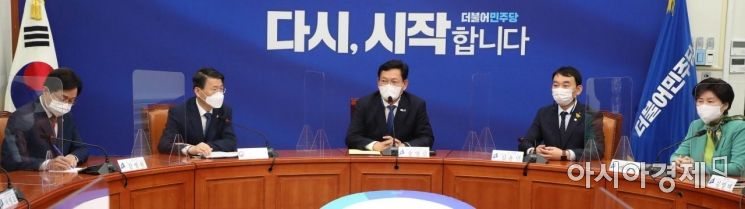 Song Young-gil, leader of the Democratic Party of Korea, is speaking at the real estate status briefing held at the National Assembly representative office on the 4th. Photo by Yoon Dong-ju doso7@
First, after the election, the Democratic Party underwent a series of changes including the resignation of the leadership, the election of Yoon Ho-jung as the new floor leader, and the election of Song Young-gil as party leader. The Democratic Party saw movements to reform the party culture dominated by pro-Moon Jae-in factions and voices pushing for change. However, reform efforts led mainly by first-term lawmakers faced backlash from the existing hardline supporters, and the reform momentum was broken as the so-called 'five first-term rebels' were openly mentioned.
Nonetheless, renewal efforts are still ongoing quietly within the party. The Democratic Party's first-term lawmakers' group, 'The Mincho,' is creating reform proposals while receiving harsh criticism from various groups including professors and people in their 20s and 30s. On April 4, they met with party leader Song Young-gil and requested a party operation focused on people's livelihoods. On April 7, Representative Lee Tan-hee, a member of The Mincho, said in an interview with MBC Radio's 'Kim Jong-bae's Focus' that "there is no separate livelihood reform. Everything must be taken care of," adding, "But currently, there are too many people who are at their limits. I urged that we urgently take care of these people."
The Democratic Party believes that reform is still in its early stages and requires time. In a phone interview with Asia Economy, Go Young-in, the secretary of The Mincho, evaluated the party's actions over the past month, saying, "I think we have moved beyond a time of reflection to a time of listening. We are creating reform proposals while hearing various voices." He emphasized, "Going forward, first-term lawmakers will continuously raise issues with the party leadership and apply pressure if necessary. Didn't Leader Song say he would change everything except the name 'Democratic Party'? I believe the reform vision will become clearer."
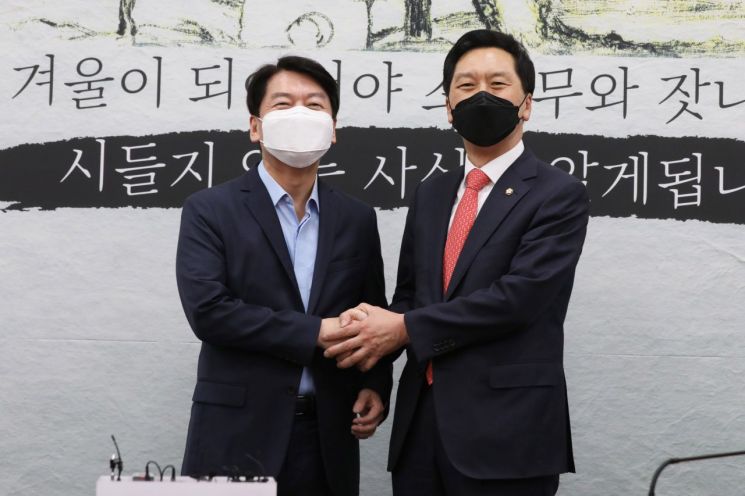
The People Power Party, which won the election, is also in the process of reorganizing its ranks. Although there were leadership changes immediately after the election, including the resignation of emergency committee chairman Kim Jong-in and the election of Kim Ki-hyun as floor leader, no meaningful changes have yet occurred. Rather, controversy arose when Oh Se-hoon and Park Hyung-joon, key figures in the April 7 by-election victory, mentioned the pardoning of former presidents Lee Myung-bak and Park Geun-hye during a meeting with President Moon Jae-in. This sparked concerns about a regression to the old Liberty Korea Party.
Although the People Power Party won the election, it has struggled to gain the support of voters in their 20s and 30s, to unify the opposition with the People Party, and to align with prominent presidential candidates such as former Prosecutor General Yoon Seok-youl. In the National Assembly, disputes over the distribution of standing committee chairmanships have surfaced, but the party has yet to propose alternatives on major issues such as real estate, vaccines, and jobs, remaining at the level of suggesting a tripartite consultative system among the ruling party, opposition, and government. Some signs of change include Kim Ki-hyun, acting party leader and floor leader, paying respects at the May 18 Democratic Cemetery and efforts to engage with the Honam region.
Representative Park Soo-young of the People Power Party said, "While the People Power Party hesitated and failed to accelerate reforms quickly, the Democratic Party started reform efforts, but with controversies like the 'five first-term rebels,' it looks like the same old story." He added, "Although the People Power Party is slow, it maintains a direction toward reform. However, depending on who is elected as party leader, it could end up being the same old story."
© The Asia Business Daily(www.asiae.co.kr). All rights reserved.


















