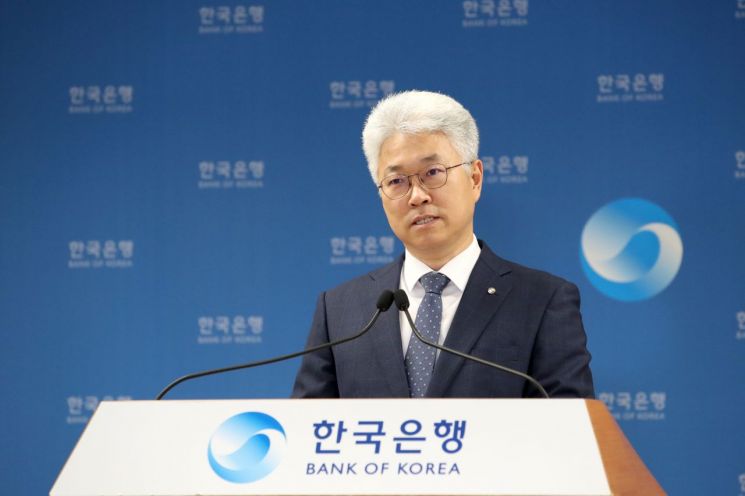
 Park Yang-su, Director of the Economic Statistics Bureau at the Bank of Korea, is explaining the main features of the March 2021 balance of payments (provisional) at the Bank of Korea in Jung-gu, Seoul, on the morning of the 7th.
[Asia Economy Reporter Kim Eunbyeol] The current account, which has shown a double-digit monthly growth rate since the beginning of this year and recorded a surplus of $23 billion in the first quarter, is expected to show a slight deficit in April. Typically, April is a period when foreign dividends from domestic companies are concentrated, and this year, major companies including Samsung Electronics have implemented special dividends as part of their shareholder return policies, increasing the possibility of a current account deficit. The rise in international oil prices, which increases import costs, is also a factor reducing the current account surplus.
According to the Bank of Korea on the 8th, the current account surplus in March this year was $7.82 billion, an increase of $1.88 billion compared to the same month last year. Exports ($54.38 billion) increased by 18.5% ($8.48 billion) compared to March last year, leading to the current account surplus. The cumulative current account surplus for the first quarter of this year reached $22.82 billion.
However, the Bank of Korea explained that the current account could turn into a deficit in April. Park Yang-su, Director of the Economic Statistics Department at the Bank of Korea, said at the international balance of payments (provisional) briefing, "Every April, dividend payments to foreign investors increase, mainly from companies with December fiscal year-ends," adding, "This time, in addition to the usual fiscal year-end dividends, special dividends from major companies under shareholder return policies have significantly increased payments to foreign investors." He continued, "Considering this, the possibility of a slight current account deficit in April cannot be ruled out."
If the current account runs a deficit in April, it will mark the third consecutive year of April current account deficits since 2019. Last year, Korea's April current account showed a deficit as exports were sluggish due to the COVID-19 situation, while domestic companies concentrated their dividend payments to foreign investors.
However, the Bank of Korea emphasized that such current account deficits are temporary phenomena. Director Park stated, "Every April, the current account surplus has either decreased or shown a slight deficit, but this has always been a temporary phenomenon," and forecasted a current account surplus for the year.
Nevertheless, the recent increase in global demand and rising international oil prices are factors that reduce the size of the current account surplus. The Bank of Korea projected in its February economic outlook that this year's current account surplus would decrease to $64 billion, down from $75.3 billion last year.
© The Asia Business Daily(www.asiae.co.kr). All rights reserved.
!["The Woman Who Threw Herself into the Water Clutching a Stolen Dior Bag"...A Grotesque Success Story That Shakes the Korean Psyche [Slate]](https://cwcontent.asiae.co.kr/asiaresize/183/2026021902243444107_1771435474.jpg)
















