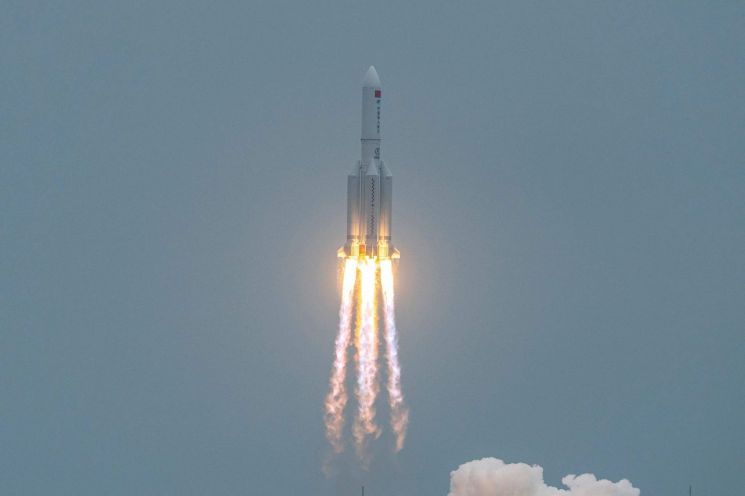
 Rocket launched by China on the 29th of last month for space station construction. [Image source=Yonhap News]
[Asia Economy Reporter Kwon Seoyoung] There are ongoing concerns that parts of the rocket China launched last month to build its space station may fall back to Earth.
On the 7th (local time), U.S. daily The New York Times and other media reported that China successfully launched the Long March 5B rocket carrying the core module Tianhe (天和) on the 29th of last month to construct its space station and placed it into the correct orbit. However, since last weekend, there have been observations that controlling the atmospheric re-entry of the Long March 5B, which is currently orbiting the Earth, is difficult.
The nonprofit research organization Aerospace Corporation estimated that debris from the rocket, measuring 30 meters in length and weighing 22.5 tons, could fall around the afternoon of the 8th (Korean time noon on the 9th). According to Aerospace Corporation’s calculations, the predicted crash site is in the northeastern region of Africa. However, since the rocket is currently orbiting the Earth at a speed of 27,000 km/h, considering factors such as solar wind, the margin of error is estimated to be relatively wide, approximately 41.5 degrees north and south latitude respectively. The U.S. Space Command also stated, "It is impossible to pinpoint the exact crash location until a few hours before atmospheric re-entry."
Earlier, the Air Force stated in a joint video conference with the U.S. Space Command’s Combined Space Operations Center that the Korean Peninsula is not included in the previously predicted crash zones. However, the Air Force added that it cannot rule out the possibility of rocket debris deviating from its original orbit, making it difficult to accurately determine the expected time and location of the crash. They also explained, "We will respond swiftly to all possible scenarios."
Meanwhile, China responded to criticism questioning whether the risk of rocket debris falling could have been eliminated during the pre-design of the flight trajectory. Wang Wenbin, spokesperson for the Chinese Ministry of Foreign Affairs, said, "The rocket was designed using special technology. Most parts will burn up and disappear during their return to Earth," and "The probability of affecting aviation activities or causing harm to Earth is very low."
He added that in the more than 60 years since humanity first launched artificial satellites, there have been no cases of rocket debris or space debris hitting people.
© The Asia Business Daily(www.asiae.co.kr). All rights reserved.
![Clutching a Stolen Dior Bag, Saying "I Hate Being Poor but Real"... The Grotesque Con of a "Human Knockoff" [Slate]](https://cwcontent.asiae.co.kr/asiaresize/183/2026021902243444107_1771435474.jpg)
















