Sharp investment fluctuations not driven by 'corporate investment'
Regulation under the Capital Markets Act, can it be seen as 'financial'?
US also yet to 'bring into the system'
2030 voter appeal vs speculation promotion dilemma
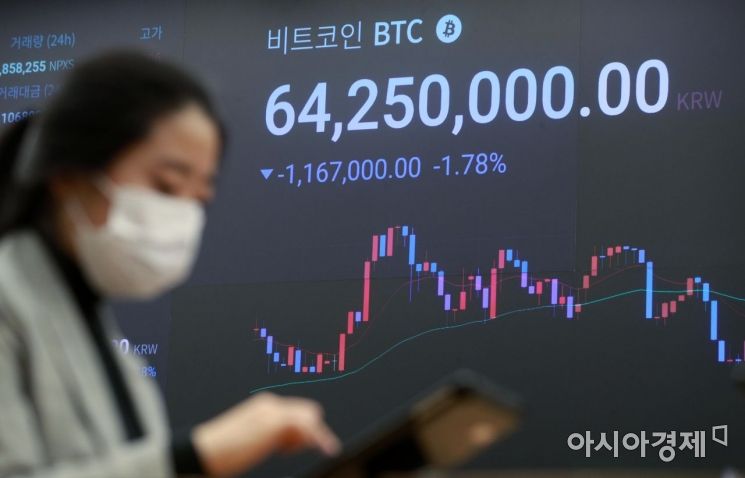 On the 22nd, the Bitcoin price was displayed on the electronic billboard at the Upbit Lounge, a cryptocurrency exchange in Gangnam-gu, Seoul. Starting next year, the government will impose a separate tax rate of 20% on income generated from the transfer or lending of virtual assets such as Bitcoin. The basic deduction amount is 2.5 million won. For example, if the profit is 10 million won, after deducting 2.5 million won, the remaining 7.5 million won will be taxed at 20%, resulting in a tax payment of 1.5 million won. Photo by Kim Hyun-min kimhyun81@
[Asia Economy Reporter Koo Chae-eun] As Prime Minister nominee Kim Boo-kyum hinted at government intervention in virtual assets, the political sphere is also beginning to move toward institutional absorption through legalization. Song Young-gil, leader of the Democratic Party of Korea, stated in an interview with this publication before his election, "It is not right to impose taxes while making institutionalization difficult."
However, with the delayed appointment of the Democratic Party's Policy Committee chairman (Park Wan-joo was appointed on the morning of the fifth day after the party leadership election), the party's official stance is also being postponed. Since institutionalization essentially means recognizing virtual assets as financial products, there are concerns that it could inadvertently encourage speculation, leading to a cautious atmosphere. While some voices call for deferring the taxation timing and bringing virtual assets under the Capital Markets Act, considering the young generation's interest in virtual asset investment, opposing opinions exist, suggesting that difficulties are expected.
According to political circles on the 7th, the representative related bills currently being promoted in the National Assembly are those proposed by Democratic Party lawmakers Kim Byung-wook and Lee Yong-woo, members of the National Assembly's Political Affairs Committee. Kim's bill is expected to include provisions obligating virtual asset exchanges to protect investors and verify the real names of traders. Lee's bill is expected to impose obligations on virtual asset exchanges and other operators to prevent hacking incidents and strengthen operator responsibilities in the form of a 'Virtual Asset Act.' These bills were prepared in response to calls for supplementing the 'Act on Reporting and Using Specified Financial Transaction Information (Special Financial Transactions Act),' the only regulation related to virtual assets.
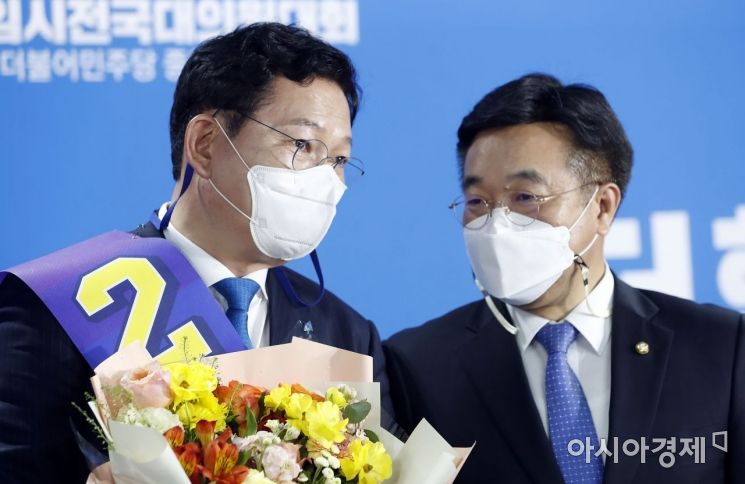 On the 2nd, Song Young-gil, who was elected as the new leader of the Democratic Party of Korea, is talking with Floor Leader Yoon Ho-jung. Photo by the National Assembly Press Photographers Group
A key Democratic Party official said, "We believe it is enough to follow the trends of major countries rather than leading them," adding, "It is uncertain whether virtual assets can be considered a financial concept, as the money flowing is not corporate funds like in institutional finance. Since policies vary by state in the U.S., with some banning and others fostering virtual assets, it is necessary to carefully observe market trends."
Within and outside the Democratic Party, there are concerns, like those from the Financial Services Commission, that bringing virtual assets into institutional finance could cause the market size to become excessively large. In the U.S., while federal economic leaders such as Treasury Secretary Janet Yellen and Federal Reserve Chair Jerome Powell openly express negative views, local governments enact laws to manage the market, employing a two-track strategy.
Therefore, at the high-level party-government-office meeting held on the 25th of last month, an agreement was reached on the principle of 'minimum investor protection.' It is known that the agreement included recognizing the market reality with daily transactions around 10 trillion won and 4 million participants, protecting market participants and improving institutional shortcomings, and ensuring that investors are aware of the possibility of losses due to high volatility.
This kind of 'wavering' stance by the Democratic Party is also evident regarding the deferral of virtual asset taxation. Lawmakers Lee Yong-woo and former Policy Committee chairman Hong Ik-pyo insist that the taxation timing should proceed as originally planned (effective January 1, 2022), while lawmakers Kim Byung-wook, Roh Woong-rae, Lee Kwang-jae, and Yang Hyang-ja argue for the need to defer taxation. Ko Yong-jin, the Democratic Party's floor leader on the National Assembly's Planning and Finance Committee, stated on the 28th of last month that "we will gather opinions on whether it is right to delay taxation further or not."
© The Asia Business Daily(www.asiae.co.kr). All rights reserved.


















