Chain Impact on Finance and Shipping Industries
Global Financial Firms' Back Offices Concentrated
Employees in New Delhi and Others Infected One After Another
Entry Ban on Indians Disrupts Global Trade
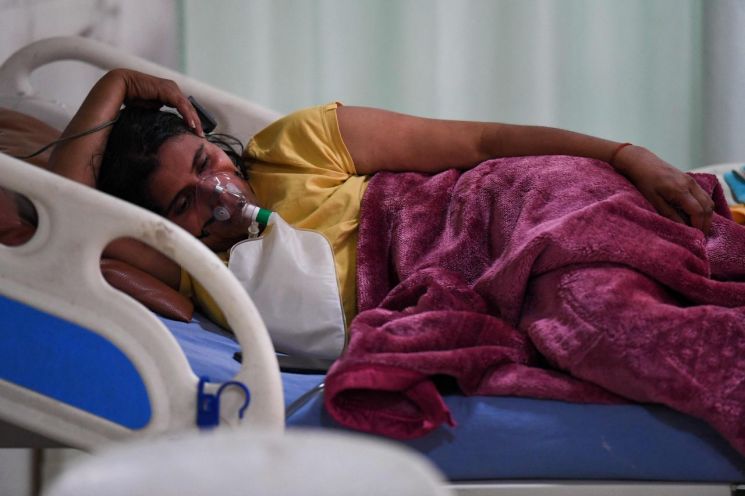 A COVID-19 patient is seen relying on an oxygen ventilator in the intensive care unit of TMU University Hospital in Moradabad, northern India, on the 5th (local time).
 [Image source=Yonhap News]
[Asia Economy Reporter Cho Hyun-ui] India's massive COVID-19 surge, which has been breaking world records day after day, has emerged as a 'black swan' for the global economy. As the spread remains uncontrolled in India, the world's 6th largest economy, disruptions are occurring in major industrial sectors.
India's COVID-19 outbreak is also impacting global financial markets. On the 6th (local time), Bloomberg reported that "Wall Street's major financial firms are shaken by India's massive COVID-19 surge."
Global financial companies such as Standard Chartered and Barclays entrust various back-office operations including customer service, crisis management, and research provision to India. However, as major cities where these companies' back offices are located?such as the capital New Delhi, Bengaluru, and Mumbai?have become 'infection hotspots,' employees are being infected one after another.
According to Bloomberg, Standard Chartered had 800 confirmed cases among 20,000 local employees last week. An internal source at Canada's UBS bank said that one in four local employees is currently absent. Transfer operations and reward programs at the Wells Fargo India office are delayed due to manpower shortages. Global IT market research firm Gartner raised its voice, saying, "India's COVID-19 crisis is not just an Indian problem but a global crisis."
There are also concerns about a shipping and logistics crisis originating from India. A foreign media outlet reported, "Major global ports are refusing entry to seafarers who have passed through India," adding, "India's COVID-19 surge is shaking the global shipping industry."
Singapore and the United Arab Emirates (UAE) recently banned the entry of ships and seafarers passing through India. Zhoushan Port in China, the world's 3rd largest logistics port, has also blocked entry for ships and seafarers who visited India and Bangladesh in the past three months.
India is one of the countries with the largest number of seafarers, along with the Philippines and China. Indians account for 15 out of every 100 seafarers worldwide, and if such measures continue, it could deal a significant blow to the global shipping industry. Senior industry officials warned, "Regulating the entry of seafarers from India will cause a chain reaction in the shipping and logistics sector, which handles 80% of global trade."
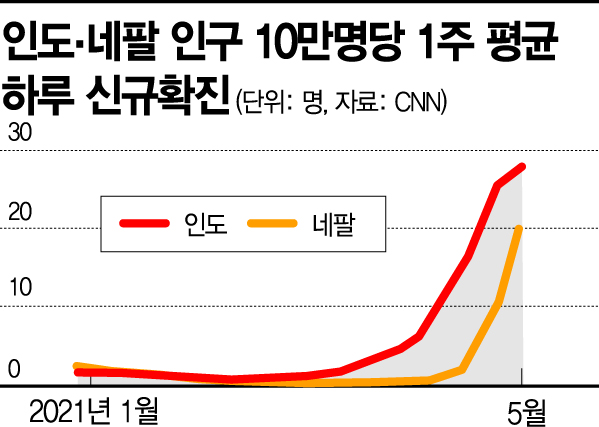
Concerns are also growing that India's COVID-19 cases may spread to neighboring countries. Nepal, an adjacent country, has recently seen a sharp increase in confirmed COVID-19 cases. With a population of 30 million, Nepal had a cumulative total of 368,580 confirmed cases as of the 7th. This means 1.2 people per 100 are infected.
Nepal's situation could worsen more than India's. A Nepal Red Cross official said, "We fear that what is happening in India now could become Nepal's future." Nepal's COVID-19 test positivity rate is as high as 44%. CNN reported, "A high positivity rate means more hidden cases," and expressed concern over Nepal's inadequate healthcare system, citing fewer doctors per capita and lower vaccination rates compared to India.
On the 6th, India recorded over 410,000 new daily confirmed cases, breaking the world's highest record. This came just five days after surpassing 400,000 on the 30th of last month. The daily new death toll also reached 3,980, marking a new high.
© The Asia Business Daily(www.asiae.co.kr). All rights reserved.


















