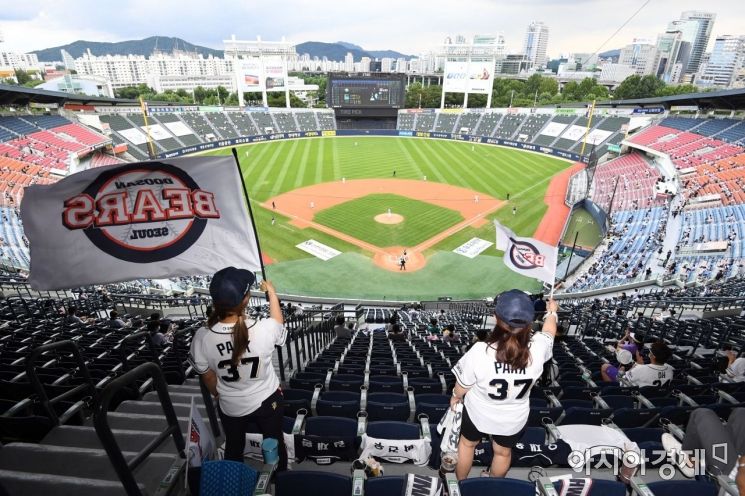
[Asia Economy Reporter Kim Daehyun] "Actions to restrict non-commercial GIFs will accelerate the decline in popularity of the KBO League."
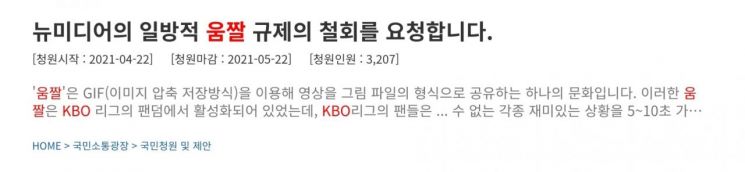
This petition was posted on the Blue House National Petition Board at the end of last month and has garnered over 3,200 supporters as of 11 a.m. on the 8th. Recently, the 'portal site and telecommunications consortium' sent warning messages to social media (SNS) and community users who uploaded baseball game 'GIFs' (short edited videos or moving images). The message stated, "These videos infringe on KBO copyrights. Until now, only deletion recommendations were made, but from May, legal actions including lawsuits will be pursued through a law firm." This has led to complaints of "excessive sanctions" even in well-known online baseball communities.
Previously, the consortium signed a five-year 'new media broadcasting rights' contract worth a total of 110 billion KRW with the KBO League in 2019. The KBO (Korea Baseball Organization) and the teams also transferred rights to game footage. However, as videos are shared in GIF format, the consortium views that SNS platforms are profiting from increased views.
In response, some baseball fans have expressed skepticism about the actual possibility of punishment, asking, "Can GIFs shared as part of fandom culture without commercial intent really be sanctioned?" However, in the legal community, the prevailing analysis is that posting broadcast captures, program screenshots, and GIFs often occurs without the copyright holder's permission, making copyright infringement punishable under copyright law.
Article 136, Paragraph 1 of the current Copyright Act stipulates that "Anyone who infringes on copyright and property rights by reproduction, exhibition, distribution, or creating derivative works may be punished by imprisonment of up to five years or a fine of up to 50 million KRW." However, Article 35-5, Paragraph 1 of the same law states that "If the use of a work does not conflict with the normal exploitation of the work and does not unjustly harm the legitimate interests of the author, the work may be used."
Attorney Kim Jonghui of Mast Law Firm stated, "Regardless of the length, size, or commercial use of edited content, touching someone else's copyrighted work can constitute copyright infringement." Since the right to edit itself belongs to the copyright holder, editing and posting without permission, regardless of commercial intent, is illegal.
In 2014, during local elections, a campaign worker who captured another person's copyrighted work and posted it on a blog to raise suspicions about an opposing candidate was fined 2 million KRW by Judge Kim Jinhui of the Uijeongbu District Court Criminal Division 11. The court emphasized, "The defendant claims that their actions constitute fair use of copyrighted material and thus are not copyright infringement, but this is difficult to accept," adding, "Even if it was not used for commercial purposes, the same applies."
Attorney Kim added, "Fair use of copyrighted works is limited to specific cases such as public work production, education, and citation for current affairs reporting," and added, "However, copying or editing (into GIFs) for personal use is possible."
© The Asia Business Daily(www.asiae.co.kr). All rights reserved.


















