10 Years of Designated Medium-Sized Business Sectors... A Dilemma Seen Through the Bakery Industry
Franchise Regulations Aim to Revive Local Markets
But 2,000 Neighborhood Bakeries Close Annually
Starbucks Expands Food Business
20 Stores Within 500m of Euljiroipgu Station
Calls for Improvement of Inequitable System
[Asia Economy Reporter Seungjin Lee] Although the Win-Win Growth Committee introduced and has been implementing the Small and Medium Enterprise (SME) Suitable Industry designation to protect neighborhood commercial districts for over 10 years, concerns about its effectiveness continue. Regulations on franchise bakeries will continue until 2024, but the space for ‘dongne bbangjip’ (local bakeries) keeps shrinking. Meanwhile, Starbucks, which has expanded its business from coffee shops to bakery products, is emerging as a new competitor to local bakeries, sparking calls for regulatory reform.
Local Bakeries Close as Many as They Open
According to KB Financial Group’s Management Research Institute on the 7th, bakery startups decreased from 2,720 in 2016 to 2,433 last year. More than 2,000 bakeries close annually, resulting in closures matching the number of new openings. It has been 10 years since the Win-Win Growth Committee designated bakeries as an SME Suitable Industry and implemented regulations on franchise bakeries in 2013, but local bakeries continue to disappear, undermining the policy’s original intent.
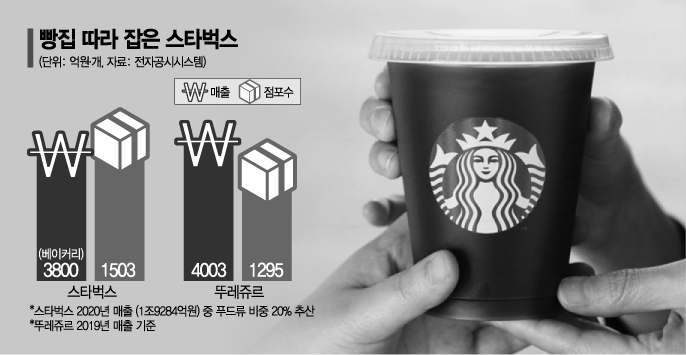
On the other hand, Starbucks, which expanded from coffee shops into the bakery business, is experiencing rapid growth in a regulatory blind spot. Last year, Starbucks’ sales reached 1.9284 trillion KRW, with food sales centered on bakery items such as cakes and sandwiches accounting for about 20% of total sales, approximately 380 billion KRW.
Considering that CJ Foodville’s Tous Les Jours, which is subject to regulation, recorded sales of about 400 billion KRW in 2019, Starbucks has grown to a level that threatens the second place in the bakery market. Starbucks increased its stores to 1,500 last year. Tous Les Jours currently operates 1,295 stores, so Starbucks also leads in store count. Starbucks sells bakery products at all 1,500 stores and introduced the ‘The Yangpyeong DTR Store’ last year, where bread is baked on-site, continuing to expand its bakery business.
20 Starbucks Stores Within 500m of Euljiro 1(il)-ga Station
In terms of scale, Starbucks already threatens second place in the bakery industry but faces no regulations. Because there is no restriction on opening stores within 500 meters, about 20 Starbucks stores are clustered within a 500-meter radius of Euljiro 1(il)-ga Station in Seoul without issue. In this area, it is difficult for small bakeries, franchise bakeries, and cafes alike to operate.
As a result, voices calling for revision of the now ineffective regulations are emerging everywhere. Recently, convenience stores have also been strengthening their bakery businesses, raising concerns about reverse discrimination since only franchise bakeries are regulated, leading to calls for completely removing the store opening restrictions.
Recently, the Tous Les Jours Franchisee Association unusually stated, "The growth limit caused by nearly 10 years of store opening restrictions has had the greatest impact," and "We request related agencies to improve the system that has driven franchisees into an unstable survival environment with unreasonable and inequitable regulations." The franchisee group, which should demand restrictions to prevent competition among stores, is instead asking for the removal of these restrictions.
Regarding this, Professor Kim Ik-sung of Dongduk Women’s University (Honorary President of the Korean Distribution Science Association) said, "It is now necessary to ease regulations on the bakery industry." He added, "The competitive landscape in the bakery industry, including Starbucks, has changed, so insisting on regulations for a specific industry seems inappropriate," and "It seems necessary to leave it to market competition."
© The Asia Business Daily(www.asiae.co.kr). All rights reserved.
![User Who Sold Erroneously Deposited Bitcoins to Repay Debt and Fund Entertainment... What Did the Supreme Court Decide in 2021? [Legal Issue Check]](https://cwcontent.asiae.co.kr/asiaresize/183/2026020910431234020_1770601391.png)















