[Asia Economy Reporter Yujin Cho] As the production disruptions caused by the shortage of automotive semiconductors prolong, car manufacturers are releasing vehicles without optional features that require semiconductors as a desperate measure.
According to Bloomberg on the 5th (local time), Japanese automaker Nissan has started releasing some vehicles without navigation systems as difficulties in procuring navigation components due to semiconductor shortages have extended.
An anonymous source reported that Nissan is reducing the number of vehicles released with navigation as a standard feature to about one-third of the previous level.
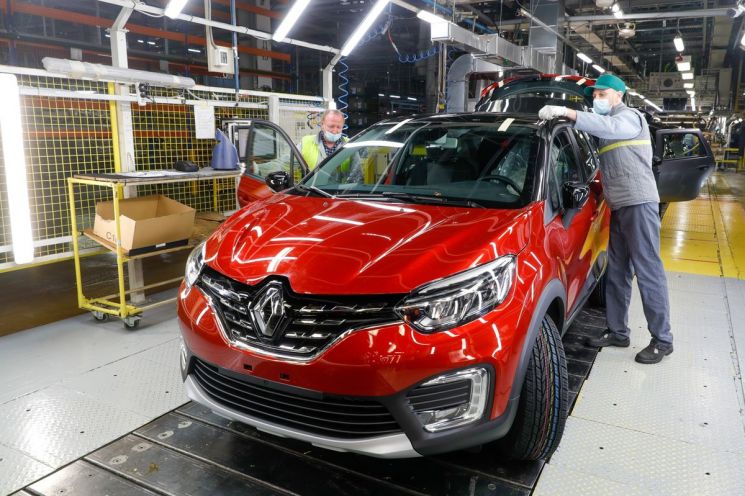
Ram, an automotive brand under Stellantis, recently excluded the intelligent rearview mirror function that eliminates blind spots from 1,500 Ram 1500 pickup trucks produced, and Renault is producing new vehicles without the large digital screen feature applied to the Arkana sport utility vehicle (SUV).
This is a desperate measure taken by the automotive industry, which has focused on offering improved software features for decades, as production stagnation lengthens due to the recent semiconductor supply shortage.
According to market information firm IHS Markit, the global automotive industry cut production by about 1.3 million vehicles in the first quarter of this year alone due to the semiconductor shortage impact.
The semiconductor chip shortage is also driving changes in the supply chain management methods of the automotive industry. Global automakers are abandoning the just-in-time production system introduced to reduce costs and attempting to stockpile key parts, leading to structural changes in the supply chain.
Jim Farley, CEO of Ford Motor Company, pointed out during the first-quarter earnings conference call, "The automotive industry has been hit hardest by this automotive semiconductor shortage because, unlike other industries, it does not manage inventory of critical parts."
Toyota has started stockpiling some parts for up to four months of production, and Volkswagen is building six factories capable of securing its own batteries.
Baird analyst Luke Jung said, "The chip shortage will be an important trigger for renegotiations between automakers and suppliers regarding prices, purchase volumes, and inventory costs of key parts in the automotive supply chain."
Meanwhile, the semiconductor sector accounts for about 10% of the global automotive industry. With increasing demand for advanced features such as software and the paradigm shift to electric vehicles, it is predicted that this will increase to up to 45% by 2030.
© The Asia Business Daily(www.asiae.co.kr). All rights reserved.

















