Remarks Comparing By-election 'Before and After' at Real Estate Market Inspection Meeting
Rise to 0.08% in Last Week of April... Gangnam and Songpa, Focused on Reconstruction, Increase
Seoul City Targeted for 'Reconstruction-driven Rise,' Jamsil Jugong and Eunma Review Deferred
[Asia Economy Reporters Kangwook Cho, Hyemin Kim] "The government and Seoul Metropolitan Government will cooperate more actively to stabilize the real estate market." (Hong Nam-ki, Deputy Prime Minister and Minister of Economy and Finance)
The government has entered a tough stance regarding ‘reconstruction.’ After the announcement of the February 4 housing supply plan, Seoul apartment prices, which had been quiet for a while, began to stir again due to expectations of easing reconstruction regulations, raising concerns that it could act as a fuse for nationwide housing price increases. Oh Se-hoon, the Mayor of Seoul, who had promoted ‘speedy housing supply’ as his number one pledge, also appears to have shifted to a cautious stance amid concerns about a backlash from reconstruction-driven housing price increases. In the market, there are even concerns that the easing of reconstruction regulations itself might be scrapped as the government emphasizes ‘active cooperation’ with Seoul for housing price stabilization.
◇Government shifts blame for housing prices to Seoul Metropolitan Government = At the 21st Real Estate Market Inspection Meeting on the 6th, Deputy Prime Minister Hong diagnosed, "The recent increase in Seoul apartment prices has expanded for two consecutive weeks after the by-election and remains at a higher level compared to before the by-election." He added, "Especially, signs of instability continue in major complexes in the four Gangnam districts where reconstruction issues exist."
What is noteworthy is the comparison between ‘before and after’ the by-election. Earlier, at the 19th meeting held on the 8th of last month, the government emphasized that the market was stabilizing, with the price increase slowing down gradually after the announcement of the February 4 plan. However, at the 20th meeting held on the 21st of the same month, it was noted that the increase in Seoul apartment prices had somewhat expanded after 10 weeks, showing signs of instability, and the government said it was "monitoring mainly the reconstruction market." It also pointed out that "unconfirmed and uncoordinated details are being reported as if they were confirmed and being promoted, causing some market agitation," indirectly criticizing the Seoul Metropolitan Government’s push for ‘reconstruction regulation easing.’
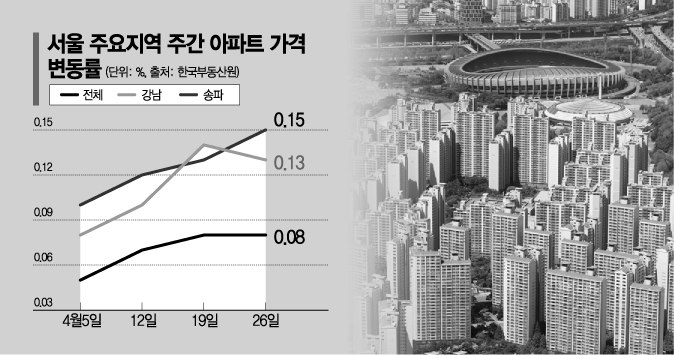
This time, the government directly mentioned the ‘by-election’ for the first time, implying that the responsibility for housing price instability lies with Mayor Oh’s election. According to the Korea Real Estate Board, the rate of change in Seoul apartment prices gradually decreased from 0.10% in the first week of February to 0.05% in the first week of April but rose again after the by-election (April 7), reaching 0.08% in the last week of April. In particular, the apartment sale price change rates in Gangnam-gu and Songpa-gu, where large-scale reconstruction complexes are concentrated, rose by 0.05 percentage points each during April. This contrasts with the overall Seoul increase of 0.03 percentage points.
◇Seoul Metropolitan Government also adopts cautious mode... Is easing regulations on hold? = In response to the government’s tough stance, Mayor Oh, who had promised to ease reconstruction regulations within a week of taking office, also seems to be weighing caution due to concerns about backlash.
In fact, the Seoul Metropolitan Government, which holds the authority for reconstruction permits, recently postponed review requests for Jamsil Jugong 5 Complex in Songpa-gu and Eunma Apartments in Gangnam-gu one after another. In the case of Gangnam District Office, after Mayor Oh’s inauguration, on the 19th of last month, it requested the Urban Planning Committee to submit the reconstruction maintenance plan and maintenance zone designation plan for Eunma Apartments in Daechi-dong, but received a request for supplementation three days later. Previously, the city also returned the reconstruction review request for Jamsil Jugong 5 Complex from Songpa District Office, asking for supplementation.
The city cautioned against overinterpretation, saying it was because past pending issues had not been supplemented. However, it was confirmed that the city also requested new supplementary matters. For Jamsil Jugong 5 Complex, the city asked the association to clarify its stance on various complaints such as floor relaxation and maintaining the 3rd residential zone, and for Eunma Apartments, in addition to the appropriateness review opinion on the skyline plan, it newly requested reinforcement of the layout and supply plan considering social mix with public rental housing. In the market, there are even concerns that Mayor Oh’s ‘pause’ on easing regulations might weaken the momentum for reconstruction itself.
Yoon Ji-hae, senior researcher at Real Estate 114, pointed out, "If the government and Seoul Metropolitan Government do not find a compromise between reconstruction activation and regulation easing due to political burdens over concerns of stimulating housing prices, reconstruction itself may become difficult." She added, "Gradual project promotion including system improvement is needed from now on, but if reconstruction is delayed by one or two more years due to burdens, development issues will accumulate and cause greater side effects."
© The Asia Business Daily(www.asiae.co.kr). All rights reserved.

















