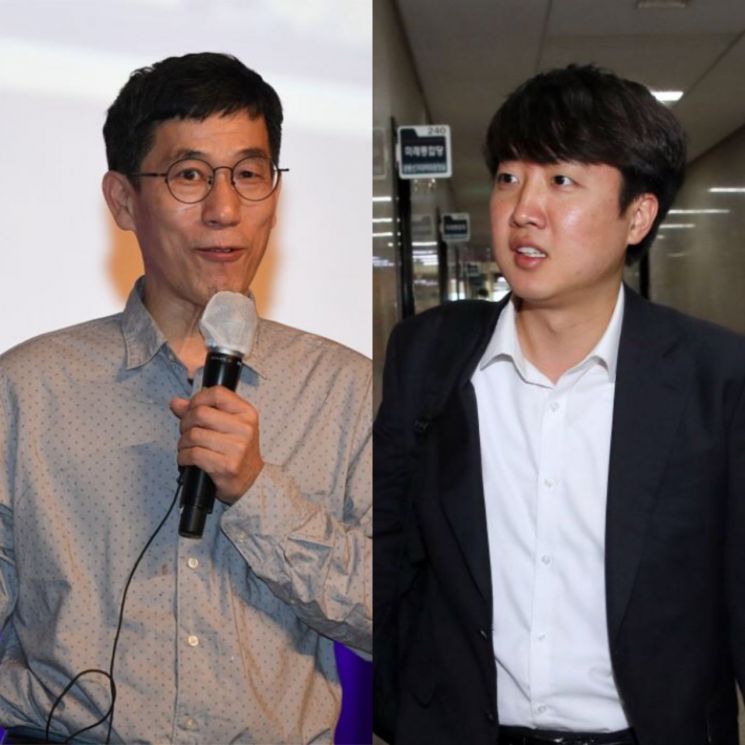
 Former Dongyang University Professor Jin Joong-kwon (left) and former People Power Party Supreme Council Member Lee Jun-seok (right). [Image source=Yonhap News]
[Asia Economy Reporter Hwang Sumi] Amid the intensifying gender conflicts recently, former Dongyang University professor Jin Joong-kwon and former People Power Party Supreme Council member Lee Jun-seok continue to engage in debates over gender issues. Criticizing Lee, who advocates for a gender-fair society by opposing "female quotas and bonus points" as unfair, Jin accused him of "acting like a 'king frog in a well.'"
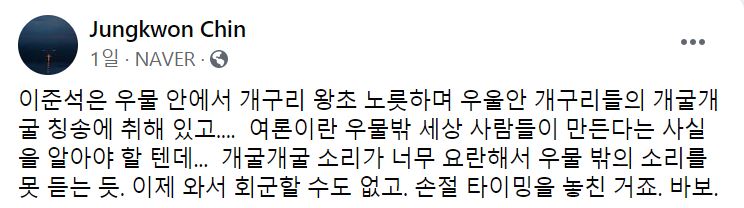 A post written by former Dongyang University professor Jin Joong-kwon on his Facebook on the 4th. [Photo by Facebook]
On the 4th, Jin posted on his Facebook, "(Lee) is intoxicated by the croaking praise of frogs in a well," adding, "He should realize that public opinion is created by people outside the well."
He also said, "The croaking is so loud that he seems unable to hear the sounds outside the well," fiercely criticizing Lee as a "fool who missed the timing to cut ties."
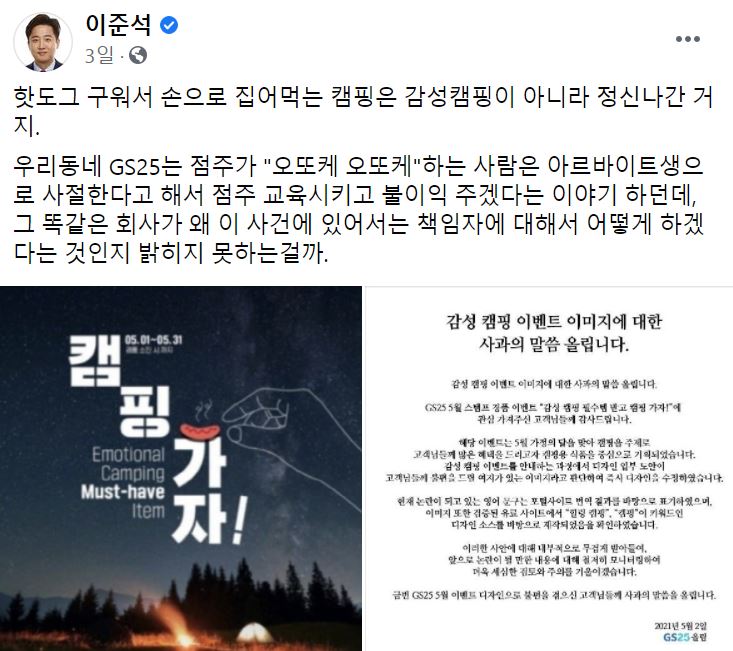 Former People Power Party Supreme Council member Lee Jun-seok expressed his position on February 2 regarding the controversy over the GS25 promotional poster accused of misogyny on his Facebook. [Photo by Facebook]
Meanwhile, Jin and Lee also clashed over the recent controversy surrounding the GS25 promotional poster accused of "misandry." Earlier, GS25 faced a boycott threat after a poster promoting a camping-related event was criticized for containing images and phrases symbolizing extreme feminist groups.
Some online communities claimed that the hand gesture used in the poster resembled the symbol of the female community "Megalia," which spread mainly through male-dominated online forums. Additionally, it was pointed out that the last letters of each word in the English phrase on the poster, "Emotional Camping Must-have Item," combine to form the word "Megal."
As the controversy escalated, GS25 promptly revised the poster, but the moon and three stars drawn at the bottom of the revised poster were alleged to represent the Seoul National University feminist society's emblem. Ultimately, GS25 deleted the poster and issued an apology.
Regarding this, Lee criticized the poster on his Facebook on the 2nd, saying, "It's not emotional camping but crazy," and added, "Those who stubbornly deny the existence of gender conflict probably don't even understand the context in which this became news."
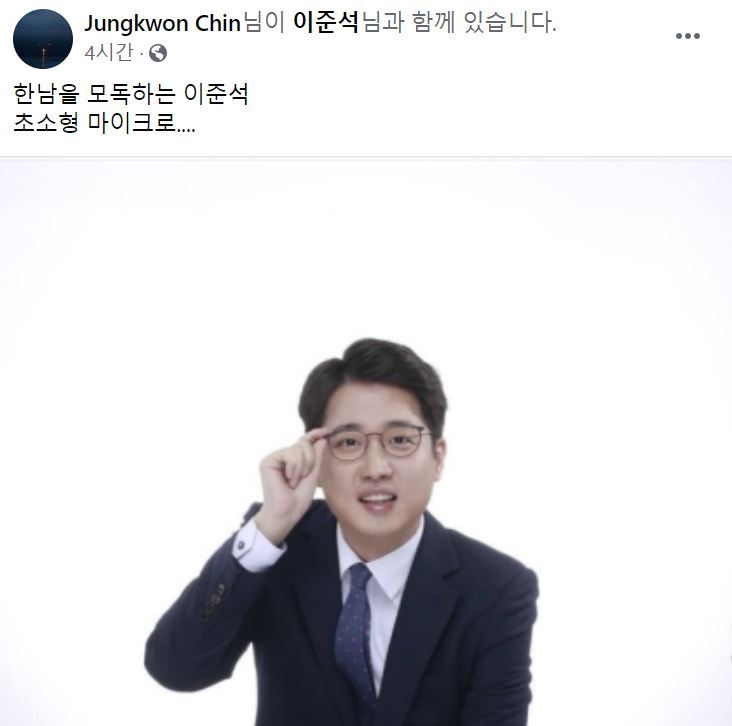 Former Dongyang University professor Jin Joong-kwon posted a photo of Lee Jun-seok, former Supreme Council member of the People Power Party, on his Facebook on the 5th.
 [Photo by Facebook]
In response, Jin commented, "The social cost caused by the collective hysteria of the accusers." On the 5th, he also posted a past photo of Lee striking the same hand pose that caused controversy in the GS25 poster, labeling him as "Lee Jun-seok insulting Han-nam (Korean men)."
Earlier on the 2nd, Jin and Lee had a heated debate over feminism on Channel A's special program "MZ Generation Talks Politics."
Lee analyzed that some factions within the Democratic Party stirred up gender conflicts over individual criminal cases, which influenced the April 7 by-elections, citing the 2016 Gangnam Station murder case and the 2018 Isu Station pub assault case as examples. He said, "I couldn't believe that political parties or the government applied a gender frame to criminal cases," adding, "It wasn't just one or two instances."
Jin countered, "Drawing a generalized conclusion that the government's feminism has gone too far based on trivial examples might please young men in their 20s (Idae-nam), but it's a provocative rhetoric," and added, "It's Lee Jun-seok's personal ideology deviating from general and universal consensus," sarcastically suggesting, "He probably wants to claim credit for gaining over 70% support within the party due to his position."
Meanwhile, gender conflicts continue to intensify, especially among people in their 20s and 30s. Whereas previously women mainly raised issues related to gender discrimination, creating a cautious atmosphere to avoid sparking 'misogyny' controversies in popular culture, recently young men in their 20s have also been raising concerns, showing a changing trend. Just as women previously objected to terms like "Kimchi-nyeo" and "Doenjang-nyeo," men now point out expressions like "Heobeoheobeo" and "Ojo-o-eok" as hateful language.
In this way, some citizens express fatigue amid the overheated gender conflicts fueled by feelings of "hatred." Especially regarding the political sphere's involvement and the spread of debates such as "Idae-nam," some experts criticize, "Ultimately, the political world is just using this for their votes," and say, "It is inappropriate for politicians, who should resolve conflicts, to incite tensions with provocative remarks to gain public support."
© The Asia Business Daily(www.asiae.co.kr). All rights reserved.



















