Brain Hemorrhage and Hemiplegia Symptoms After Vaccination
Despite 'Coerced Vaccination' Controversy
Employees Encouraged Each Other by Posting Internal Network Reviews
"Acknowledging Justification but Should Leave It to Voluntary Choice"
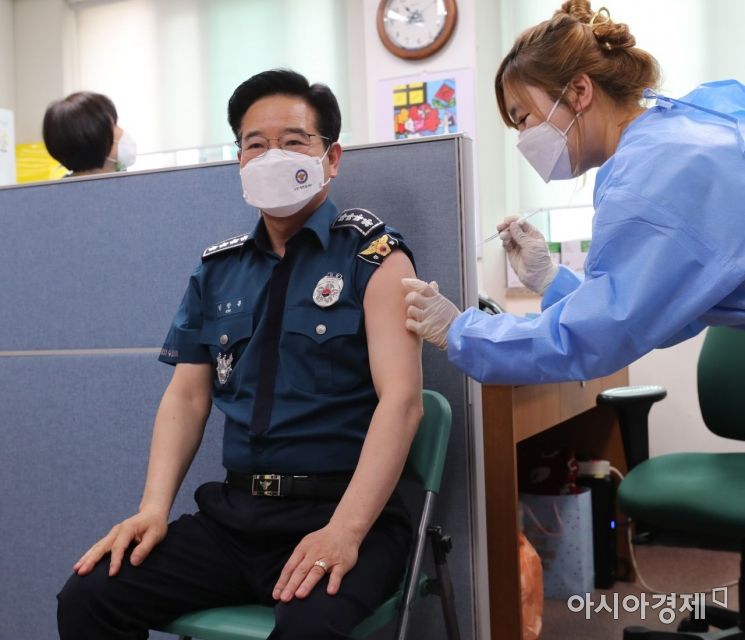 On the 26th, when vaccinations for essential social workers such as police officers and firefighters began, Kim Chang-ryong, Commissioner of the National Police Agency, received the AstraZeneca COVID-19 vaccine at the Jongno-gu Public Health Center in Seoul. Photo by Moon Honam munonam@
[Asia Economy Reporter Lee Gwan-joo] The police force is unsettled after a female police officer in her 50s underwent surgery for a brain hemorrhage and has not regained consciousness following AstraZeneca (AZ) vaccine administration. The previously smooth vaccination process among police officers appears to be shifting amid controversy over ‘mandatory vaccination.’
According to the police on the 4th, Officer A, a female police officer in her 50s affiliated with the Gyeonggi Nambu Police Agency, showed symptoms of brain hemorrhage three days after receiving the AZ vaccine on the 29th of last month, underwent surgery on the 2nd of this month, and is currently receiving treatment in the intensive care unit. The day before, a petition titled “I am the child of a female police officer who is unconscious after receiving the AZ vaccine” was posted on the Blue House’s national petition board by Officer A’s child, calling for a thorough investigation. Additionally, it was revealed that Sergeant B, also in his 50s from the Jeonbuk Police Agency, developed hemiplegia symptoms after receiving the AZ vaccine and is being treated in the intensive care unit.
The vaccination of police officers, which began on the 26th of last month, proceeded without major issues despite controversy over mandatory vaccination. On the police internal network, frontline officers left ‘vaccination reviews’ encouraging their colleagues to get vaccinated. Most of these reviews mentioned mild side effects such as muscle pain or fever but nothing serious.
The police initially faced criticism over ‘mandatory vaccination.’ Although Commissioner Kim Chang-ryong of the National Police Agency stated directly that “vaccination is voluntary,” continuous encouragement to get vaccinated led to criticism that it was ‘semi-mandatory.’ Nevertheless, ongoing vaccination encouragement combined with frontline officers’ sense of duty as essential social personnel resulted in a vaccination reservation rate approaching 80%, and vaccinations proceeded without significant problems.
However, frontline officers report that the atmosphere within the police force is changing as cases of side effects emerge. A police inspector working in Busan said, “Most frontline officers acknowledge the necessity of vaccination,” but added, “There is a sense of unease as cases of side effects among colleagues arise.” Another frontline officer said, “There used to be many posts on the internal network saying there were no issues after vaccination, but as side effect cases appeared, the atmosphere of mutual encouragement has largely disappeared.”
Frontline officers have raised their voices demanding appropriate responses to side effect cases following vaccination. A representative of a police station’s workplace council said, “If a police officer contracts COVID-19, it causes a security gap, so despite complaints, officers have been getting vaccinated,” emphasizing, “Proper information about side effects must be provided, and if unfortunate incidents occur, appropriate measures should be taken.”
In this regard, the police reiterated that vaccination is not being forced. A National Police Agency official explained, “We tracked the reservation rate, but since vaccinations began in earnest, we have not monitored the vaccination rate at all,” adding, “We understand some concerns about the vaccine, but vaccination remains entirely voluntary.”
© The Asia Business Daily(www.asiae.co.kr). All rights reserved.

















