Top 5 Banks' Household Loan Balance Rises by 9.2 Trillion KRW in April
Mortgage Loan Growth Slows but Household Loans Jump
Money Move to Speculative Assets "Risk of Crash"
[Asia Economy Reporters Sunmi Park and Seungseop Song] The massive shift of market funds from low-interest deposits to speculative high-yield, high-risk financial products is interpreted as a warning sign that household debt defaults may increase. With the base interest rate expected to remain at the current level for some time due to the impact of COVID-19, investors seeking to avoid becoming 'lightning beggars' are predicted to increasingly turn to stocks, cryptocurrencies, and other investments instead of meager deposit interest.
Furthermore, since there is a time lag until the financial authorities' 'Household Loan Management Plan' is fully implemented in July, the enthusiasm for investing in high-yield assets is likely to continue for the time being. Experts have expressed concerns that with the effective rise in loan interest rates this year, speculative loans without proper measures could become a trigger for financial market instability. In particular, they warned that virtual assets are risky because they have no intrinsic value and are purely driven by supply and demand, making them susceptible to sudden crashes without reason.
Rising Interest Rates but Household Debt Continues to Accumulate
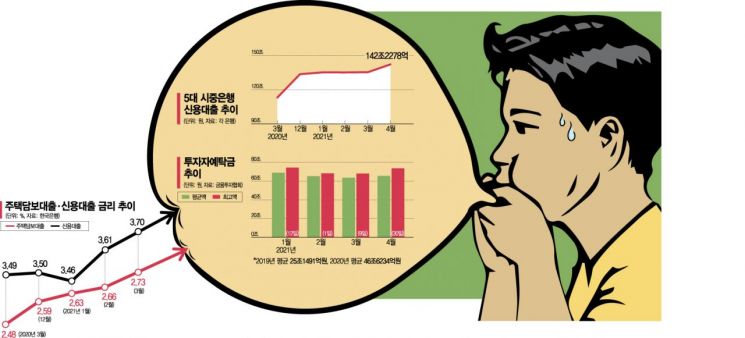
According to the five major commercial banks?KB Kookmin, Shinhan, Hana, Woori, and NongHyup?household loan balances reached 690.8622 trillion won last month, an increase of 9.2 trillion won from 681.6357 trillion won at the end of March. The household loan increase exceeding 9 trillion won last month is nearly three times the 3.79 trillion won in February and 3.4 trillion won in March. Although the growth of mortgage loans has slowed due to strengthened real estate market regulations, these measures have had no effect in curbing household loans.
The problem lies in rising loan interest rates. According to the latest statistics from the Bank of Korea, the overall household loan interest rate (weighted average based on new loans) for deposit banks in March was 2.88%, up 0.07 percentage points from 2.81% in February. The interest rate on unsecured loans rose 0.09 percentage points from 3.61% to 3.70%, and mortgage loan rates increased 0.07 percentage points from 2.66% to 2.73%, continuing an upward trend for two and seven consecutive months, respectively. The unsecured loan rate is at its highest since February 2023 (3.70%), and the mortgage loan rate is at its highest since June 2019 (2.74%).
Although financial consumers are increasing household debt while bearing higher loan interest, the economic environment has not clearly improved due to the ongoing COVID-19 situation, and money is flowing into speculative assets, increasing the risk of defaults. Typically, defaults or delinquencies occur after a certain period following loan issuance. Loans issued during periods of rapid increase are relatively more likely to become non-performing. This is why concerns are emerging that the surge in household debt could potentially threaten financial stability.
The Korea Institute of Finance stated, "As temporary measures such as maturity extensions or interest payment deferrals implemented by financial authorities due to COVID-19 normalize, latent defaults may surface," adding, "Measures that only adjust loan repayment methods or periods for a soft landing may only delay defaults."
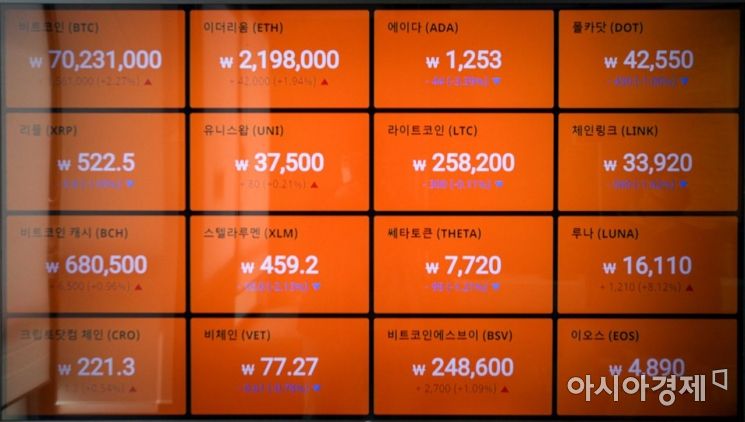 On the 14th, as Bitcoin surpassed 70 million won to reach a new all-time high, the prices of Bitcoin and other cryptocurrencies were displayed on the market board at Bithumb Gangnam Customer Center in Gangnam-gu, Seoul. Photo by Jinhyung Kang aymsdream@
Experts Warn of Money Move Risks Linked to Speculative Assets
Most experts analyze that the accelerating money move phenomenon is connected to the speculative assets currently rampant in the market. Professor Donggeun Cho, Emeritus Professor of Economics at Myongji University, said, "People are ready to withdraw money at any time to buy stocks, Bitcoin, and other virtual assets," warning, "It is risky that many in their 20s and 30s are putting all their money into speculative assets." He added, "Money is flowing in even though there is no official announcement of big wins by others," expressing concern that "when the price bubble of assets with no intrinsic value bursts, the negative impact on the market will be significant."
Professor Sangbong Kim of Hansung University also noted, "The surge in unsecured loans and reduction in deposits indicate that funds have moved to stocks or the cryptocurrency market," analyzing, "In the past, money moves were thought to direct funds to real estate, but given the high prices now, that is difficult to expect." He further pointed out, "Virtual assets are purely driven by supply and demand, so there is a risk of sudden crashes without reason."
There is also an assessment that an environment allowing money moves to continue is being created. Professor Taeyoon Sung of Yonsei University explained, "As interest rates are expected to rise, funds are first moving from fixed deposits to 'parking accounts,'" adding, "This reflects the psychology of waiting for interest rates to rise further before putting money into high-interest products."
Although the financial authorities announced the 'Household Loan Management Plan' at the end of last month to curb the surge in household loans, the plan will be applied after July, and there is a rush of 'last-minute demand' to borrow before then, so the money move toward speculative assets is expected to continue for the time being.
In particular, the financial authorities plan to announce expanded financial support measures for housing ladders targeting the homeless and young people within this month, aiming at those in their 20s and 30s who are leading the money move, raising concerns about potential side effects from loan easing.
© The Asia Business Daily(www.asiae.co.kr). All rights reserved.


















