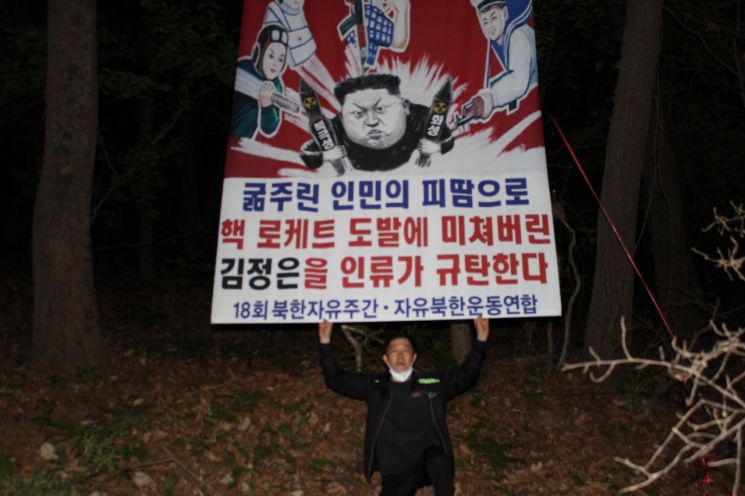
 The North Korean defector organization, the Free Joseon Movement Alliance, announced that it distributed 500,000 leaflets to North Korea in two rounds between the 25th and 29th of last month in the Gyeonggi and Gangwon provinces. Park Sang-hak, the representative of the Free Joseon Movement Alliance, is holding a leaflet for North Korea.
 [Image source=Yonhap News]
[Asia Economy Reporter Lee Gwan-joo] It has been confirmed that Park Sang-hak, the head of the Free North Korea Movement Alliance, who recently claimed to have distributed leaflets to North Korea, refused police protection and absconded.
Nam Gu-jun, head of the National Investigation Headquarters of the National Police Agency, stated this at a press conference on the 3rd, adding, "If protection is abandoned, we will verify the possibility that leaflets were distributed."
Nam explained, "If the individual refuses protection, there is no way to enforce it," and added, "Although a protection team was deployed, he refused and absconded." He also said, "The Security Investigation Unit of the Seoul Metropolitan Police Agency has formed an investigation team to confirm whether balloons carrying leaflets to North Korea were actually launched, as well as the timing and location." It is reported that Park is currently receiving protection again.
Furthermore, when asked whether the instruction by Police Chief Kim Chang-ryong the previous day to "investigate the distribution of leaflets to North Korea swiftly and thoroughly" constitutes a 'specific investigative command,' Nam replied, "It is regarded as a 'general investigative command' meaning to take strict measures."
The National Investigation Headquarters (NIH) is an organization under the National Police Agency, but to ensure investigative independence, the Police Chief is generally restricted from issuing specific investigative commands on individual cases. However, in urgent and important cases that pose significant risks to citizens' lives, bodies, property, or public safety, where large-scale police resources must be mobilized and integrated on-site response is necessary, the Police Chief may exceptionally issue specific commands and supervision through the NIH Chief.
Regarding this, an NIH official explained, "Specific investigative command refers to direct involvement in investigations, such as requesting arrest warrants or instructing on investigation details," and clarified that "instructions like 'investigate swiftly' or 'comply with human rights procedures' are general investigative compliance directives," indicating that Chief Kim's instructions fall under general investigative command.
© The Asia Business Daily(www.asiae.co.kr). All rights reserved.
![Clutching a Stolen Dior Bag, Saying "I Hate Being Poor but Real"... The Grotesque Con of a "Human Knockoff" [Slate]](https://cwcontent.asiae.co.kr/asiaresize/183/2026021902243444107_1771435474.jpg)
















