[Asia Economy Reporter Moon Jiwon] The government will expand the 'Smart Signal Operation System' nationwide by the second half of this year.
The Ministry of Land, Infrastructure and Transport announced on the 2nd that it will officially start a project to expand the smart signal operation system, which significantly improves traffic flow at intersections and reduces accidents, to major intersections nationwide.
The smart signal operation system is an 'intelligent signal operation system' that optimally controls signals in real-time according to traffic volume to facilitate vehicle flow or grants priority signals to emergency vehicles such as fire trucks.
It is divided by function into responsive signal systems, emergency vehicle priority signal systems, and smart intersections.
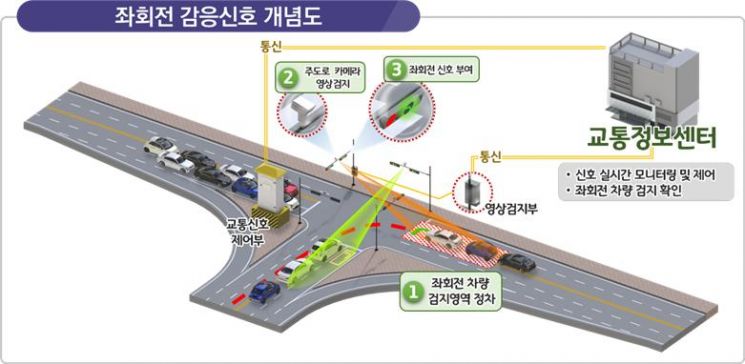
First, the responsive signal prioritizes the main road traffic signal under normal conditions and only grants signals to left-turning vehicles on side roads when detected, reducing unnecessary signal waiting times.
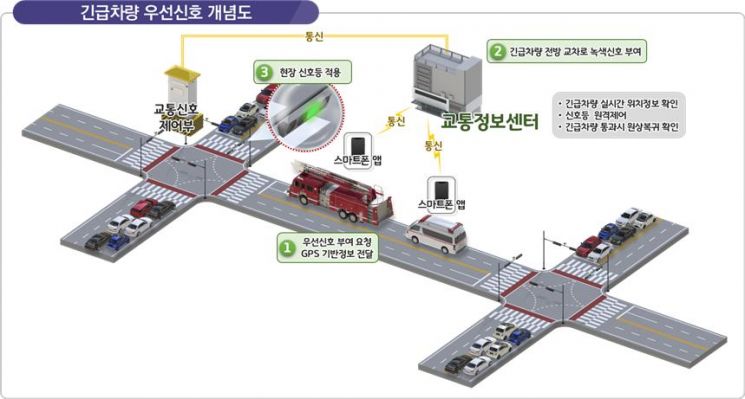
The emergency vehicle priority signal system temporarily controls intersection signals to grant customized priority passage when an emergency vehicle is moving. This helps shorten accident handling time and secure the golden time.
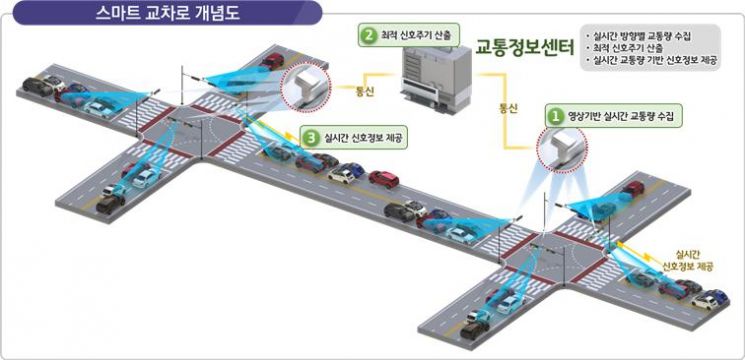
The smart intersection applies different optimal signals during peak and off-peak traffic hours using big data.
By the end of last year, the Ministry of Land, Infrastructure and Transport had implemented 509 responsive signal systems, 44 emergency vehicle priority signal systems, and 746 smart intersections. As a result, visible effects such as improved traffic flow and reduced signal violations were observed.
Specifically, the introduction of responsive signals resulted in a 41% reduction in vehicle delay time and a 36% decrease in signal violations. Through emergency vehicle priority signals, emergency vehicle travel time was reduced by 20?60%, and at locations with smart intersections, improvements in traffic flow on major roads were observed.
The Ministry plans to significantly expand the signal operation system improvements targeting major intersections nationwide starting this year.
This year, responsive signals will be installed at 403 national and local government sites nationwide, emergency vehicle priority signals at 372 sites in 19 local governments, and smart intersection systems at 1,224 sites in 31 local governments.
Juhyunjong, Director of the Road Bureau at the Ministry of Land, Infrastructure and Transport, said, "We will continue to expand the smart signal system project, which has a strong impact on the public, and actively introduce new technologies such as artificial intelligence (AI) and advanced sensors into intelligent transportation system projects."
© The Asia Business Daily(www.asiae.co.kr). All rights reserved.



















