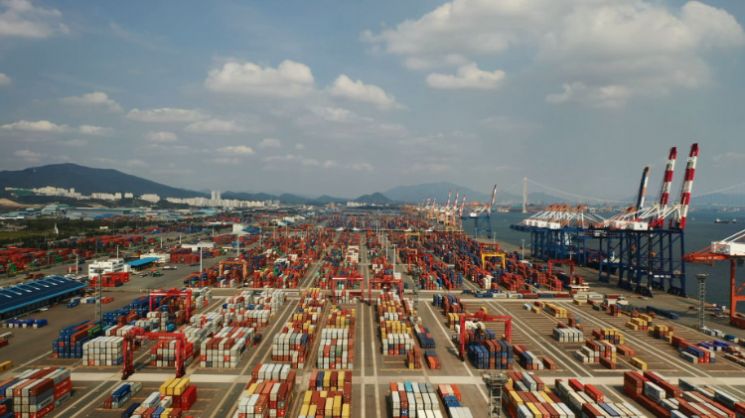
[Asia Economy Reporter Dongwoo Lee] The global major shipping freight indices for container ships and bulk carriers each surpassed the 3000 mark, setting new record highs.
According to the shipping industry on the 1st, the Shanghai Containerized Freight Index (SCFI), which aggregates freight rates for 15 container shipping routes, stood at 3100.74 as of the previous day, up 120.98 points from the previous week. This is the first time the SCFI has exceeded 3000 since its inception in October 2009.
In particular, freight rates on major routes for domestic export companies, such as those to the Americas and Europe, rose significantly.
The freight rate for the US West Coast route increased by $56 per 1FEU (one 40-foot container), reaching an all-time high of $5,023. This is the first time the US West Coast freight rate has surpassed $5,000.
The US East Coast freight rate also surged by a whopping $732 per 1FEU, hitting a record high of $6,419. Freight rates on European routes rose by $305 from the previous week to $4,630 per 1TEU (one 20-foot container).
The Baltic Dry Index (BDI), a key indicator for bulk carrier freight rates, also soared to 3007 as of the 29th of last month. The BDI has risen by an astonishing 373.54% over the past year. The overall freight rates were driven up particularly by increased demand for Capesize bulk carriers (around 150,000 tons), which primarily transport iron ore and coal.
The industry analyzed that the prolonged COVID-19 situation, combined with increased cargo volumes since the second half of last year and ongoing congestion at major ports, has pushed freight rates higher.
The rise in bulk carrier freight rates is attributed to increased demand for high-quality Brazilian iron ore, as China's steel production margins have improved recently. As Brazilian iron ore is imported via the Atlantic route, available vessels are rapidly being depleted.
The shipping industry expects the BDI to continue its upward trend for the time being, as China's iron ore imports steadily increased in the first half of this year and the iron ore production of Vale, one of the world's largest mining companies based in Brazil, is entering a recovery phase in the second half of the year.
© The Asia Business Daily(www.asiae.co.kr). All rights reserved.

















