- Gyeonggi Gwangju's Population Increased by 53% (132,000 People) in the Last 10 Years... Ranked Among Top in 31 Cities and Counties of Gyeonggi Province
- GS Construction to Supply 'Opo Jai The Obeu' in May in Gyeonggi Gwangju, Where Population Increased Due to Transportation Network Improvements
The population growth trend in Gwangju City, Gyeonggi Province, is remarkable. Although Gwangju City was once a region isolated due to a lack of transportation networks and living infrastructure despite its geographical proximity to the central metropolitan area, it has recently emerged as a representative residential city in the metropolitan area.
The population of Gwangju City, Gyeonggi Province, has increased significantly over the past decade. According to Statistics Korea, the population, which was 249,789 in 2010, increased by 53% over ten years to reach 382,054 in 2020. Among the 31 cities and counties in Gyeonggi Province during the same period, only Hanam City, Gimpo City, and Hwaseong City showed a higher growth rate than Gwangju City.
The significant population increase in Gwangju City is analyzed to be due to the expansion of transportation networks, improvements in living infrastructure, and a rush of new apartment move-ins.
First, the opening of the Gyeonggang Line subway in 2016 contributed greatly. From Gwangju Station, it takes only three stops to reach Pangyo Station, and from Pangyo Station, transferring to the Shinbundang Line allows reaching Gangnam Station in seven stops.
Improvements in the road network also played a major role. With the opening of the Seongnam-Icheon Road (National Route 3), accessibility from Gwangju to Seongnam has greatly improved. Through the Seongnam-Icheon Road, travel to Songpa area including Jamsil, as well as Gangnam and Yeoksam areas, has become more convenient.
Additionally, with the opening of new highway access points such as Opo IC on the Sejong-Pocheon Expressway in 2022, Gwangju City is expected to have easier access to Seoul and the metropolitan central area.
Due to these transportation improvements, residential demand from Seoul’s Gangnam area and Bundang, Pangyo, etc., has increased significantly. According to Hogangnono, among the 17,039 households that moved into Gwangju City from November 2017 to October 2020, 48.23% (9,965 households) came from Seongnam City, 6.2% (1,282 households) from Songpa-gu, 3.92% (810 households) from Gangdong-gu, and 3.8% (785 households) from Gangnam-gu, showing continuous population inflow from Seoul’s Gangnam area and Seongnam to Gwangju.
The recent concentration of apartment households in Gwangju has also influenced population growth. From 2014, when new apartment supply began in earnest in Gwangju, to 2020, the number of general sale households was 20,462, which is more than the 18,148 households supplied in Seongnam during the same period.
Since supply and absorption happen simultaneously, newly supplied housing is expected to continue selling out quickly. In fact, 'The Sharp Opo Centriche,' which was sold in the Gosan district of Gwangju in February this year, also recorded a rapid sell-out.
A sales official said, “The population increase in Gwangju City, Gyeonggi Province, occurred due to transportation network expansion and living infrastructure improvements from new apartment supply,” adding, “With new apartment supply planned in the Gosan district this year, the residential rush to Gwangju is expected to continue.”
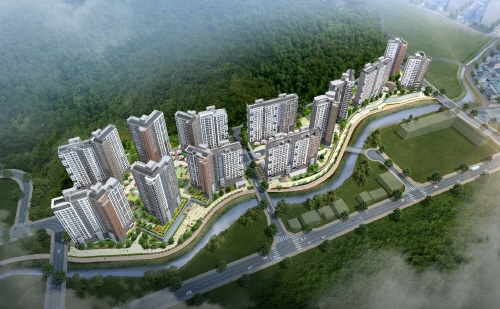
Meanwhile, GS Construction plans to supply ‘Opo Xi The Orb’ in Gwangju City, Gyeonggi Province, in May. ‘Opo Xi The Orb’ will consist of 895 households in total, with 447 households in six buildings in C-3 block and 448 households in seven buildings in C-4 block, ranging from 62 to 104 square meters in exclusive area, and from two basement floors to 23 floors above ground.
The complex is located in an area that can utilize Gwangju’s convenient transportation environment. First, the Opo IC on the Sejong-Pocheon Expressway, scheduled to open in 2022, will be near the complex, making travel to Seoul and other metropolitan cities more convenient.
Additionally, access to Pangyo, Bundang, and the metropolitan area is convenient via the Gyeonggang Line subway and Seongnam-Icheon Road (National Route 3). It also has abundant living infrastructure. The complex is surrounded by the Munhyeongsan forest area in the Gosan district, ensuring a pleasant natural environment. There is also a planned elementary school site near the complex, allowing children to attend school safely.
Various specialized designs will be applied. These include unit-specific specialized layouts such as penthouses, open balconies, and three-sided open plans, as well as diverse community facilities by block.
© The Asia Business Daily(www.asiae.co.kr). All rights reserved.
![Clutching a Stolen Dior Bag, Saying "I Hate Being Poor but Real"... The Grotesque Con of a "Human Knockoff" [Slate]](https://cwcontent.asiae.co.kr/asiaresize/183/2026021902243444107_1771435474.jpg)
















