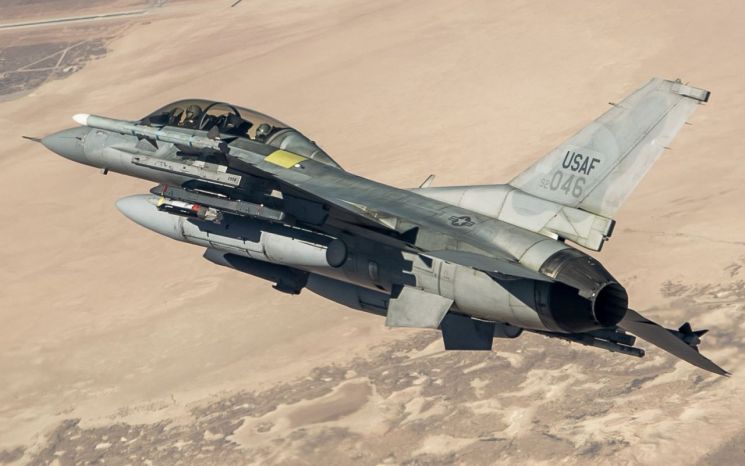
[Monthly Defense Times Editor-in-Chief An Seung-beom] The GBU-39 is a 250-pound class small guided bomb. It was used to destroy Hamas's underground tunnels during the Israeli Air Force's Gaza Strip airstrike operation (Operation Cast Lead) and was also adopted by South Korea following the November 2010 Yeonpyeong Island shelling incident.
The SDB was developed to penetrate and strike enemy fuel storage tanks, underground tunnels, and bunkers. It is a lightweight small bomb weighing about 250 pounds and is operated in large quantities mounted on F-15K Slam Eagle fighter jets. The SDB can be launched simultaneously from multiple aircraft to destroy specific targets.
Like the JDAM guided bomb, it has built-in GPS and INS, but unlike the GPS-dependent JDAM, the INS is the primary guidance system, and the GPS is used as an auxiliary system to correct the INS's cumulative flight errors.
Equipped with a more precise digital GPS than JDAM, it achieves high accuracy with a circular error probable (CEP) of about 5 meters.
The warhead is an AFX-757 high-explosive bomb weighing only about 40 pounds. Its frontal cross-sectional area is narrow relative to its length, reducing drag. When launched at high speed from a fighter jet aimed at a target, it gains high velocity and can strike the target with high energy.
The warhead's tip, which contacts the target first, is pointed and concentrates energy, boasting powerful penetration capability.
It has penetration power comparable to the 2000-pound class BLU-109 penetrator bomb. Although the BLU-109 is about ten times heavier than the GBU-39, the energy upon target impact is similar, indicating that the GBU-39 strikes the target at a considerably higher speed.
The wings that deploy upon release have a relatively large width compared to their area, making it advantageous for long-distance flight. It is a stand-off weapon with a flight range of up to 110 km.
Since 2006, the GBU-53/B, which adopts new wings like the Diamond Back for long-range attack capability, has been developed. This system integrates an infrared imaging seeker, allowing the terminal guidance phase to recognize targets visually. It also adds an ATR (Automatic Target Recognition) function that automatically identifies targets by comparing infrared image data with pre-acquired target angles, enabling precise attacks on aircraft parked on runways, armored vehicles, and more.
Another advantage of the SDB is its ability to perform various dive maneuvers using multiple aerodynamic fins. These maneuvers are used to maximize energy by approaching at high altitude and high speed for direct impact on the target or to attack targets that are significantly offset from the dive direction or to strike vulnerable points of the target.
© The Asia Business Daily(www.asiae.co.kr). All rights reserved.

















