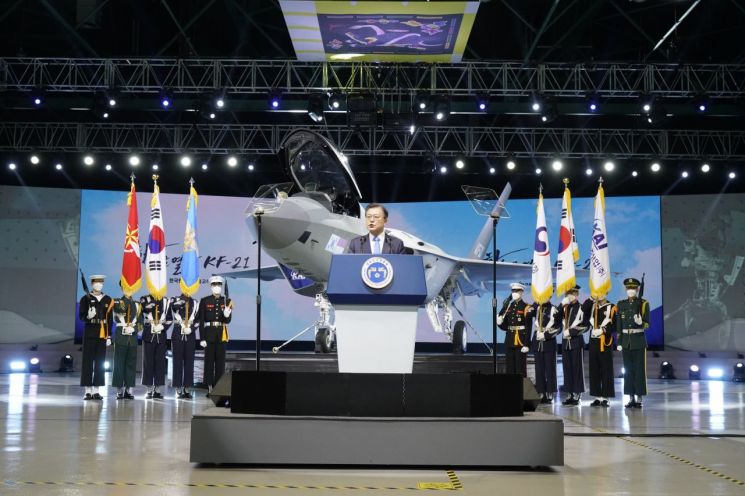
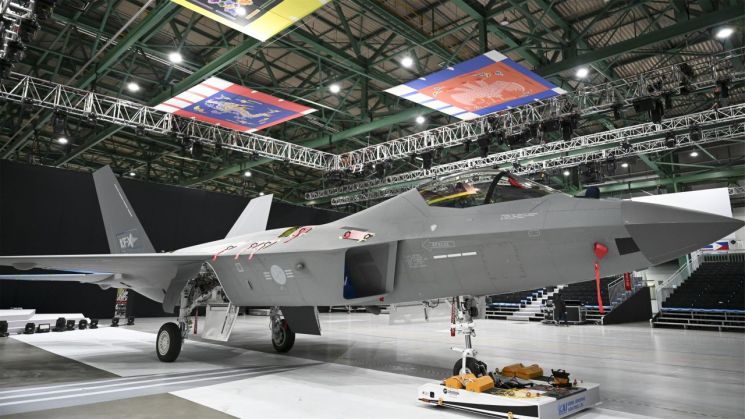
[Monthly Aviation Editor-in-Chief Kim Jae-han] On April 9th, the Korean fighter jet was finally delivered under the new name ‘KF-21 Boramae.’ It appeared 20 years after then-President Kim Dae-jung first announced the development of a state-of-the-art domestic fighter jet at the Air Force Academy graduation ceremony on March 20, 2001. On that day, President Moon Jae-in also remarked in his commemorative speech, “In 2001, President Kim Dae-jung presented the vision for developing an advanced domestic fighter jet,” adding, “Although there was much skepticism that it would be difficult to achieve with only our technology due to the increasing difficulty of acquiring core technology transfers, our development team turned doubt and anxiety into confidence and made the impossible possible.”
▲ Prototype delivery after numerous controversies = The development of the KF-X faced numerous controversies over the 20 years. First, the feasibility study results regarding the KF-X acquisition plan were inconsistent, causing the project to waver. In fact, Konkuk University gave a positive assessment of domestic development, while the Korea Development Institute (KDI) and the Korea Institute for Defense Analyses (KIDA) produced negative results.
In particular, based on the study conducted by Konkuk University in 2012, system development was scheduled to begin in 2013. However, a feasibility study commissioned by the Ministry of Strategy and Finance to the Defense Research Institute in 2012 yielded negative results, leading to the complete cut of the system development budget except for 4.5 billion won allocated for the feasibility study.
As the project direction fluctuated, the Air Force’s urgency over the capability gap continued to grow. In January 2013, the Air Force issued an unusual official statement saying, “Whether through direct purchase or domestic development, it is essential to acquire a fighter jet that meets the required performance on time to carry out airspace defense missions without any capability gap,” and “The acquisition method must be finalized by the first half of this year no matter what.”
The failure to acquire core technology transfers from the United States also sparked controversy. Initially, the government agreed to purchase 40 F-35A jets for about 7.34 trillion won and to receive transfers of 25 related technologies including radar, flight control, avionics, and armaments. However, in April 2015, the U.S. government refused to transfer system integration technology for four key systems?Active Electronically Scanned Array (AESA) radar, Infrared Search and Track (IRST), Electro-Optical Targeting Pod (EO TGP), and Radio Frequency Jammer (RF Jammer)?citing national security reasons.
The U.S. government’s refusal to transfer these core technologies triggered widespread negative public opinion about the KF-X project. In response, the Defense Acquisition Program Administration (DAPA), which oversees the project, announced plans to prioritize domestic development and system integration of the four key systems using domestic technology levels and experience with similar equipment development, and to pursue overseas technology cooperation if necessary.
Subsequently, in June 2017, DAPA conducted a first review of the AESA radar development status and judged that continuous domestic development was feasible. In April 2018, it reached the final conclusion that AESA radar could be developed domestically.
There was also controversy over the number of engines. The number of engines is a critical factor in determining the aircraft’s configuration, and opinions were sharply divided between the single-engine C-501 and the twin-engine C-103. In particular, the preference for the C-103 was strong from a performance perspective, while the C-501 was favored for economic reasons.
Ultimately, the engine number controversy was settled on July 18, 2014, when the Joint Chiefs of Staff announced that, considering performance, scalability, and the development trends of neighboring countries’ fighter jets, the twin-engine configuration was chosen. Accordingly, the basic configuration of the KF-X was finalized as the twin-engine C-103. Later, the actual engine to be installed was selected between GE Aviation’s F414-GE-400 and Eurojet’s EJ200, with the F414-GE-400 engine chosen in May 2016.
Besides these, the KF-X project faced many twists and turns but officially began system development in December 2015 when DAPA and Korea Aerospace Industries (KAI) signed the system development contract. Subsequently, the Preliminary Design Review (PDR) was held in June 2018, the Critical Design Review (CDR) in September 2019, and final assembly of the first prototype began in September 2020, culminating in the delivery ceremony on April 9th.
▲ Prototype delivery marks a new starting line = The prototype delivered after overcoming many obstacles is closer to a new starting line than a final result. There remains a rigorous process of thoroughly verifying through various tests whether the performance matches the design and whether the aircraft is suitable for military operation, and addressing any deficiencies found. Field engineers unanimously agree that while the delivery process is difficult, the testing and evaluation phase is even more challenging.
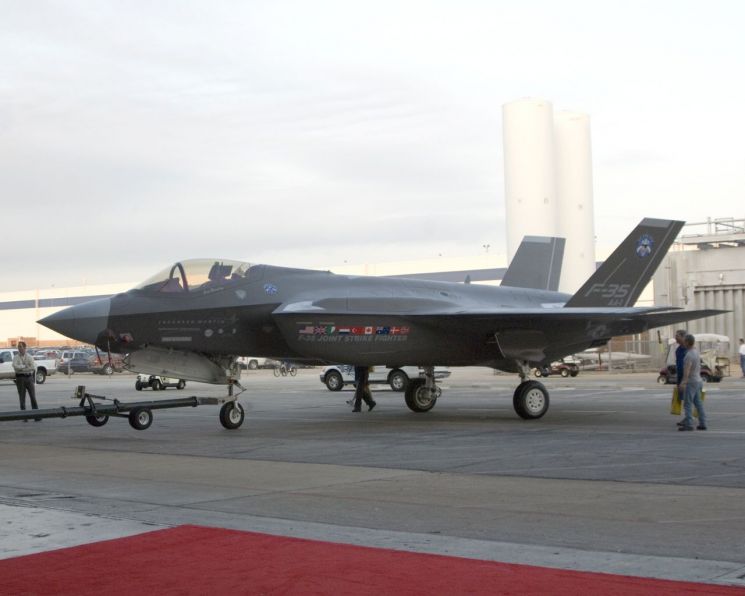
For example, the F-35A’s first prototype was delivered in February 2006, but it was only in August 2016 that it was handed over to the U.S. Air Force, the user, achieving Initial Operational Capability (IOC) to perform basic combat missions. This delay was due to unforeseen issues discovered during testing and evaluation that required time to resolve. In other words, it took 10 years from the first delivery to deployment in actual combat.
The Eurofighter Typhoon, currently operated as a main fighter in Europe, also flew its first prototype in March 1994 but only began operational service in August 2003, taking nearly 10 years from first flight to first operation. This is a common example showing how many difficulties exist in refining a delivered prototype into a combat-ready fighter. The reason the prototype delivery is called a ‘new starting line’ is precisely because of this.
However, in the domestic aircraft development process, there tends to be a perception that prototype delivery means ‘completion.’ Perhaps for this reason, even minor issues discovered during the testing and evaluation phase after delivery are met with harsh criticism. Problems found in a supposedly completed aircraft are perceived as ‘faults.’ Especially, sharp criticism that blames the common ‘problem discovery’ during aircraft development as faults often becomes a harsh blow to the engineers involved in development. This is one of the most difficult aspects for field engineers.
Now, South Korea is a developer and exporter of domestic aircraft including the KT-1 basic trainer, T-50 advanced trainer, Surion helicopter, and small armed/civil helicopters. Accordingly, a broader understanding of the aircraft development process is necessary. Of course, as citizens, rigorous oversight of projects involving massive budgets is essential. However, at this time, engineers bearing the heavy burden of developing a domestic fighter jet in a short period need encouragement more than harsh criticism.
© The Asia Business Daily(www.asiae.co.kr). All rights reserved.



















