Samsung Electronics Announces Confirmed Q1 Results for This Year on the 29th
[Asia Economy Reporter Suyeon Woo] Samsung Electronics announced that the loss from the suspension of operations at its Austin plant in the United States amounts to approximately 300 billion to 400 billion KRW, and that operations have now returned to normal. From the second quarter, the company plans to focus its capabilities on minimizing the impact of semiconductor supply shortages at both the set and semiconductor divisions.
On the 29th, during Samsung Electronics' first-quarter conference call, Seobyunghun, Vice President in charge of IR, stated, "We are making various efforts to minimize the impact of semiconductor supply shortages," adding, "We are closely cooperating with major suppliers of set products such as smartphones, TVs, and home appliances to secure necessary component inventories and are conducting rebalancing across the entire production process."
To manage such component inventories, Vice President Seo also revealed plans to sequentially introduce the next-generation resource management system, the N-ERP system, to global subsidiaries by January next year. In the display sector, where DDI supply shortages had become an issue, Samsung is closely cooperating and negotiating with suppliers, while the foundry division plans to maximize production efficiency and actively respond to increasing customer demand by fully operating the Pyeongtaek Line 2 from the second half of the year.
The foundry division, which suffered losses of 300 billion to 400 billion KRW in the first quarter, is expected to recover production as the Austin plant's operations normalize from the second quarter. Seunghoon Han, Executive Vice President of the Foundry Business Division, explained, "The power outage in the Austin area caused production disruptions of approximately 71,000 semiconductor wafers, corresponding to a loss of 300 billion to 400 billion KRW."
He continued, "Since the suspension in February, we have been focusing on phased recovery, reaching over 90% production capacity as of March 31, and operations are now fully normalized," adding, "We are closely consulting with the U.S. government and water and power companies to prevent recurrence."
During the conference call, Samsung Electronics forecasted that the semiconductor and home appliance markets would improve in the second quarter, raising expectations for better performance. The DRAM market in the second quarter faces some production disruption risks due to component supply issues in mobile, but steady demand continues thanks to the expansion of the 5G market and increased capacity. The server market is also expected to see increased shipments of key products alongside the launch of new CPUs. The foundry business anticipates expanded supply as the Austin plant fully normalizes in the second quarter and mass production at Pyeongtaek Line 2 begins in earnest in the second half.
In the display sector, Samsung plans to accelerate the transition to new businesses based on next-generation QD display technology, while responding flexibly to market conditions regarding LCD product production. Kwonyoung Choi, Executive Vice President of Samsung Display, said, "We are focusing on developing QD and enhancing its completeness to strengthen long-term competitiveness," adding, "We are working to launch as scheduled in the second half."
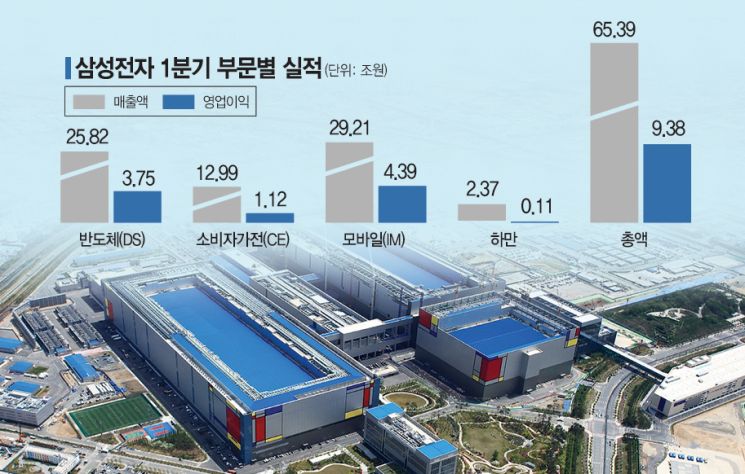
Meanwhile, Samsung Electronics' first-quarter results announced that day exceeded market expectations and achieved record-high sales for a first quarter. Consolidated sales for the first quarter reached 65.39 trillion KRW, and operating profit was 9.38 trillion KRW, representing increases of 18% and 45% year-on-year, respectively. By business division, operating profits improved year-on-year in major sectors such as home appliances, mobile, display, and Harman, but the semiconductor division was the only one to see a decline in operating profit due to the impact of the Austin plant suspension.
© The Asia Business Daily(www.asiae.co.kr). All rights reserved.

















