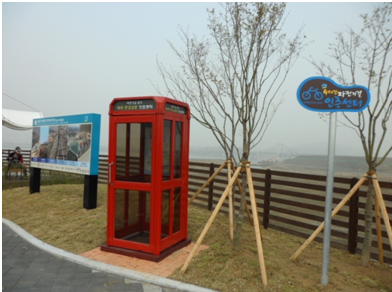
 The photo is unrelated to the article. Source=Asia Economy DB
[Asia Economy (Hongseong) Reporter Jeong Il-woong] Public phone booths are being utilized as a platform to respond to the climate crisis. Public phone booths, which could have easily become burdensome relics, have found a new use.
Chungnam Province announced on the 29th that it plans to repurpose public phone booths, once considered nostalgic artifacts(?), into shared battery stations for electric two-wheelers.
The use of public phone booths as shared battery stations is expected to reduce air pollutants, decrease noise pollution, and lower maintenance costs for riders by promoting the expansion and active use of electric two-wheelers.
To this end, the province signed a business agreement with KT and KT Linkers the day before. According to the agreement, the province and KT·KT Linkers plan to convert 20 outdoor public phone booths distributed across Chungnam?selecting at least one per city and county out of a total of 900?into shared battery stations for electric two-wheelers this year.
Next year, they plan to further convert 80 public phone booths into shared battery stations, significantly expanding the charging infrastructure.
Starting in 2023, the converted public phone booths will be upgraded by adding eco-friendly energy functions, CCTV, and unmanned civil service issuance features.
The conversion of public phone booths into shared battery stations is meaningful primarily because it allows the reuse of public phone booths that could easily have become burdensome relics.
Moreover, the activation of eco-friendly electric two-wheelers is expected to improve local air quality and reduce noise pollution.
For example, a single internal combustion engine two-wheeler with an engine displacement of 50cc or more that uses gasoline as fuel emits 79.19 kg of carbon monoxide (CO), 1.08 kg of nitrogen oxides (NOx), and 11.88 kg of volatile organic compounds (VOCs) annually.
This is 2.2 times more carbon monoxide, 4.2 times more nitrogen oxides, and 91.4 times more volatile organic compounds than a small passenger car under 1600cc.
Additionally, noise from internal combustion engine two-wheelers is typically measured at 115 dB, which is higher than subways (80 dB) and trains (100 dB), and slightly lower than fighter jets (120 dB).
In contrast, electric two-wheelers have negligible emissions and noise levels that are almost unmeasurable. Most importantly, the maintenance cost for electric two-wheelers is about 400,000 KRW per 10,000 km, which is approximately 300,000 KRW less than internal combustion engine two-wheelers (125cc two-wheelers cost about 770,000 KRW for maintenance over 10,000 km), reducing the financial burden on riders.
However, it takes 4 to 5 hours to fully charge the battery of an electric two-wheeler, and even then, the driving range is limited to 40 to 50 km, which has limited their practical use. Reflecting this, as of the end of last year, there were 136,965 registered internal combustion engine two-wheelers in Chungnam, while only 717 electric two-wheelers were distributed between 2018 and 2020, showing a significant gap.
But with the introduction of shared battery stations, these issues are expected to gradually be resolved. Shared battery stations allow users to exchange discharged batteries for fully charged ones. This charging method combines the sharing economy with electric two-wheelers that have removable batteries.
Based on this, the province expects that the limitations of electric two-wheelers, which have been overlooked by riders, will be resolved, accelerating the spread of electric two-wheelers.
Yang Seung-jo, Governor of Chungnam Province, said, “Once shared battery stations are installed, the drawbacks of long charging times and short driving ranges can be overcome, leading to increased adoption and use of electric two-wheelers. Additionally, we expect that converting public phone booths into shared battery stations will lay the groundwork for drastically reducing air pollutant emissions and noise.”
© The Asia Business Daily(www.asiae.co.kr). All rights reserved.
















