Medical Oxygen Demand Overwhelms Production... Severely Short Despite US Support
Toyota and Suzuki India Units Halt Operations One After Another... Korean Companies Also Watching Closely
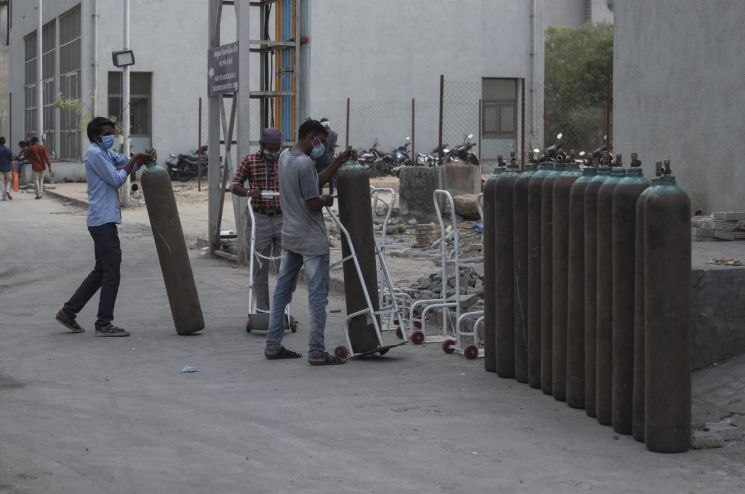
[Asia Economy reporters Hyunwoo Lee and Yoonju Hwang] As COVID-19 cases surge in India, where oxygen shortages are severe, the government has taken the drastic measure of redirecting oxygen used for essential industries to medical use, leading to the suspension of operations at steel and automobile factories. Korean companies operating in India are still running normally for now, but with the death toll surpassing 200,000 and the spread worsening, they are closely monitoring the situation. As the COVID-19 crisis in India reaches catastrophic levels, the United States has urgently announced plans to supply AstraZeneca (AZ) vaccines and oxygen.
According to the Nihon Keizai Shimbun on the 28th (local time), Toyota Motor announced that its plant in Karnataka, southern India, will be closed from the 26th of this month until the 14th of next month. Suzuki Motor also plans to suspend operations at its Gurugram and Manesar plants in India from the 1st to the 9th of next month.
According to the Hindustan Times, Navin Jindal, chairman of India’s largest steel company Jindal Steel and Power, tweeted on the same day, "We are supplying 200 to 300 tons of liquid oxygen daily to various state governments and hospitals," adding, "We will supply all liquid oxygen used in factories for medical purposes to overcome the oxygen shortage."
Earlier, on the 22nd, the Indian Ministry of Home Affairs issued an order restricting the use of industrial oxygen. Although the steel sector was classified as an essential industry and exempted from the restriction, the urgent situation appears to have led to the redirection of oxygen for medical use.
Korean companies operating in India have not yet experienced direct impacts such as work stoppages, but they remain tense as the local situation deteriorates rapidly. Currently, 263 Korean companies, including Samsung Electronics, Hyundai Motor, and POSCO, are operating in India.
Samsung Electronics, which operates the world’s largest mobile phone factory in Noida near New Delhi, recently advised its expatriates and their families to return home and is supporting round-trip airfare and self-quarantine costs for temporary returns.
Hyundai Motor and Kia, which operate production subsidiaries in Chennai and Anantapur and a sales subsidiary in Delhi, stated that all these production and sales subsidiaries are currently operating normally, with remote work being implemented as needed. Approximately 50 expatriates are currently stationed in India for Hyundai and Kia.
POSCO also reported that all office workers at its Indian subsidiary are working from home, and only 50% of the workforce is attending the Maharashtra production plant, but operations continue normally.
On the same day, the Indian Ministry of Health reported a new daily record of 360,960 COVID-19 cases. The daily death toll was also recorded at 3,293, pushing the cumulative death toll past 200,000 for the first time.
With a sharp increase in critically ill patients urgently needing medical oxygen, the demand for oxygen in India has already exceeded total production. According to the BBC, India’s daily liquefied oxygen production is about 7,500 tons, but current medical oxygen demand has surpassed 8,000 tons. Even if all 2,500 tons of oxygen allocated for essential industries were redirected to medical use, it would still be insufficient.
On the same day, the White House announced it would send $100 million worth of relief supplies to India, including 20 million doses of AZ vaccine, 1,000 oxygen cylinders, 15 million N95 masks, and 1 million rapid diagnostic tests.
© The Asia Business Daily(www.asiae.co.kr). All rights reserved.

















