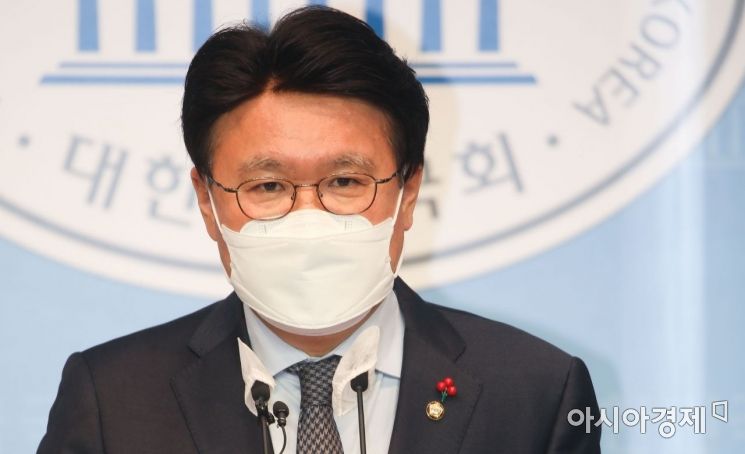
[Asia Economy Reporter Baek Kyunghwan] Hwang Unha, a member of the Democratic Party of Korea who caused controversy by being elected in the general election while holding an active police officer status, has been able to retain his position as a member of the National Assembly following a Supreme Court ruling.
On the 29th, the Supreme Court's First Division (Presiding Justice Kim Seonsu) dismissed the claim of former Future United Party (now People Power Party) lawmaker Lee Eun-kwon, who filed a lawsuit to invalidate Hwang's election as a member of the National Assembly.
In the April 15 general election last year, Hwang applied for resignation from the police agency to run for office, but it was not accepted because he was undergoing a criminal trial. According to the presidential decree 'Regulations on Handling of Public Officials' Misconduct Cases,' public officials under investigation or prosecution for misconduct cannot resign from their positions. Hwang was indicted in January last year on charges of interfering in the 2018 Ulsan mayoral election and was undergoing trial.
However, Hwang ultimately ran in the general election while maintaining his status as a police officer and was elected, defeating former lawmaker Lee. In response, Lee filed a lawsuit on May 18 last year, claiming, "The election of Police Commissioner Hwang Unha, who was nominated by a political party while holding an active police officer status, violates the National Public Officials Act and the Public Official Election Act and is therefore invalid."
Subsequently, the National Police Agency conditionally processed Hwang's resignation on May 29, one day before the National Assembly convened. This measure stipulates that if a guilty verdict is confirmed in the election interference case, the resignation will be nullified. The intention was to grant resignation to eliminate the possibility of violating the National Assembly Act's prohibition on holding concurrent positions, but if the Supreme Court confirms a guilty verdict, Hwang's police status will be restored and disciplinary action will be taken.
At the hearing held in December last year, Hwang's side argued that according to Article 53, Paragraph 4 of the Public Official Election Act, "If a resignation letter is submitted to the head of the affiliated institution, it is considered that the person has resigned from the position," and therefore the election is not invalid. In response, Lee's side argued that for public officials undergoing disciplinary action, the resignation letter cannot be immediately accepted.
However, on this day, the Supreme Court ruled, "If a resignation letter is submitted within the period specified in Article 53, Paragraph 1 of the Public Official Election Act, it is deemed that the person has resigned at the time of receipt of the resignation letter regardless of whether it is accepted or not, according to Article 53, Paragraph 4 of the same Act, and therefore the person can join a political party and register as a candidate to receive party nomination thereafter."
A Supreme Court official explained, "This is the first precedent regarding whether a public official who submitted a resignation letter to become a candidate in a public election but whose resignation was not accepted can join a political party and register as a candidate to receive party nomination."
Meanwhile, this election invalidation lawsuit is proceeding under the Supreme Court's single-instance system. Election lawsuits filed with the Supreme Court include election invalidation lawsuits due to allegations of election fraud and lawsuits to invalidate election results.
© The Asia Business Daily(www.asiae.co.kr). All rights reserved.
![Clutching a Stolen Dior Bag, Saying "I Hate Being Poor but Real"... The Grotesque Con of a "Human Knockoff" [Slate]](https://cwcontent.asiae.co.kr/asiaresize/183/2026021902243444107_1771435474.jpg)
















