Samsung Family's Unique Medical Contributions

[Asia Economy Reporter Kim Heung-soon] The family of the late Samsung Chairman Lee Kun-hee has decided to donate 700 billion KRW to overcome infectious diseases that threaten the lives and safety of the public. This move is being praised by the business and medical communities as the optimal choice to realize the late chairman’s lifelong philosophy of respecting humanity and contributing to human society. It concretizes his management philosophy, which emphasized corporate social responsibility and coexistence efforts, through the goal of eradicating infectious diseases.
Establishment of a Specialized Hospital Worth 500 Billion KRW
Contribution to Building Facilities for a National Research Institute
Expectations for a Dedicated Infectious Disease Control Tower
According to Samsung and business circles on the 29th, the family of Chairman Lee paid over 12 trillion KRW in inheritance tax on the shares and real estate left by the late chairman the day before, and simultaneously decided to donate 1 trillion KRW for medical contributions as a form of social return. Amid the global suffering caused by COVID-19, 700 billion KRW will be used to respond to infectious diseases, which have emerged as the greatest threat to humanity, and to build infrastructure to eradicate them. The remaining 300 billion KRW will be used to support children with pediatric cancer and rare diseases who cannot receive treatment due to economic burdens.
Notably, the family has shown exceptional interest and determination in overcoming infectious diseases. Infectious diseases have already emerged as a source of anxiety threatening future society. During the Severe Acute Respiratory Syndrome (SARS) outbreak in 2002-2003, more than 700 people worldwide lost their lives. The Middle East Respiratory Syndrome (MERS) outbreak in 2015 claimed over 800 lives, exceeding the SARS toll. The COVID-19 pandemic, ongoing for over a year since last year, has caused even greater damage. More than 3 million people have died worldwide, and as of this date, 1,825 deaths have been recorded in South Korea. Medical experts have warned that new infectious diseases will continue to emerge after COVID-19, with shorter cycles and greater impact.
Since the outbreak of COVID-19, the South Korean government and citizens have united to minimize damage compared to other countries. However, despite experiencing infectious disease crises such as SARS, MERS, and COVID-19, the infrastructure to respond remains inadequate. Most negative pressure rooms in medical institutions nationwide are temporary facilities using movable negative pressure devices or makeshift buildings. Since the MERS outbreak, voices within and outside the medical community have called for securing specialized infectious disease hospitals, but issues with funding and site acquisition have stalled progress for years. Concerns have also been raised that South Korea lags behind major countries in vaccine and treatment development and supply.
The family of Chairman Lee recognized these difficulties and agreed that building a system to overcome infectious diseases is the best way to honor the late chairman’s wishes. Of the 700 billion KRW donation, 500 billion KRW will be used to establish Korea’s first specialized infectious disease hospital, the ‘Central Infectious Disease Specialized Hospital.’ The hospital is planned to be a world-class facility with 150 beds equipped with advanced facilities such as general, intensive care, and high-level negative pressure rooms, negative pressure operating rooms, and biosafety laboratories. The remaining 200 billion KRW will support the establishment of a state-of-the-art research institute and necessary facilities under the National Infectious Disease Research Institute affiliated with the Korea Disease Control and Prevention Agency. This will be used for comprehensive research support for vaccine and treatment development.
The National Medical Center will finalize the utilization plan for the donation in consultation with related institutions. A National Medical Center official said, "The donation from Chairman Lee’s family will greatly aid in eradicating infectious diseases in the future," adding, "The specific use of the donation will be decided in consultation with the Ministry of Health and Welfare."
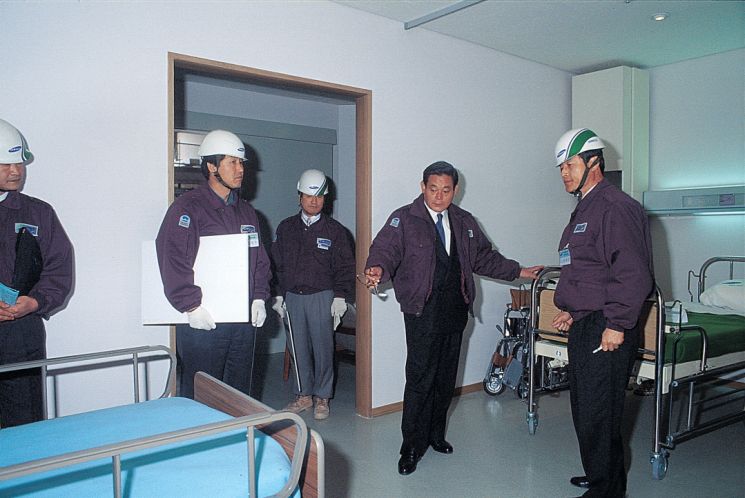 Late Chairman Lee Kun-hee of Samsung (second from the right) is inspecting the construction status of Samsung Seoul Hospital as part of his social contribution activities during his lifetime.
 [Photo by Samsung Electronics]
"Enhancing Human Health and Quality of Life Is a Corporate Mission"
Emphasis on Social Responsibility and Coexistence During His Lifetime
As the family decided to focus on infectious disease response, renewed attention is being paid to Chairman Lee’s exceptional interest in the medical field during his lifetime. In a Samsung executive meeting he presided over in 2010, he emphasized, "Enhancing human health and quality of life is the mission of a corporation."
When commemorating the establishment of Samsung Medical Center in 1994, he explained, "To realize a healthy society and welfare state, we established Samsung Medical Center as a warm-hearted company that shares with neighbors." He added, "When many people suffering from illness find joy here with healthy minds and bodies, Samsung will fulfill its role as a national company," and "We hope this place will be widely and beneficially used not just as a hospital but as a center for medical advancement and education." This statement remains prominently displayed at the entrance of Samsung Medical Center.
Additionally, during a domestic business trip in 2003, he remarked, "There are many cases where people cannot receive treatment or early cancer detection because they cannot afford it or do not undergo health checkups," and said, "If we each contribute a little money annually, wouldn’t we be able to save many people?" Based on this management philosophy of ‘respect for humanity’ and ‘contribution to human society,’ Samsung Medical Center was established, and in 2000, 30 billion KRW was donated to the Seoul National University Medical School Cancer Research Institute.
It is widely agreed within and outside Samsung that if Chairman Lee had continued his management activities, he would have focused on overcoming the MERS and COVID-19 crises as well. A business community official evaluated, "The family of Chairman Lee understood what he most wished for and donated to a field that is essential for the public."
© The Asia Business Daily(www.asiae.co.kr). All rights reserved.


















