'Korea's First Win-Win Regional Job Model, Gwangju Global Motors Completion Ceremony Held'
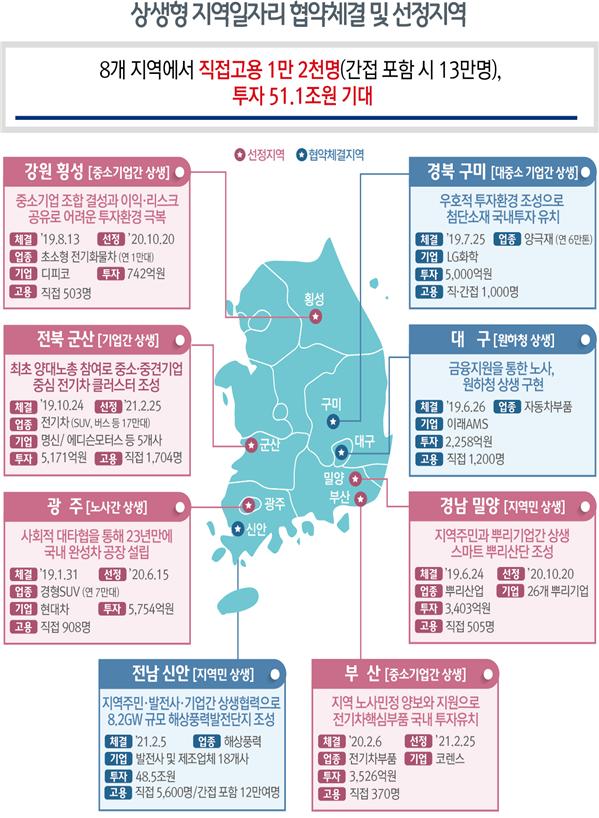
[Sejong=Asia Economy Reporter Joo Sang-don] On the 29th, the Gwangju Global Motors (GGM) factory in the Gwangju Bitgreen Industrial Complex was completed. As the first win-win regional job model, the 'Gwangju-type job' marks the opening of a new domestic finished car factory after 23 years. It is expected to create an actual investment of 575.4 billion KRW over three years and 908 regular jobs (11,000 indirect jobs).
According to the government on the day, a 'Korea's first win-win regional job, Gwangju Global Motors Completion Ceremony' was held at the GGM factory in the Gwangju Bitgreen Industrial Complex.
The Gwangju-type job was achieved by signing a win-win agreement on appropriate working conditions and mutual growth among local labor, management, civic groups, and government in January 2019, and despite difficulties such as the spread of COVID-19, the factory was completed in two years and three months.
This is the first domestic finished car factory completion in 23 years since the Samsung Motors Busan factory in 1998. A government official said, "The domestic completion of the finished car factory will enhance the competitiveness of the automobile industry and create jobs in the region, revitalizing Gwangju's economy," adding, "It is expected to greatly contribute to revitalizing the local economy along with enhancing the competitiveness of the automobile industry, which accounts for nearly half (49.2% in 2018) of Gwangju's manufacturing sales."
The GGM factory has secured equipment competitiveness by 100% domestic production of body and assembly facilities, and has cost competitiveness through smart factory operation management and process optimization. It plans to launch the country's first compact sports utility vehicle (SUV) in September this year. Additionally, it has established a flexible production line capable of switching to various models and responding to future vehicle transitions. In the future, it is expected to contribute to creating new growth engines in the region along with the establishment of an AI-based eco-friendly vehicle cluster in the Bitgreen Industrial Complex.
So far, after the Gwangju-type job agreement, the government has established institutional foundations such as the formulation of win-win regional job measures (February 2019), installation of the Win-win Regional Job Support Center (September 2019), and amendment of the Special Act on Balanced National Development (enforced April 2020). Accordingly, customized package support is provided according to regional conditions, including local investment promotion subsidies, tax benefits, improvement of living conditions, research and development (R&D) support, workforce training, and infrastructure construction for selected regions. So far, win-win agreements have been signed in a total of eight regions including Gwangju, Daegu, Gumi, and Gunsan, among which five regions including Gwangju, Miryang, and Hoengseong have been finally selected as win-win regional jobs.
© The Asia Business Daily(www.asiae.co.kr). All rights reserved.

















