Q1 Results... Among 180 Projects, 16 Have Budget Execution Below 10%
7 Projects with 0% Execution Rate
Government Focuses Only on Allocating Budgets to Execution Agencies
Actual On-Site Execution Progress Is Slow
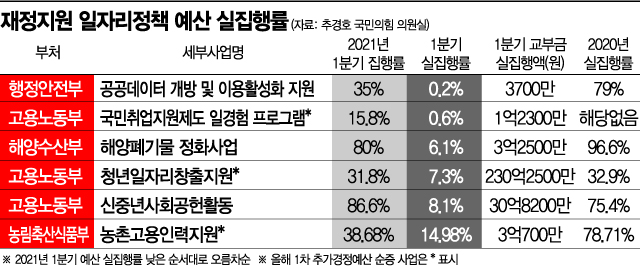
[Sejong=Asia Economy Reporter Moon Chaeseok] Although the government allocated nearly 3.16 trillion won in budget for direct job creation this year, the pace of execution at the frontline sites has been slow. Only about 1 out of 10 projects had an actual execution rate below 10%. This means that even if the government sends 1 million won in budget to executing agencies during the first quarter, frontline agencies spent less than 100,000 won. When on-site execution falls behind, the perceived impact of job creation inevitably diminishes.
On the 27th, the office of Choo Kyung-ho, a member of the People Power Party, compiled the progress status of financially supported job projects in the first quarter of this year from six ministries including the Ministry of Employment and Labor, Ministry of Oceans and Fisheries, and Ministry of Agriculture, Food and Rural Affairs. Among a total of 180 projects, 16 projects (8.9%) had an actual execution rate below 10%. Including projects in the 10% range, there were 24 projects (13.3%), and 7 projects (3.9%) had no progress at all with an actual execution rate of 0%. The actual execution rate refers to the proportion of the budget actually spent by frontline agencies. The average execution rate in the first quarter for the 16 projects with less than 10% actual execution was 73.6%, suggesting that the government focused more on sending budgets to executing agencies rather than on actual spending.
The Ministry of Employment and Labor’s Senior Social Contribution Activities project was allocated a budget of 43.826 billion won this year, with a first-quarter execution rate of 86.6%. However, the actual execution rate for this project was only 8.1%. The Ministry of Trade, Industry and Energy’s "Support for Overcoming Employment Crisis in the Automobile Industry" project reported full execution of its 1.44 billion won budget, but the actual execution rate was 0%.
Some projects with actual execution rates below 10% were also reflected in the supplementary budget passed by the National Assembly last month. The Ministry of Employment and Labor’s "National Employment Support System Work Experience Program," a newly introduced project this year where companies employ youth for three months before hiring them, had its budget increased by 84.4 billion won following the original 54.2 billion won. The first-quarter actual execution rate was only 7.3%. The Ministry explained that since support funds are given to companies only after confirming the employment retention period post-hiring, actual execution in the first quarter was difficult. A representative from the Korea Employment Development Institute, the operating agency, said, "The Ministry of Employment and Labor communicated registration procedures to each center and entrusted agencies in February, and information was transferred to our agency after mid-last month. Since personnel expenses are paid only after one month of employment, actual execution will likely occur next month at the earliest."
The Ministry of Agriculture, Food and Rural Affairs’ "Rural Employment Support" project had an actual execution rate below 100% last year but was increased by 7 billion won through the supplementary budget this year. The project’s first-quarter execution rate was 38.7%, but the actual execution rate was only 15.0%. This project matches jobs through employment agencies, and the ministry explained that actual matching occurs in June, making it difficult to spend the budget during the busy farming months of April and May. This raises concerns that proper execution may be difficult when rural labor is most needed. Choi Rak-jeong, director of the Rural Labor Brokerage Center at the Naju Agricultural and Fisheries Chamber of Commerce and Industry in Jeollanam-do, said, "During the busy farming season, we need to dispatch idle urban labor to farms, but if project funds are not released on time, it could disrupt transportation and support for farming tools. We are persuading farmers to first deploy labor and then execute the budget as soon as it is released."
This situation undermines the government’s emphasis on early budget execution. The government announced it would execute more than 70% of the total budget in the first half of the year, but complex procedures at the field level make actual execution difficult.
Experts call for measures to increase the actual execution rate. They suggest improving on-site difficulties and combining incentives and penalties, such as allocating less budget to projects with actual execution rates below 50%. Professor Park Ki-baek of the University of Seoul said, "If the reasons for low actual execution rates are not properly explained, the financial authorities should send a message that they can adjust budgets anytime, even for projects that are not carried over or unused."
© The Asia Business Daily(www.asiae.co.kr). All rights reserved.
![Clutching a Stolen Dior Bag, Saying "I Hate Being Poor but Real"... The Grotesque Con of a "Human Knockoff" [Slate]](https://cwcontent.asiae.co.kr/asiaresize/183/2026021902243444107_1771435474.jpg)
















