Seoul City District Unit Plan Released
Resident Opinions to Be Heard, Expected Confirmation in June
Anticipation Rises for Apgujeong and Yeouido Areas Delayed by Former Mayor Park Won-soon
However, Rising Housing Prices Pose Obstacle; Effectiveness of Land Transaction Permission System Is Key
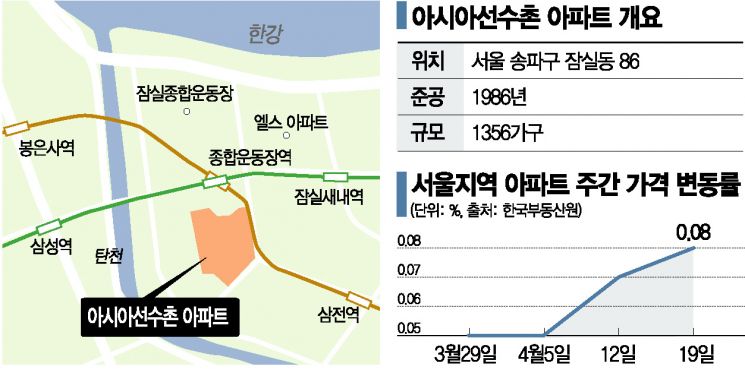
[Asia Economy Reporter Onyu Lim] The Seoul Metropolitan Government has unveiled the reconstruction blueprint for the Asia Athlete Village Apartments in Jamsil-dong, Songpa-gu. This move is being interpreted as Mayor Oh Se-hoon signaling the normalization of reconstruction projects, raising expectations for the previously stalled large-scale redevelopment areas in Apgujeong-dong, Gangnam-gu, and Yeouido-dong, Yeongdeungpo-gu. However, rising housing prices remain an obstacle. Depending on the effectiveness of the Land Transaction Permission System implemented in major reconstruction complexes, there is speculation that Mayor Oh may adjust the pace accordingly.
According to Seoul City on the 27th, the city is conducting a public review of the Asia Athlete Village district unit plan designation and the district unit plan decision draft until June 7. The district unit plan includes provisions for supplying sale and rental housing targeting newlyweds, the elderly, and youth, as well as the installation of open community facilities such as libraries. The city plans to finalize the district unit plan as early as June after collecting opinions from residents and related agencies and undergoing a supplementation process. Residents with opposing views can submit their opinions during the review period. A Seoul city official stated, "After the opinion collection process, the plan will be finalized through deliberation by the Urban Architecture Joint Committee."
The Asia Athlete Village was originally built in 1986 to house athletes and officials participating in the Seoul Asian Games and was later sold to the general public. It consists of a total of 1,356 households, mainly medium to large-sized units. It is located in a prime area near the Sports Complex Station, a transfer station for subway lines 2 and 9. Adjacent to Samsung-dong, Gangnam-gu, it is also considered the biggest beneficiary complex of Hyundai Motor’s Global Business Center (GBC). The complex passed the preliminary safety inspection for reconstruction in 2018 and is currently undergoing a detailed safety inspection. Once the district unit plan is established and the detailed safety inspection is passed, the reconstruction project can proceed in earnest.
The designation of the Asia Athlete Village district unit plan is interpreted as a signal that Mayor Oh has initiated the normalization of reconstruction. Consequently, expectations are rising for the large-scale reconstruction complexes in Apgujeong and Yeouido areas, where projects were effectively halted during former Mayor Park Won-soon’s administration. Many complexes in these areas have passed safety inspections and received approval for association establishment, so once Seoul City decides on the district unit plan, the projects are likely to accelerate. In Apgujeong, the district unit plan draft has been on hold for five years, and in Yeouido, the plan has been delayed due to the former mayor’s ‘Yeouido Master Plan’ being blocked by soaring housing prices.
However, rising housing prices driven by expectations of reconstruction activation remain a hurdle. According to the Korea Real Estate Board, the apartment sale prices in Seoul rose by 0.08% in the third week of April, increasing from 0.07% the previous week. Major reconstruction complexes such as Sanggye-dong in Nowon-gu, Apgujeong, and Yeouido led the price increases. Ultimately, the success or failure of reconstruction normalization is seen to hinge on whether the Land Transaction Permission System, effective from the 27th in Apgujeong, Yeouido, Seongsu-dong in Seongdong-gu, and Mok-dong in Yangcheon-gu, can curb the rise in housing prices.
When designated as a land transaction permission zone, homebuyers are required to reside in the property for two years after purchase, making gap investments?buying with a lease?impossible and likely reducing transactions. However, opinions differ on whether this trend will ease housing price increases. Jang Jae-hyun, head of Real Today, said, "Due to the strict permission requirements, transaction volumes will decrease, but as the reconstruction signal becomes clearer, prices may actually rise further."
© The Asia Business Daily(www.asiae.co.kr). All rights reserved.
![Clutching a Stolen Dior Bag, Saying "I Hate Being Poor but Real"... The Grotesque Con of a "Human Knockoff" [Slate]](https://cwcontent.asiae.co.kr/asiaresize/183/2026021902243444107_1771435474.jpg)
















