Semiconductor Supply Shortage Impact Intensifies from April
Concerns Grow Over Additional Factory Shutdowns in May
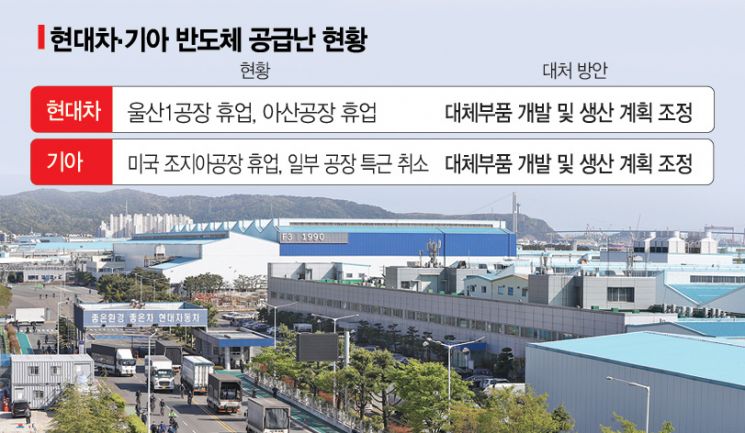
[Asia Economy Reporter Changhwan Lee] Hyundai Motor Group's semiconductor supply shortage is expected to reach its peak in May. The shortage of automotive semiconductors continues, and since it is difficult to find alternative solutions, the factory shutdowns that occurred on some production lines this month are showing signs of further spreading.
Hyundai Motor stated during the Q1 earnings conference call held on the 22nd that the shortage of automotive semiconductors is likely to be prolonged.
Suh Kanghyun, Vice President of Hyundai Motor (Head of Finance Division), explained, "As of April, shutdowns lasting several days have occurred at domestic plants in Ulsan and Asan, as well as some overseas plants due to semiconductor shortages. With the rapid recovery of automobile demand, semiconductor parts are being depleted early, and external factors such as the Texas cold wave and the fire in Renesas' cleanroom in Japan are causing the semiconductor supply difficulties to last longer than expected."
Despite the global semiconductor shortage, Hyundai Motor had managed to avoid factory shutdowns or large-scale production adjustments until Q1. However, as the damage became more serious this month, major plants have been temporarily closed. Since the 7th, Ulsan Plant 1 has been shut down for about a week, and Asan Plant also halted operations on the 12th-13th and 19th-20th. Ulsan Plant 1 produces the Ioniq 5, and Asan Plant is a key plant producing the Grandeur and Sonata, so there are concerns about significant damage due to production cuts.
Kia is also experiencing damage due to the semiconductor supply shortage. Kia's Georgia plant in the U.S. temporarily stopped operations earlier this month due to semiconductor shortages, and domestically, weekend overtime work at major plants such as Gwangmyeong and Gwangju has been suspended.
The problem is that this situation is difficult to resolve in the short term. Vice President Suh said, "Since the semiconductor supply situation is rapidly changing, it is difficult to predict production conditions after May," but added, "We are preparing for the possibility of production adjustments in May at levels similar to or greater than those in April."
Growing Concerns Over Factory Shutdowns in May
The automotive industry expects that Hyundai Motor's factory shutdowns are likely to continue in May.
Hyundai Motor is currently coping by prioritizing semiconductor parts allocation to popular models with long waiting periods or by reducing hourly production volume, but since semiconductor inventory is limited, it is judged that such measures cannot be sustained. Although efforts are being made to increase parts supply through the development of alternative semiconductor components, this also has its limits.
Kia's situation is similar. Joo Woojung, Vice President of Kia (Head of Finance Division), said, "May seems to be the most difficult time for the semiconductor supply issue. Until April, we responded with existing stockpiles, but now they are running low, and no one can accurately predict the extent of the shortage."
However, the situation is expected to improve from June. There are also forecasts that recovery will be possible in Q3. Vice President Joo emphasized, "Through the effect of new models, the backlog demand can be sufficiently recovered afterward. In the long term, there should be no significant impact."
The financial investment sector also views that since the shortage is on the supply side while demand remains strong, if the semiconductor situation improves in Q3, concerns about performance will disappear. Yongjin Jung, a researcher at Shinhan Financial Investment, predicted, "Production cuts due to semiconductor shortages in Q2 are unavoidable, but the sales decline in the first half will be deferred to new car demand in the second half."
© The Asia Business Daily(www.asiae.co.kr). All rights reserved.
![Clutching a Stolen Dior Bag, Saying "I Hate Being Poor but Real"... The Grotesque Con of a "Human Knockoff" [Slate]](https://cwcontent.asiae.co.kr/asiaresize/183/2026021902243444107_1771435474.jpg)
















