US 52%, EU 55%, Japan 46%...Major Countries' Reduction Efforts
"US Must Stop All Coal Power...Concerns Over Major Disruptions Raised
Korea Should Present Additional Increased Targets...Challenges Due to Overlapping Nuclear Phase-Out Policy
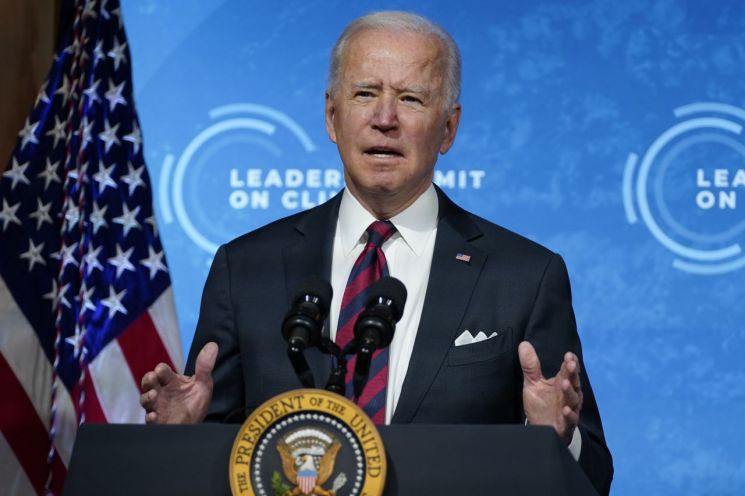
[Asia Economy Reporters Jusangdon and Hyunwoo Lee] At the ‘Climate Change Summit’ hosted by U.S. President Joe Biden, the United States declared it would reduce greenhouse gas emissions by more than half by 2030, prompting major countries to competitively present stronger reduction targets than before. As various new environmental regulations and carbon taxes are expected to follow, a major upheaval in the global industry is inevitable. South Korean President Moon Jae-in also plans to present a new reduction target to the international community by the end of the year, which is expected to spark controversy.
◆Competitive Increase in Carbon Reduction Targets
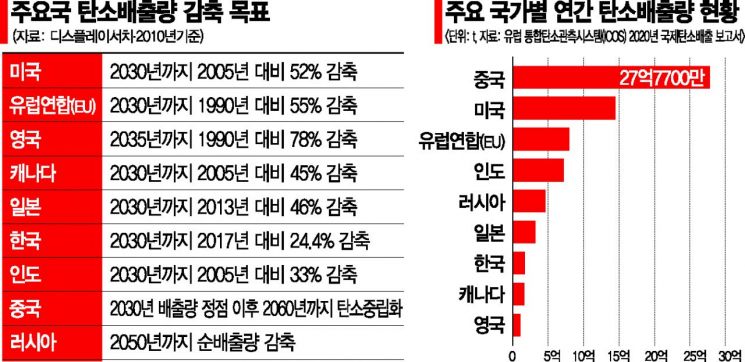
On the 22nd (local time), President Biden announced at the climate change summit held via video conference with leaders from 40 major countries, "The United States will reduce greenhouse gas emissions by 50-52% compared to 2005 levels by 2030," presenting a strengthened reduction target. This is nearly double the 26-28% reduction level proposed by the Barack Obama administration during the 2015 Paris Climate Agreement.
Major U.S. allies also simultaneously raised their reduction targets. The European Union (EU), which had previously proposed a 40% reduction compared to 1990, raised its target to 55%. The United Kingdom, which had announced a 68% reduction compared to 1990 last year, increased it by 10 percentage points to 78%. Japan also sharply raised its reduction target from 26% compared to 2013 to 46%.
In contrast, China and Russia, while stating they would align with the U.S. and major developed countries' increased reduction targets, did not specify concrete figures and emphasized the responsibility of developed countries. Chinese President Xi Jinping, who participated in the summit, emphasized, "China will achieve carbon neutrality by 2060, reducing carbon emissions to zero," and added, "Historically, developed countries with large carbon emissions must take differentiated responsibility by helping developing countries transition to low carbon." Russian President Vladimir Putin also said, "We will reduce net emissions by 2050," but did not disclose specific targets.
◆Possible Only if All U.S. Coal Power Plants Stop...Industry Faces Great Confusion
As the U.S. and other major developed countries suddenly announced significant increases in environmental regulations, confusion is expected in the industries of each country. According to The New York Times (NYT), experts in the U.S. warn that achieving the increased reduction targets will require a major transformation of the national industry, and pushing forward as is could cause great confusion.
In fact, a study released by the Global Sustainability Center at the University of Maryland states that to reduce greenhouse gas emissions in the U.S. by more than half by 2030, the following must be achieved within 10 years: ▲convert heating in all new buildings in the U.S. to electric ▲close all approximately 200 coal-fired power plants ▲increase the share of eco-friendly energy such as wind and solar power from the current 25% to 50% ▲reduce emissions from cement, steel, and chemical companies by up to 60%. Dr. Nathan Hartman, who led the study, criticized, "Achieving even one of these goals in a short period is impossible," adding, "The entire U.S. power grid and transportation network must undergo tremendous changes, but the government has not presented concrete plans."
Japan, which has a similar industrial structure to South Korea, is also closely monitoring the situation. The Nihon Keizai Shimbun pointed out, "Since the Great East Japan Earthquake in 2011, the share of nuclear power in Japan is only about 6%, while coal-fired power accounts for 70%," and added, "Steel companies are expected to spend 4 to 5 trillion yen to establish new manufacturing methods to reduce emissions, but the government's decarbonization policy fund is expected to be around 2 trillion yen."
◆Additional Increase in South Korea Inevitable...Role of Nuclear Power Likely to Emerge

South Korea, which must present a new reduction target by the second half of the year, is facing deep concerns. The government set a goal last year to reduce greenhouse gases by 24.4% compared to 2017 by 2030, but with the U.S. and major allies significantly raising their targets, an additional increase has become inevitable. In particular, it is pointed out that it will be difficult to raise carbon reduction targets while maintaining the policy direction of phasing out nuclear power.
An official from the Ministry of Environment stated, "Since raising the reduction target directly affects all areas of the national economy, including industrial competitiveness and power supply and demand, the additional increase level will be determined after sufficient review." The government plans to minimize the burden on industry by establishing a climate response fund from 2022 to support fair transitions such as ▲corporate decarbonization through reduction facilities and research and development (R&D) ▲replacement of stranded industries and business conversion to promising sectors.
© The Asia Business Daily(www.asiae.co.kr). All rights reserved.



















