Convenience Store Makgeolli Prices Increasing One After Another
[Asia Economy Reporter Lim Hye-seon] "Makgeolli deliveries have been delayed since this month."
An employee at a makgeolli specialty store located on the B1 floor of the Shinsegae Department Store main branch in Jung-gu, Seoul, said, "The number of people looking for makgeolli has increased, but the supply is lower than usual." On that day, only 2 to 3 products, including Boksundoga hand-made makgeolli, were displayed in the store. Originally, this store sold more than 10 types of makgeolli such as Haechang, Neurin Maeul, and Dameun, but before the price increase, suppliers reduced their supply, leaving many shelves empty.
Makgeolli Prices Increase by Up to 35%
On the 23rd, makgeolli manufacturers raised prices due to a surge in raw material costs caused by rice shortages. According to the convenience store industry, starting next month on the 1st, makgeolli prices at convenience stores will increase by up to 35%. Fresh rice makgeolli will rise from 1,700 won to 2,300 won, a 35.2% increase. Idong Jujyo 1957 Idong Saeng Makgeolli will change from 1,700 won to 2,100 won, and Incheon Takju’s Soseongju Saeng Makgeolli will increase from 1,300 won to 1,500 won. Seoul Saeng sterilized makgeolli will go from 1,400 won to 1,600 won, and Busan Hapdong Brewery’s Saengtak makgeolli will rise from 1,500 won to 1,800 won.
Seoul Jangsu Makgeolli, which accounts for more than 50% of the domestic makgeolli market, raised the ex-factory price of fresh makgeolli by 120 won for the first time in 15 years. Seoul Jangsu Makgeolli stated, "We decided to raise prices due to increases in rice prices, packaging materials, and distribution costs." Major companies such as Kooksoondang are also expected to raise prices consecutively, with increases expected to be at least 10%. Local small and medium-sized makgeolli companies are also raising prices, making a domino effect of price hikes a reality.
A representative from the Korea Makgeolli Association said, "We are procuring government stockpiled rice at prices 15% higher than in 2019, and regular rice prices have risen by 30%. Box packaging material prices have also increased by 30%, and liquor tax has risen by 0.02% due to inflation adjustment policies, so companies have no choice but to raise prices."
Not only makgeolli but also rice-processed foods are raising prices. CJ CheilJedang raised the price of Hetbahn by 100 won (6-7%) last month for the first time in two years. The price of the representative product, white rice Hetbahn, increased from 1,600 won to 1,700 won. Dongwon and Ottogi also decided to raise the prices of instant rice. Dongwon F&B’s Sen Cook increased from 1,350 won to 1,500 won last month, an 11% increase. Ottogi also raised the price of Ottogi rice by about 7%.
Government Stockpiled Rice Used to Stabilize Rice Prices
The sharp rise in prices of makgeolli and rice-processed foods is due to the government releasing stockpiled rice to stabilize prices amid soaring rice costs. According to the industry, the amount of government stockpiled rice used as raw material for makgeolli has decreased by about 60% compared to the previous year. The shortage of raw materials has made production difficult. Companies are producing makgeolli by substituting the insufficient raw materials with expensive regular rice. Purchasing rice at prices more than three times higher than government stockpiled rice has increased production costs. Due to the cost burden, companies plan to raise prices starting next month.
A representative from the Korea Makgeolli Association explained, "Not only makgeolli but also processing companies that make food and alcoholic beverages from rice are struggling because they cannot receive stockpiled rice supplies," adding, "They are producing makgeolli with market rice to meet market demand." He continued, "The number of people seeking makgeolli is increasing, bringing vitality to the makgeolli market after a long time, but it is unfortunate that supply cannot keep up."
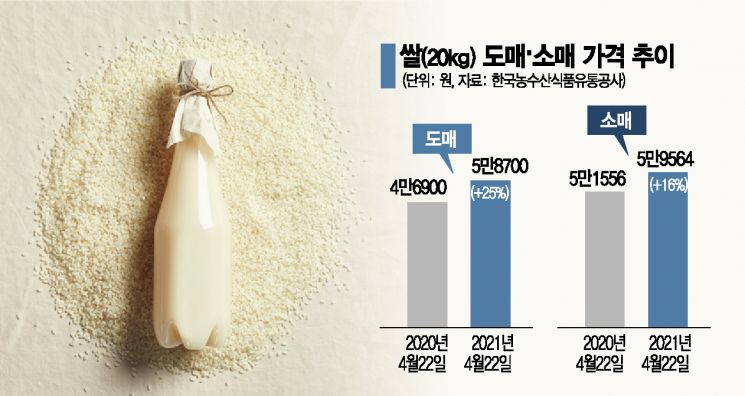
Rice prices continue to soar. Even though the government is releasing government grain stocks, prices are not stabilizing. According to the Korea Agro-Fisheries & Food Trade Corporation (aT), as of the 22nd, the wholesale price of rice was 58,700 won, a 25% increase from 46,900 won a year ago. Compared to the average price over the past five years, it is 37% higher. The prolonged rainy season last summer led to poor rice harvests, and increased domestic consumption demand is cited as the cause of the rice price surge. The government released 370,000 tons of rice into the market this year due to supply instability caused by decreased rice production.
© The Asia Business Daily(www.asiae.co.kr). All rights reserved.

















