No Balcony Provided as Service Area
Exclusive Area and Sale Area Standards Differ
Industry Says "84㎡ Office-tel Comparable to 59㎡ Apartment"
[Asia Economy Reporter Ryu Tae-min] #Office worker A visited a model house to purchase a residential officetel unit but found it puzzling. Despite having the same exclusive area of 84㎡, the internal space felt smaller than the apartment he currently rents.
Recently, residential officetels, commonly called ‘Apatel (Apartment + Officetel),’ have been recording high subscription competition rates, rivaling the popularity of apartments. They are especially popular among young people with limited funds due to looser loan regulations, and the increase in mid-sized officetels with two- or three-room layouts has led to growing demand as apartment alternatives.
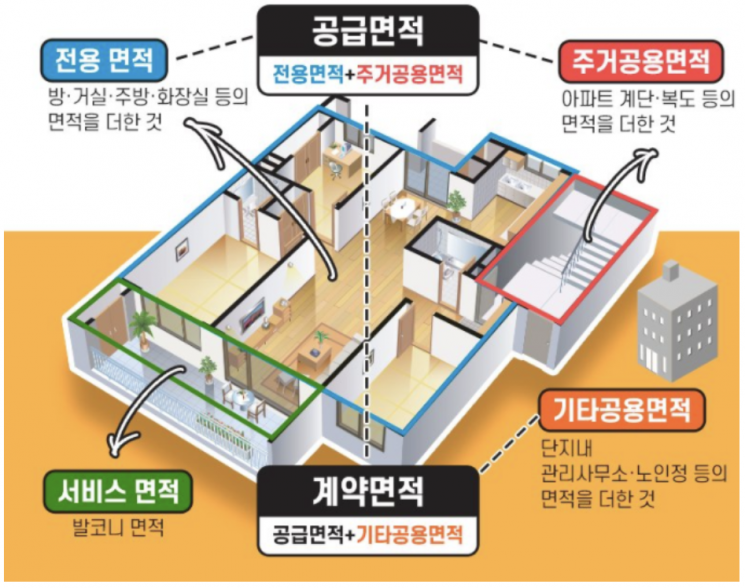
However, experts point out that even with the same exclusive area, there can be differences in the actual usable space between officetels and apartments. This is mainly because balconies, which are provided as service areas not included in the exclusive area, are rarely available in officetels. In apartments, the actual usable area provided through balcony extensions can range from as little as 25㎡ to as much as 40㎡.
Different Standards for Exclusive Area and Sale Area
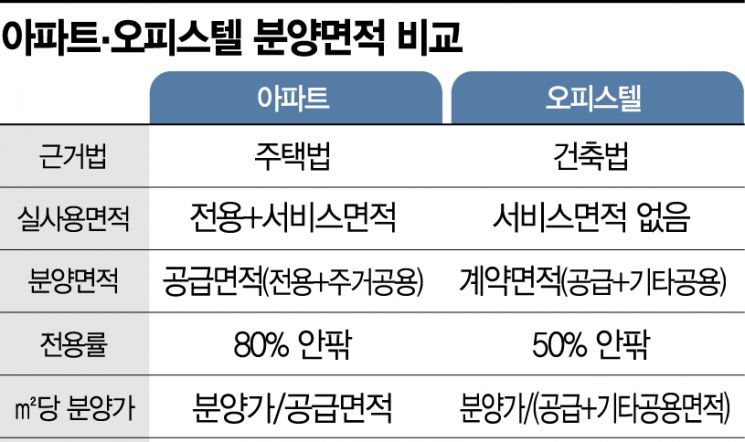
The criteria for measuring exclusive area also vary. For officetels that received building permits before April 30, 2015, the exclusive area was calculated based on the centerline of the walls (wall thickness). This means the actual usable area is reduced by half the thickness of the walls. This difference arises because apartments are governed by the Housing Act, while officetels fall under the Building Act. However, for officetels permitted after April 30, 2015, the exclusive area is calculated using the inner wall line (clear dimension), similar to apartments.
It is also important to note that the standards for sale area differ. Apartments display the supply area as the sale area, while officetels use the contract area. The supply area is the sum of the exclusive area (rooms, living room, kitchen) and residential common areas such as stairs and corridors. In contrast, the contract area includes the supply area plus other common areas like basements and management offices. This is why the exclusive area ratio of officetels is around 50%, lower than the approximately 80% typical for apartments.
Industry insiders generally consider that, for these various reasons, the actual usable area of a 59㎡ exclusive apartment (with balcony extension) is similar to that of an 84㎡ exclusive officetel.
The method of calculating the sale price per square meter also differs. For apartments, the price per ㎡ is the total sale price divided by the supply area (exclusive + residential common area). For officetels, the price per ㎡ is calculated by dividing the total sale price by the sum of the supply area and other common areas, making it appear cheaper on the surface.
Yoon Ji-hae, Senior Researcher at Real Estate 114, said, "In addition, officetels have higher maintenance fees and faster depreciation compared to apartments, among other differences. When purchasing an officetel for residential use, these aspects should be carefully considered."
© The Asia Business Daily(www.asiae.co.kr). All rights reserved.


















