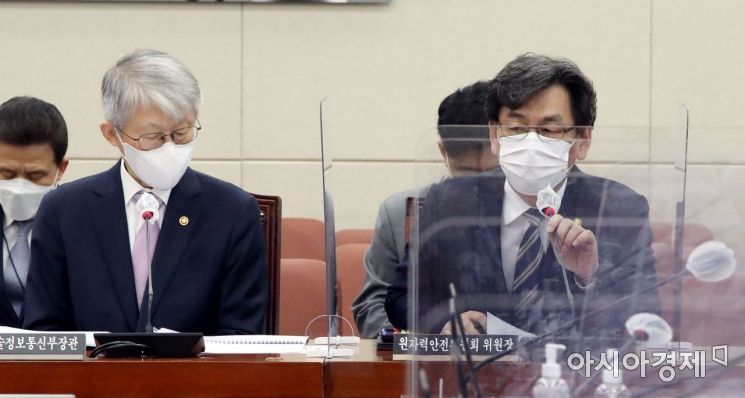
 Eom Jae-sik, Chairman of the Nuclear Safety and Security Commission, is attending the full meeting of the Science, ICT, Broadcasting and Communications Committee held at the National Assembly on the 26th, responding to questions from lawmakers. Photo by Yoon Dong-joo doso7@
[Asia Economy Reporter Kim Bong-su] At the National Assembly Science, Technology, Information and Communication Committee meeting held on the 22nd, severe criticism was directed at the Nuclear Safety and Security Commission regarding the discharge of contaminated water from the Fukushima nuclear power plant in Japan.
Kim Young-sik, a member of the People Power Party, criticized Chairman Eom Jae-sik of the Nuclear Safety and Security Commission during the afternoon plenary session of the committee, saying, "Upon reviewing what the Commission has done, it appeared passive rather than proactive," and added, "Our country is not playing a proper role in this international issue. I believe the government has nothing to say about what role it played in the discharge decision process." Another member of the same party, Jeong Hee-yong, also criticized, "Japan began considering the discharge of contaminated water in October 2018, but after two and a half years, what has our government been doing to respond appropriately?"
This was a critique of the government's joint task force report released in October last year, which stated that "if the Japanese government discharges contaminated water below the standard levels, there is scientifically no safety problem," while the government is now opposing the actual decision to discharge. He criticized, "Although the Nuclear Safety and Security Commission held seven expert meetings, they say it is not the official position of the Prime Minister's Office. The public distrusts the idea of responding only after the discharge."
Ruling party lawmakers also joined the criticism. Kim Sang-hee of the Democratic Party of Korea said, "During last year's audit, we requested proper international cooperation to minimize harm to the public, but I do not know what has been done so far," and added, "I am not aware of any visible achievements or activities." Lawmaker Han Jun-ho also urged a change in attitude, saying, "The Nuclear Safety and Security Commission should be taking the lead, but it is acting as a commentator."
In response, Chairman Eom explained, "We have not been unresponsive to the discharge plan; we have established a principled stance and are continuously responding." Regarding the actual risk of the contaminated water, he said, "It will only be possible to assess once Japan's detailed discharge plan is finalized," but added, "If it is discharged, we have no choice but to say it is not safe."
Regarding the expert task force's conclusion, he explained, "I fully agree that it is not the government's position. The experts only evaluated the impact assuming that all procedures and methods claimed by Japan are complied with." Chairman Eom also stated, "Once Tokyo Electric Power Company submits the disposal plan and Japanese regulatory authorities review and approve it, we will monitor the procedural process and check whether it is proceeding according to standards," and added, "We will participate in verification activities through the International Atomic Energy Agency (IAEA) and initiate bilateral efforts where possible."
© The Asia Business Daily(www.asiae.co.kr). All rights reserved.
![Clutching a Stolen Dior Bag, Saying "I Hate Being Poor but Real"... The Grotesque Con of a "Human Knockoff" [Slate]](https://cwcontent.asiae.co.kr/asiaresize/183/2026021902243444107_1771435474.jpg)
















