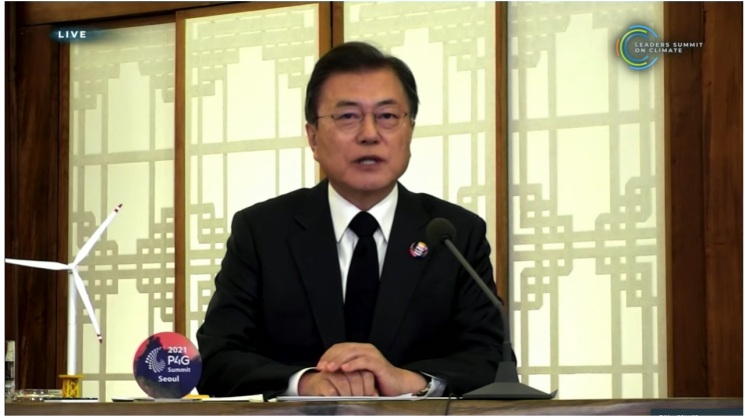
[Asia Economy Reporter Lee Ji-eun] The Blue House evaluated that President Moon Jae-in's participation in the Climate Summit would solidify South Korea's position as a leading country in international climate response while also positively influencing the expansion of the Korea-US alliance. In his speech at the Climate Summit, President Moon announced plans to expand support for renewable energy instead of overseas coal power plants.
President Moon, invited by US President Biden, pledged strengthened climate action to achieve '2050 Carbon Neutrality' during the first session of the Climate Summit held on the 22nd.
First, South Korea will further raise its 2030 Nationally Determined Contribution (NDC) and submit it to the UN this year. South Korea submitted an NDC last December aiming to reduce greenhouse gas emissions by 24.4% compared to 2017 levels by 2030, and plans to raise this target further.
This is based on the recognition that more countries need to enhance their NDCs to achieve the global temperature rise limitation goals. According to a recently released NDC report, the 48 NDCs submitted last year fall significantly short of the reduction levels required to meet the Paris Agreement targets.
Accordingly, the government will analyze domestic conditions, conduct social discussions and reach consensus to prepare an NDC enhancement plan within the year. For industries that may face difficulties due to greenhouse gas reductions, support for low-carbon transition will be provided through increased funding.
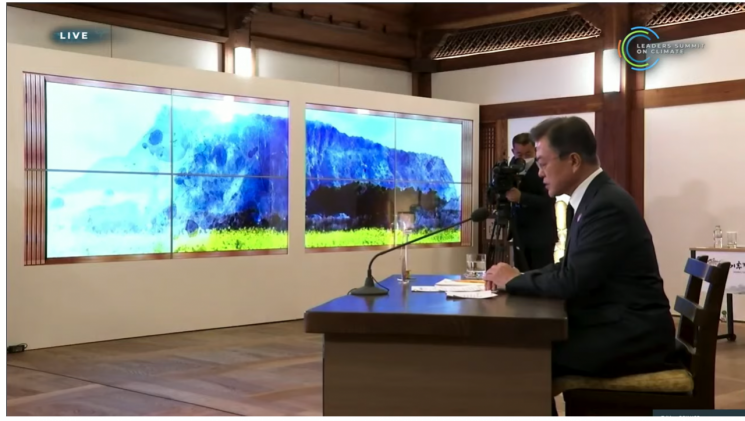
Additionally, President Moon declared that public financial support for new overseas coal power plants will be halted, and permits for additional new domestic coal power plants will be banned. This declaration to stop public financial support applies to newly pursued overseas coal power projects and directly concerns policy financial institutions such as the Export-Import Bank, Korea Trade Insurance Corporation, and the Korea Development Bank.
The government plans to use this opportunity to expand support for renewable energy technology development. By the first half of this year, a 2050 carbon neutrality scenario will be established, and based on this, sector-specific strategies will be prepared by the end of the year. Efforts to increase research and development, technology sharing, corporate investment and support for green technology development, renewable energy expansion, and energy efficiency improvements will also be intensified. Furthermore, conditions will be created to allow private financial companies to voluntarily spread the movement away from coal in the future.
President Moon emphasized that achieving 2050 carbon neutrality is a task that cannot be accomplished by any single country alone and stressed international solidarity and cooperation. In this regard, he stated that the '2021 Seoul P4G (Partnership for Green Growth and the Global Goals 2030)' Summit, hosted by South Korea next month, will serve as a catalyst for promoting international carbon neutrality solidarity. He urged all countries to pay attention and participate so that the Climate Summit and the P4G Summit can serve as stepping stones for the successful 26th UN Climate Change Conference of the Parties (COP26) to be held this November.
© The Asia Business Daily(www.asiae.co.kr). All rights reserved.


















