Suspected Vascular Malformation, Not Rare Thrombosis
"Initially Reported as General Case, Later Changed to Severe"
Medical Expense Support to Be Prioritized Through Existing Welfare System for Paralyzed 40s Nursing Assistant
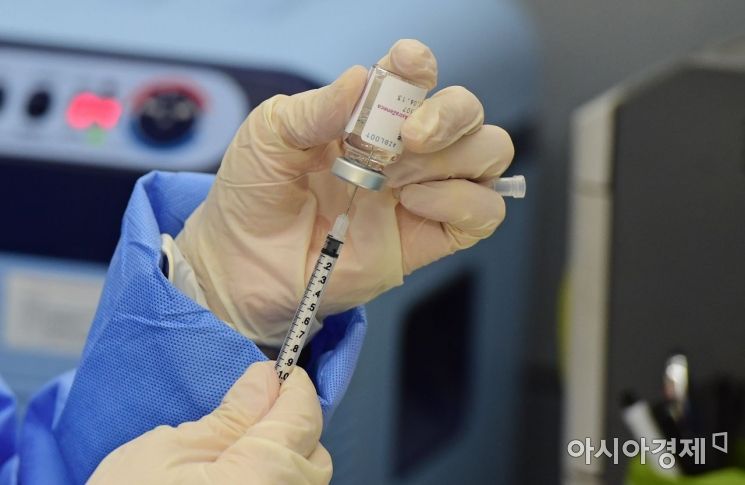 On the 26th, when the vaccination for the novel coronavirus infection (COVID-19) began, medical staff at the Dobong-gu Public Health Center in Seoul were filling syringes with the AstraZeneca (AZ) vaccine. Photo by Hyunmin Kim kimhyun81@
[Asia Economy Reporter Kim Ji-hee] In Hadong-gun, Gyeongnam Province, a public official in their 20s showed symptoms of cerebral hemorrhage after receiving the AstraZeneca (AZ) vaccine. Health authorities stated that this case is far from the rare thrombosis recognized as a side effect by the European Medicines Agency (EMA).
On the 22nd, Park Young-jun, head of the Adverse Reaction Investigation Support Team at the COVID-19 Vaccination Response Task Force, said at the regular COVID-19 briefing, "The presumed diagnosis is based on clinical opinions and symptoms judged by the medical institution, and it seems to be cerebral hemorrhage or a vascular abnormality in the brain, which could also be called a 'vascular malformation.' Currently, it is understood to be a case somewhat distant from thrombosis accompanied by thrombocytopenia, which is being closely monitored."
However, he added, "The diagnosis may change depending on additional hospital tests," and "Further investigations will be conducted, and after confirming the diagnosis, causality assessment will proceed according to the system and procedures."
The public official in their 20s, Mr. A, received the AZ vaccine at a public health center on the 16th of last month. Three weeks after vaccination, on the 9th of this month, he was treated at a local medical institution for headaches and right-side paralysis symptoms. Mr. A is currently recovering after surgery.
Park said, "The system for classifying reported cases includes general reports, severe reports, and death reports. Depending on the condition at the time of reporting, cases requiring intensive care unit hospitalization or accompanied by disability, or life-threatening conditions are reported as severe, while others are reported as general based on symptoms at the time of reporting." He added, "Initially, cases reported as general due to symptoms like headache or paralysis may be changed to severe if the condition worsens. Therefore, it can be understood that the case was initially counted as general but later changed to severe."
Meanwhile, authorities previously announced plans to provide support for a nurse assistant in her 40s who showed limb paralysis symptoms after receiving the same AZ vaccine. Bae Gyeong-taek, head of the Situation General Team at the Task Force, said, "Officials from the Ministry of Health and Welfare, the Korea Disease Control and Prevention Agency, and local governments will meet directly with the patient and her guardian to offer condolences and discuss support measures." He added, "Considering that the review for compensation after vaccination takes time, for this case, we will first link existing welfare systems to ensure medical expenses are supported."
Authorities plan to establish and implement a personalized support system by designating dedicated personnel in local governments if similar severe adverse reaction reports occur in the future. They also plan to match patients and local governments with a dedicated officer on a one-to-one basis to guide and manage the entire process from adverse reaction reporting to compensation.
© The Asia Business Daily(www.asiae.co.kr). All rights reserved.

















