Weekly Apartment Price Trends by Korea Real Estate Board
Expansion for 2 Consecutive Weeks After Mayor Oh Se-hoon's Election
Market Stirring Despite Housing Supply Expansion Policy
Reconstruction Prices Rising on Deregulation Expectations
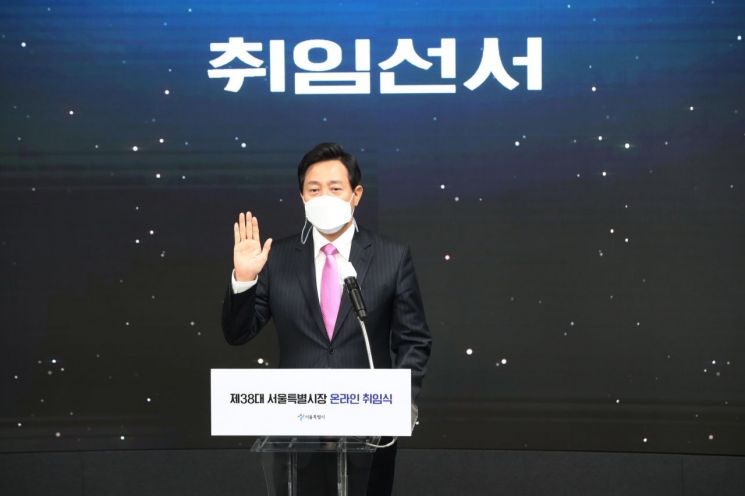 Seoul Mayor Oh Se-hoon is taking the oath of office at the online inauguration ceremony held at Dongdaemun Design Plaza in Dongdaemun-gu, Seoul, on the morning of the 22nd.
 [Image source=Yonhap News]
[Asia Economy Reporter Moon Jiwon] The rise in Seoul apartment prices expanded again this week following last week. Despite the government's policy to increase housing supply, the expectation that regulations might be eased after the inauguration of Seoul Mayor Oh Se-hoon has spread, creating an atmosphere where the upward trend in housing prices is intensifying every week.
According to the 'National Weekly Apartment Price Trends' for the third week of April released by the Korea Real Estate Board on the 22nd, as of the 19th, apartment prices in Seoul rose by 0.08%, an increase from the previous week's 0.07%.
The rate of increase in Seoul apartment prices shrank from 0.10% in the first week of February to 0.05% in the first week of this month, but rebounded to 0.07% last week and further increased to 0.08% this week.
Although the market seemed to be stabilizing after the government announced the 2·4 measures to supply about 830,000 households nationwide, housing prices have been rising again since Mayor Oh, who pledged to ease real estate regulations, was elected in the Seoul mayoral by-election on the 7th.
The Korea Real Estate Board analyzed, "Amid growing expectations of deregulation, buying demand increased mainly in areas with development prospects in northern Seoul and in reconstruction complexes in the three Gangnam districts, expanding the overall rise in Seoul."
In Seoul, apartment prices in Nowon-gu (0.17%), where reconstruction expectations have grown, recorded the highest increase again this week following last week. In Gangnam-gu (0.14%), where major reconstruction complexes are concentrated, apartment prices rose significantly mainly in Apgujeong-dong reconstruction and Gaepo-dong, while Songpa-gu (0.13%) saw increases centered on Jamsil and Bangi-dong reconstruction, and Seocho-gu (0.13%) rose mainly around Jamwon and Bangbae-dong reconstruction.
Additionally, Yangcheon-gu (0.08%) continued its upward trend mainly due to the reconstruction of the Mokdong new town, and Mapo-gu (0.08%) saw apartment prices rise mainly around Seongsan-dong reconstruction.
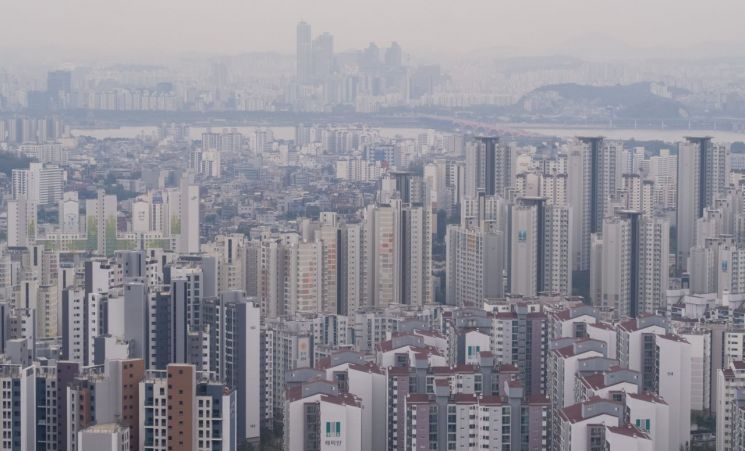
However, this survey was conducted from the 13th to the 19th, so the effects of the pre-sale volume confirmation announced the previous day and the designation of Seoul land transaction permission zones were not reflected.
The Ministry of Land, Infrastructure and Transport announced the final confirmation of 30,200 pre-sale units in the metropolitan area, including the 3rd new towns, the day before. Accordingly, pre-sales will be conducted four times from July to December in major metropolitan areas such as Incheon Gyeyang, Hanam Gyosan (3rd new towns), and Seongnam and Gwacheon.
Also, as the housing market showed signs of excitement in areas with concentrated reconstruction complexes, Mayor Oh held an emergency briefing the previous afternoon and announced that the Apgujeong Apartment District, Yeouido Apartment District and nearby complexes, Mokdong Land Development Project District, and Seongsu Strategic Maintenance District will be designated as land transaction permission zones for one year.
In Incheon, the apartment price increase rate expanded from 0.39% last week to 0.51% this week. Yeonsu-gu (0.65%), Seo-gu (0.65%), and Michuhol-gu (0.46%) all saw increased buying demand, resulting in a larger rise compared to last week.
Gyeonggi-do rose by 0.32%, the same as last week. Siheung-si (1.08%), which saw a significant price increase after being designated as a 3rd new town, continued to rise mainly in mid-to-low priced older complexes due to ongoing expectations of transportation improvements, and Ansan-si (0.80%) and Uiwang-si (0.76%) also maintained upward trends.
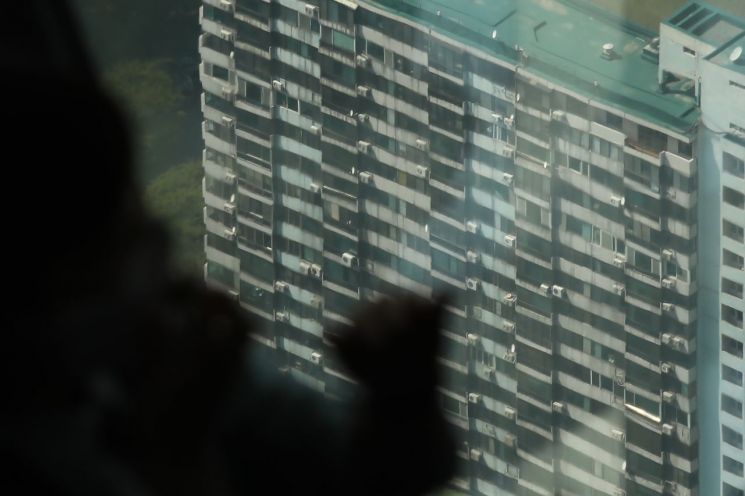 Apartment complexes under reconstruction viewed from the Lotte World Tower Observatory in Songpa-gu, Seoul [Image source=Yonhap News]
The apartment jeonse (long-term lease) market showed a generally similar pattern to the previous week. Nationwide apartment jeonse prices rose by 0.14%, slightly up from 0.13% the previous week, but Seoul remained unchanged at 0.03%.
Nowon-gu (0.11%), where the price increase was significant, also saw jeonse prices rise considerably, mainly in mid-to-low priced complexes in Junggye and Gongneung-dong. Seongdong-gu (0.07%) also rose mainly in station-area complexes.
However, Mapo-gu (0.00%) showed mixed trends and turned stable, and Seocho and Songpa-gu (0.01%) saw slight increases in areas with good living conditions but generally remained stable. Gangnam-gu (0.00%) also remained stable, while Gangdong-gu (-0.02%) continued to decline as listings accumulated in most complexes. Yangcheon-gu (-0.01%) also maintained a downward trend due to the impact of new housing supply.
In Incheon, the jeonse price increase rate expanded from 0.31% to 0.38%. Seo-gu (0.63%) rose mainly in the well-connected Geomdan New Town and Gajeong-dong station areas, and Bupyeong-gu (0.38%) and Gyeyang-gu (0.35%) also saw relatively significant jeonse price increases.
Gyeonggi-do's jeonse prices rose by 0.12% compared to the previous week. Siheung-si (0.46%), Pyeongtaek-si (0.37%), Dongducheon-si (0.34%), and Osan-si (0.33%) showed steep increases, while Seongnam Sujeong-gu (-0.12%) continued to decline due to increased new housing supply.
© The Asia Business Daily(www.asiae.co.kr). All rights reserved.



















