"Suyudong Demon... Woman Kidnapped on Street, Held in Motel for Three Days and Sexually Assaulted" Blue House Petition
Man in 30s Targeted Alone Women with 'Coffee Terror'... "Had Great Social Frustration" Statement
Expert: "Awareness Needed to Consider Physically Vulnerable"
[Asia Economy Reporter Heo Midam] "What crime have the female victims committed?"
Recently, the so-called 'Suyudong Devil Case,' in which a woman was kidnapped, confined in a motel for three days, raped, and threatened with murder, has sparked public outrage. The perpetrator had no prior acquaintance with the victim and reportedly dragged the woman he had just met to a motel room he had prepared in advance, where he confined her. Some have labeled this a 'misogynistic crime' and condemned crimes targeting women. Experts suggest the need for awareness that considers physically vulnerable individuals.
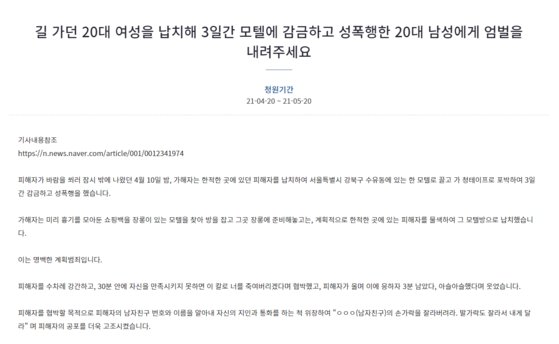
On the 20th, a petition titled "Please severely punish the man in his 20s who kidnapped a woman in her 20s walking down the street, confined her in a motel for three days, and sexually assaulted her" was posted on the Blue House National Petition Board.
The petitioner, who introduced themselves as the close younger sibling of victim A, explained, "On the night of April 10, when A briefly went outside for some fresh air, the perpetrator kidnapped her from a secluded area and took her to a motel in Suyudong, Gangbuk-gu, Seoul, where he tied her up with tape and confined and raped her for three days. The perpetrator had collected weapons in the wardrobe of the motel room he had reserved in advance and deliberately sought out A in a quiet place to kidnap her to that motel room."
They continued, "The perpetrator raped A multiple times and threatened her, saying, 'If you don't satisfy me within 30 minutes, I will kill you with this knife.' When A cried and complied, he laughed, saying, 'Three minutes left. That was close.'"
According to the petitioner, when the perpetrator contacted A's parents, he imitated A's messenger tone to make it appear as if she had run away from home. When A spoke with her parents, the perpetrator switched to speakerphone, held a weapon to her neck, and forced her to speak according to his instructions.
A is reported to have suffered a broken neck and severe trauma from this incident. The petitioner claimed, "The perpetrator said he had several mental illnesses while holding A captive. This seems to be a pretext to claim diminished responsibility or an impulsive crime due to mental illness if caught."
This is not the first time a 'random attack' has targeted a woman with no prior acquaintance. Earlier, on the 5th, a man in his 30s suddenly entered a cafe in downtown Daegu and indiscriminately assaulted a woman he had just met, causing controversy.
The man had moved the victim's bag without permission while sitting next to her and was confronted. Angered, he suddenly cursed and assaulted the victim by hitting her head.
 On the 5th, a man who was a stranger indiscriminately assaulted a woman at a cafe in downtown Daegu and fled, causing controversy. Photo by SBS Broadcast Screen Capture.
Given these circumstances, women are reportedly expressing anxiety about when and where they might become victims of crime. According to the '2020 Women's Life Statistics' released last year by Statistics Korea and the Ministry of Gender Equality and Family, 57.0% of women feel 'unsafe from crime.' This is 12.5 percentage points higher than men (44.5%).
Office worker Kim (27) said, "I don't understand why 'random attacks' always happen only to women. I've never heard of a physically strong man being indiscriminately assaulted. Isn't it because women appear weak and vulnerable? I even question whether these crimes can be called 'random attacks.' They seem closer to 'misogynistic crimes.'"
University student Jung (25) also expressed frustration, saying, "Recently, while walking and talking with a friend, a drunk man shouted at us, saying 'You're noisy.' I was so startled. Even though I wanted to confront him, I stayed quiet fearing we might be assaulted. These things happen frequently to women."
 In Changwon, Gyeongnam, a man was arrested by the police for targeting women who were alone and splashing drinks such as coffee or spitting on them. Photo by Gyeongnam Police Agency
Meanwhile, there was also an incident where a man targeted women returning home late at night. Last month in Changwon, Gyeongnam, a man in his 30s was caught by the police for spraying coffee and other drinks or spitting on women sitting alone at bus stops.
This man is suspected of riding a bicycle around Seongsan-gu, Changwon City, from February 22 to March 23, targeting 15 women alone at night by spraying coffee or spitting on them. Notably, he also committed obscene acts by pulling down the pants of three women and exposing parts of his body.
In police interrogation, he stated, "After losing my job and facing difficulties going out due to COVID-19, my frustration grew, and I targeted socially vulnerable women."
Given these circumstances, women reportedly feel uneasy even when walking alone at night. According to the '2020 Social Indicators of Korea' released by Statistics Korea, the national safety level for nighttime walking was 66.5%. However, only 50.2% of women said they felt safe walking alone at night, which is 33 percentage points lower than men (83.1%). In other words, one in two women feels anxious about walking at night.
Another office worker, Kim (28), said, "When I walk alone at night, I take the main roads instead of alleys. The world is so dangerous that I'm scared to walk alone in alleys."
Experts suggest the need for awareness that prioritizes consideration for physically vulnerable individuals. Professor Gong Jeongsik of the Department of Criminal Psychology at Kyonggi University said, "Eighty percent of violent crime suspects are men targeting women. Criminals believe that crimes against physically vulnerable people are less likely to be caught. That's why these incidents happen frequently. Crimes against socially and physically vulnerable people can happen anytime, so there needs to be awareness to prioritize protecting them. CCTV and other measures are for crime prevention. Unless awareness toward vulnerable people changes, such crimes will not decrease."
© The Asia Business Daily(www.asiae.co.kr). All rights reserved.



















