Number of Children Decides Outcome... Aim for Newlywed Special Supply with 2 or More Children
If Points Under 10 in Scoring System, First-Time Lottery System Is More Advantageous
Worth Trying Multi-Child Special Supply with 3 or More Minor Children
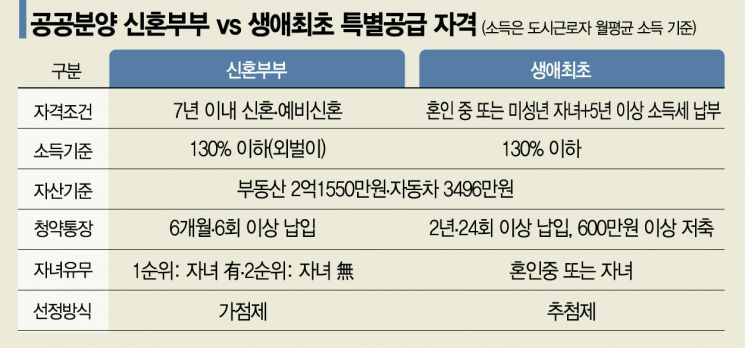
[Asia Economy Reporter Ryu Tae-min] Starting from July, with the pre-subscription of 32,000 public sale apartments in the 3rd phase new towns in the metropolitan area and major housing sites, demanders are also engaging in fierce strategies to secure their own homes. In this pre-subscription, which will be conducted in four rounds, 14,000 units of the supply will be allocated to Newlywed Hope Towns. Among the remaining public sale apartments, 85% are special supply (special quota) units for first-time homebuyers and multi-child families. In particular, since some supply types have overlapping eligibility criteria, applicants are facing deeper dilemmas. This article introduces pre-subscription strategies through expert interviews.
‘Newlyweds vs First-time Homebuyers’ Which is More Advantageous?
This is the case where applicants generally overlap the most. Jung Ji-young, CEO of iOne, advised that generally applying under the newlywed qualification is more advantageous than first-time homebuyer status. The newlywed special quota limits eligibility to those married within 7 years, resulting in lower competition rates, whereas the first-time homebuyer category has no restrictions on marriage or age.
However, Jung explained that since the newlywed special quota applies a point system, it is necessary to calculate the score in advance. The number of children largely determines the outcome, so newlyweds with two or more children have a higher chance of winning. He said, “Points are awarded out of 13 based on the number of children, household income, and residence period. If you have 10 points or more, it is better to apply for the newlywed special quota. If you have 9 points or less, the chance of winning is low, so aiming for the lottery-based first-time homebuyer special quota is more advantageous.”
In fact, the more children, the higher the chance of winning. According to the winning status of special supply for private sales in Seoul from May 2018 to August 2020, received by Rep. Kim Eun-hye of the People Power Party from the Korea Real Estate Board, only 9.9% of winning newlyweds had no children. Couples with two children accounted for the largest share at 63%, followed by one child (25%) and three children (3%).
Newlyweds vs Multi-child Families, First-time Homebuyers vs Multi-child Families
In other special supply categories, the biggest factor affecting winning probability is the ‘number of children.’ Since the multi-child category requires at least three minor children to be eligible, the competition rate is lower than other special quotas. If you meet the eligibility, it is advantageous to aim for the multi-child special quota.
The multi-child special quota awards points out of 100 based on the number of children, period of being homeless, and residence period in the relevant area. Jung explained that generally, a score of 70 or above is considered a winning score. Unlike other categories, the multi-child category allows applicants to apply not only for housing in their current residence area but also in nearby regions, which is an advantage.
Points to Note When Applying for General Supply
The general supply, which accounts for 15% of public sale units, allows first-priority application for household heads who have been subscribed to a subscription savings account for at least 2 years and have made at least 24 payments, based on the criteria for speculative overheated districts and subscription overheated areas. If the number of first-priority applicants exceeds the supply, priority is given to household heads who have been homeless for 3 years or more. However, the calculation of the homeless period starts from the earlier of the day the applicant turns 30 or the date of marriage registration. Therefore, even if the applicant is a homeless household head in their 20s, if they are not married, the homeless period is not counted, so caution is required.
© The Asia Business Daily(www.asiae.co.kr). All rights reserved.

















