OECD/NEA Launches Atlas Phase 3 Project
Nuclear Research Institute Holds Joint Meeting with 12 Countries on 22nd to Discuss Research Details
Plans to Study Safety Improvements Including Reactor Cooling During Accidents
[Asia Economy Reporter Kim Bong-su] An international research project aimed at resolving and improving the safety issues of nuclear power plants has been launched under the leadership of a Korean national research institute.
The Korea Atomic Energy Research Institute (KAERI) announced on the 22nd that it has initiated the 3rd phase of the international joint research project 'OECD/NEA ATLAS' under the Nuclear Energy Agency (NEA) of the Organisation for Economic Co-operation and Development (OECD), which focuses on resolving and enhancing nuclear power plant safety issues.
Following the 1st and 2nd phases, KAERI is once again solely leading this joint research. In this regard, from the 20th to the 22nd, a virtual kickoff meeting for the OECD/NEA ATLAS 3rd project was held, involving 20 institutions from 12 countries including the United States, France, Germany, China, and Spain. Over 40 nuclear experts participated to discuss detailed aspects of the joint research and future plans.
This 3rd phase project will run for four years until December 2024. In particular, it plans to conduct experiments to address major nuclear safety issues highlighted after the 2011 Fukushima nuclear accident in Japan, such as reactor cooling problems during accidents exceeding existing design criteria, and to verify new safety concepts including passive safety systems.
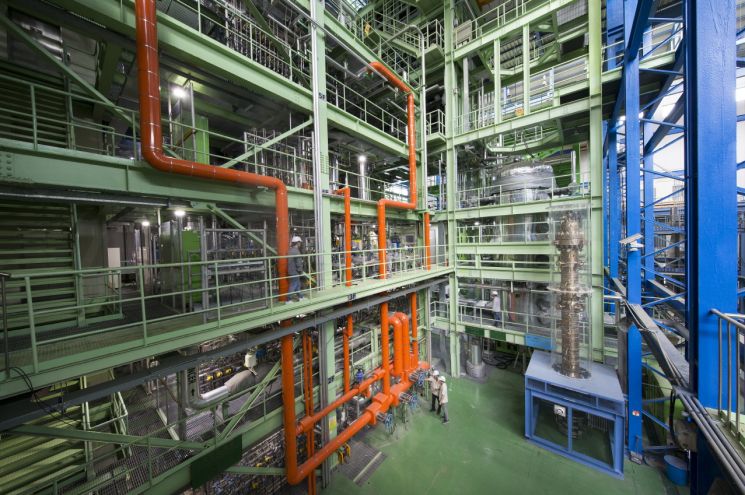
Using ATLAS (Advanced Thermal-Hydraulic Test Loop for Accident Simulation), a pressurized water reactor thermal-hydraulic integral effect test facility designed and operated with domestic technology, KAERI will distribute experimental data produced to participating countries and play a leading role in overall joint research, including analysis of experimental results and establishment of interpretation methods.
ATLAS is a world-class large-scale research facility established and operated by KAERI since 2007. By precisely scaling down the reactor system, safety systems, and containment building of a nuclear power plant, it can simulate various accident scenarios such as loss of coolant and feedwater pipe breaks under actual pressure and temperature conditions. Additionally, by using electric heaters instead of uranium nuclear fuel, it fundamentally eliminates concerns about radiation accidents.
Park Hyun-sik, head of the Innovation System Safety Research Division at KAERI, stated, “Through this joint research, we will not only strengthen cooperation with OECD/NEA member countries and domestic and international nuclear-related organizations but also make a key contribution to improving global nuclear power plant safety.”
© The Asia Business Daily(www.asiae.co.kr). All rights reserved.

















