The Stupa with the Highest Base Featuring Royal Buddhist Art Elements
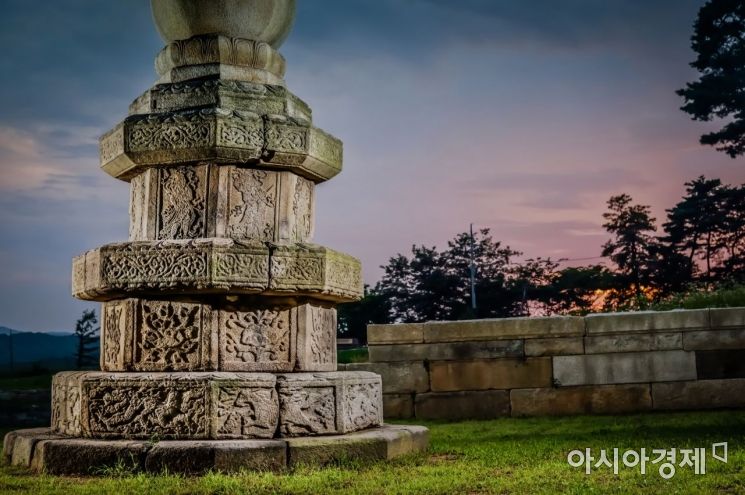
[Asia Economy Reporter La Young-cheol] The 'Yangju Hoeamsaji Saritap' has been preliminarily designated as a national treasure following the Cultural Heritage Administration's Cultural Heritage Committee's Architectural Cultural Heritage Subcommittee review.
Yangju City announced on the 21st, "To enhance the academic and cultural heritage value of the Yangju Hoeamsaji Saritap and to ensure systematic preservation management, we established a plan last year to designate it as a national cultural asset and submitted it to Gyeonggi Province and the Cultural Heritage Administration."
The 'Yangju Hoeamsaji Saritap,' designated and managed as Gyeonggi Province Tangible Cultural Property No. 52, is a true relic sarira pagoda built by royal patronage in the early Joseon period. It is an extremely valuable cultural asset that reveals various elements of royal Buddhist art, including its form, Buddhist iconography, and decorative patterns.
The sarira pagoda, constructed primarily with an octagonal base, consists of a multi-tiered pedestal, a spherical pagoda body, and a finial, featuring the tallest pedestal among existing sarira pagodas.
Each side of the pedestal is adorned with dragons, kirin, floral patterns (草花紋), arabesque patterns (唐草紋), and the Eight Heavenly Generals, decorated from the lower pedestal stones to the upper pedestal capstones.
Notably, excavation surveys and historical records document the enshrinement of the true relics of Sakyamuni Buddha, and the relationship with the Samhwasang Buddha stupa in the Hoeamsa area can also be inferred.
Scholars estimate that the sarira pagoda's style, construction techniques, and detailed patterns resemble royal stone structures related to early Joseon royal tombs. Considering the pagoda's scale, stone condition, and jointing methods, it is believed that the finest stonemasons of the time designed and constructed it.
Furthermore, through extensive scholarly research and various records such as the 2013 Hoeamsaji Museum research series, this cultural asset is recognized as a representative work of early Joseon period Buddhist pagodas in the form of a 승탑 (seungtap), holding significant historical, academic, and artistic value. It is an important resource for studying Joseon stone art and pagoda styles.
Lee Seong-ho, mayor of Yangju City, stated, "'Hoeamsaji Buddha Stupa' has been confirmed as a valuable asset that should be systematically preserved and managed as a nationally designated cultural property. We will utilize this designation to demonstrate its world heritage value when promoting the UNESCO registration of Yangju Hoeamsaji and use it as a representative historical and cultural tourism resource of Yangju."
Meanwhile, the 'Yangju Hoeamsaji Saritap' will be officially designated as a treasure after a 30-day public notice period, during which opinions from various sectors will be collected and the Cultural Heritage Committee's review procedures will be completed.
© The Asia Business Daily(www.asiae.co.kr). All rights reserved.
![Clutching a Stolen Dior Bag, Saying "I Hate Being Poor but Real"... The Grotesque Con of a "Human Knockoff" [Slate]](https://cwcontent.asiae.co.kr/asiaresize/183/2026021902243444107_1771435474.jpg)
















